

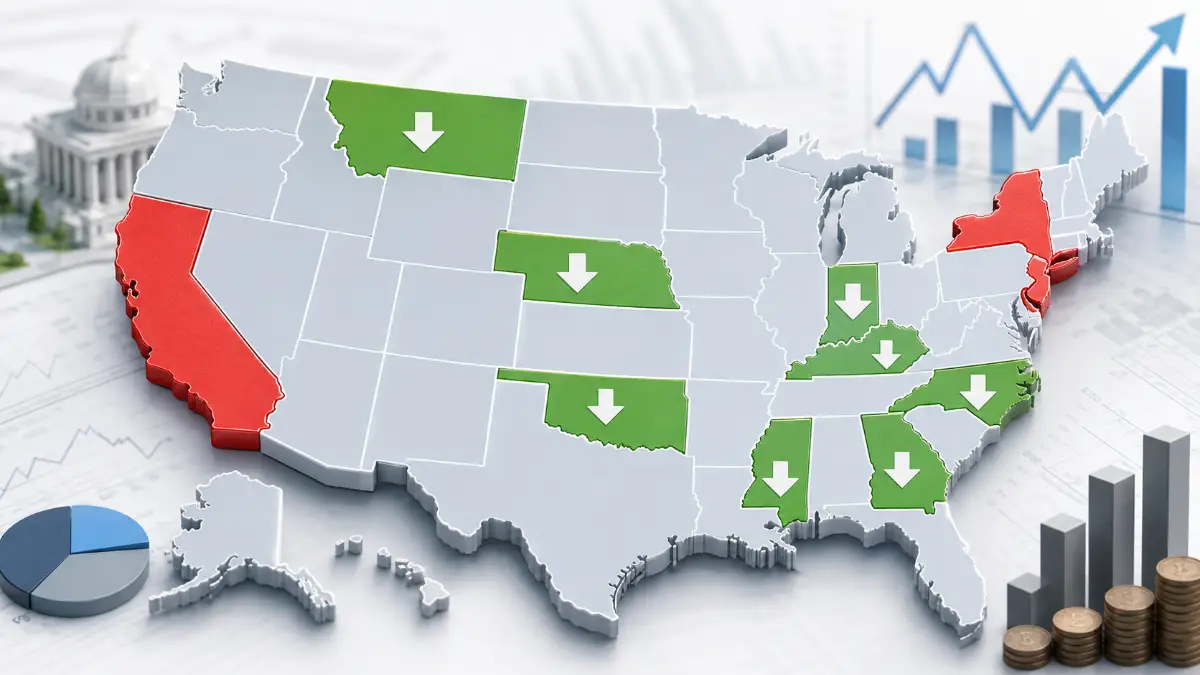
The 2026 State Tax Landscape — Nine States Cut Rates on the Same Day
State income tax competitiveness has become one of the most actively contested areas of state policy. The Tax Foundation and other analysts track these changes annually, and 2026 represents an inflection point: eight states had individual income tax rate reductions take effect specifically on January 1, 2026 — Indiana, Kentucky, Mississippi, Montana, Nebraska, North Carolina, Ohio, and Oklahoma — with Georgia's reduction to 5.09% also reflected in 2026 filings after being retroactively certified to January 1, 2025. Since 2021, more than two dozen states have cut individual income tax rates, and the pace has not slowed — if anything, 2026 represents an acceleration, with Ohio's conversion to a flat-rate system being the single largest structural change of the year.
The driving forces behind this wave are consistent across states: revenue surpluses accumulated during 2021–2023 funded rate cuts without requiring service reductions; remote work mobility means more workers can choose their state of residence based partly on tax considerations; and once one state in a region cuts rates, neighboring states face competitive pressure to follow. Ohio's move to a flat 2.75% rate puts pressure on neighboring Indiana (already at 2.95% and dropping further to 2.9% in 2027) and Kentucky (now at 3.5%) — a regional dynamic that has played out repeatedly across the Midwest and South over the past several years.
At the same time, the states with the highest rates — California, New York, New Jersey, Minnesota, Hawaii, and Oregon among them — have seen no comparable reductions. The result is that the spread between the lowest-rate states with an income tax (several now below 3%) and the highest (California at 13.3%, New York at 10.9% on ultra-high incomes) has widened to one of the largest gaps in the modern history of state income taxation.
Key Highlights
- Eight states had individual income tax rate cuts take effect January 1, 2026: Indiana, Kentucky, Mississippi, Montana, Nebraska, North Carolina, Ohio, and Oklahoma. Georgia's cut to 5.09% (retroactively certified to January 1, 2025) is also reflected in 2026 filings — nine states total with lower 2026 rates than 2025.
- Ohio's conversion to a flat 2.75% rate on non-business income above $26,050 (income at or below that threshold remains untaxed) is the single largest structural change — Ohio joins 14 other states with flat individual income tax rates, replacing its prior two-bracket graduated system under HB96.
- North Carolina's flat rate dropped from 4.25% to 3.99% on January 1, 2026 — the final step in a multi-year phasedown plan. Further reductions from 2027–2034 are possible if revenue triggers are met.
- Kentucky's flat rate dropped from 4.0% to 3.5% — a trigger-based reduction under HB 1 that could continue toward 0% in future years if revenue benchmarks are met.
- Nebraska's top rate dropped from 5.2% to 4.55% under LB 754 — continuing a phasedown toward a 3.99% target by 2027.
- Indiana's flat rate dropped from 3.0% to 2.95% — with another reduction to 2.9% scheduled for 2027.
- Mississippi's flat rate dropped from 4.4% to 4.0% — part of a multi-year plan to phase the rate down to 3% by 2030, with an eventual target of eliminating the income tax entirely.
- Georgia's flat rate dropped from 5.19% to 5.09% — on a schedule of annual 0.10 percentage point reductions toward a 4.99% target by 2029.
- Montana's top rate dropped from 5.9% to 5.65%, with a further reduction to 5.4% scheduled for 2027. Oklahoma's top rate dropped from 4.75% to 4.5% while simplifying from six brackets to three.
- Louisiana's switch from graduated brackets (topping at 4.25%) to a flat 3.0% rate took effect for tax year 2025 and continues unchanged into 2026 — Louisiana also phases out its corporate capital stock (franchise) tax in 2026.
- Iowa's transition to a 3.8% flat rate took effect for tax year 2025 and continues unchanged into 2026 — Iowa also newly requires state withholding on sports betting winnings starting 2026, classifying them as Iowa-source income (a procedural change, not a rate change).
- California (13.3% top rate), New York (10.9% on income above $25 million plus NYC's additional 3.876%), New Jersey (10.75% above $1 million), and Minnesota (9.85% above $183,340 single) remain unchanged for 2026 — no reform enacted in any of these states.
2026 Rate Changes — Corrected Figures for Every Mover
The table below shows the confirmed 2025-to-2026 rate change for every state with a reduction, verified against Tax Foundation's official 2026 state tax changes report and corroborated by Kiplinger and Americans for Tax Reform. Several commonly-circulated figures for 2026 do not match the actual enacted changes — the figures below reflect the as-enacted 2026 rates.
| State | 2025 Rate | 2026 Rate | Structure | Path Forward |
|---|---|---|---|---|
| Ohio | 2.75% / 3.5% (two brackets) | Flat 2.75% on income above $26,050 | Converted from 2-bracket graduated to flat under HB96 | Income at or below $26,050 remains untaxed — effectively a 0% bracket plus a flat rate above it |
| North Carolina | 4.25% flat | 3.99% flat | Flat rate — final step of phasedown | Further 0.5% reductions possible 2027–2034 if revenue triggers are met |
| Kentucky | 4.0% flat | 3.5% flat | Flat rate — trigger-based reduction under HB 1 | Potential further reductions toward 0% if future revenue triggers are met |
| Nebraska | 5.2% top | 4.55% top | Graduated — top rate reduced under LB 754 | Continues toward 3.99% target by 2027 |
| Indiana | 3.0% flat | 2.95% flat | Flat rate — scheduled incremental reduction | Further reduction to 2.9% scheduled for 2027 |
| Mississippi | 4.4% flat | 4.0% flat | Flat rate — multi-year phase-down | Continues toward 3% by 2030, with an eventual goal of full elimination |
| Georgia | 5.19% flat | 5.09% flat | Flat rate — annual 0.10pp scheduled reductions under HB 111 | Targets 4.99% by 2029, contingent on revenue thresholds |
| Montana | 5.9% top | 5.65% top | Graduated — top rate reduced | Further reduction to 5.4% scheduled for 2027 |
| Oklahoma | 4.75% top (6 brackets) | 4.5% top (3 brackets) | Graduated — top rate cut and brackets consolidated 6→3 | Standard deduction also increased to $8,750 (single) from $8,500 |
| Louisiana | 3.0% flat (new for 2025) | 3.0% flat (unchanged) | Flat rate — replaced 3-bracket graduated structure topping at 4.25% | Corporate capital stock (franchise) tax fully phased out in 2026 |
| Iowa | 3.8% flat (effective 2025) | 3.8% flat (unchanged) | Flat rate — replaced 9-bracket graduated system topping above 8% | New 2026 procedural rule: state withholding required on sports betting winnings whenever federal withholding applies |
| Missouri | 4.8% top | 4.7% top (effective 2025, continues 2026) | Graduated — top rate reduced | Also phasing out income tax on Social SecurityIs Social Security Taxable in 2026? Thresholds + Senior Deduction benefits |
Sources: Tax Foundation "2026 State Tax Changes Taking Effect January 1st," Tax Foundation "2026 State Income Tax Rates and Brackets," Kiplinger "2026 State Tax Changes to Know," Americans for Tax Reform "Income Tax Cuts Take Effect In Nine States On New Year's Day" — verified May 2026.
Most of the changes in the table above are incremental — a state that was already a flat-rate state shaving a fraction of a percentage point off its existing flat rate (Indiana 3.0%→2.95%, Mississippi 4.4%→4.0%, Georgia 5.19%→5.09%). Ohio's change is categorically different: it is a structural conversion from a graduated, multi-bracket system to a flat rate, enacted through the state's main budget bill (HB96). Under the new structure, all non-business income up to $26,050 is untaxed entirely — effectively a zero-rate bracket — and every dollar above that threshold is taxed at a single flat 2.75% rate, regardless of how high total income climbs. This means a taxpayer earning $50,000 and a taxpayer earning $5,000,000 face the same marginal rate (2.75%) on income above $26,050 — a dramatic simplification compared to Ohio's prior system, which had a top marginal rate of 3.5% under a two-bracket structure. Ohio now joins the growing club of flat-tax states — which the search results confirm now totals 15 states including Ohio — continuing a trend that has converted ten states from graduated to flat systems since 2021 (Arizona 2023, Georgia 2024, Iowa 2025, Kentucky 2023, Louisiana 2025, and Ohio 2026, among others).
Reverse Formula — Calculate Your State Tax Differential
For mobile workers comparing states, the relevant calculation is the dollar difference in state income tax between two states at the same income level — not just the percentage-point difference in rates, since graduated states apply rates only to income within each bracket.
For flat-rate states, the calculation is straightforward multiplication. For graduated states — Nebraska, Montana, Oklahoma, and the high-tax states like California, New York, and Minnesota — each bracket must be applied to its portion of income separately, exactly as with federal tax brackets. A taxpayer comparing North Carolina (flat 3.99%) to Nebraska (graduated, top rate 4.55%) cannot simply compare 3.99% to 4.55% — Nebraska's effective rateHow Federal Tax Brackets Work: Marginal vs Effective Rate Explained (2025) at most income levels is below its 4.55% top rate because lower brackets apply to the first portions of income.
Step-by-Step: Comparing Two States for a Relocation Decision
Reverse Sales Tax Calculator
Global Reverse Tax Tool (VAT & GST) 2026 — Remove tax from any total and calculate the original price in seconds.
Real-World Scenarios — 2026 Rate Changes in Dollar Terms
Scenario 1: Ohio's New Flat Tax — $75,000 Earner
Situation
A single filer in Ohio earns $75,000 in 2026. Under Ohio's new structure (HB96), the first $26,050 of non-business income is untaxed, and income above that threshold is taxed at a flat 2.75%.
Taxable portion: $75,000 − $26,050 = $48,950.
Ohio tax owed: $48,950 × 2.75% = $1,346.13.
Effective rate on total income: $1,346.13 ÷ $75,000 = 1.79% — well below the 2.75% statutory rate, because the first $26,050 is untaxed.
Comparison to 2025 Ohio (prior 2-bracket system, rates up to 3.5%): Under the prior structure, this filer would have faced a blended calculation across Ohio's old brackets — producing a higher total than $1,346.13 in most cases, since the old top rate of 3.5% applied to a meaningful portion of this income range.
Key lesson: Ohio's flat-tax conversion benefits filers across the income spectrum because the $26,050 untaxed threshold functions like a universal deduction, and the 2.75% flat rate above it is lower than Ohio's prior top marginal rateEffective vs. Marginal Tax Rate 2026: What's the Difference? of 3.5%. The effective rate (1.79% in this example) is meaningfully lower than the headline 2.75% — a distinction that matters when comparing Ohio to other flat-rate states whose flat rate applies from a much lower income threshold.
Scenario 2: North Carolina's Final Phasedown Step — $120,000 Earner
Situation
A single filer in North CarolinaNorth Carolina Sales Tax: 4.75% earns $120,000 in taxable income in 2026. North Carolina's flat rate dropped from 4.25% (2025) to 3.99% (2026) — the final scheduled step in its multi-year phasedown.
2025 North Carolina tax: $120,000 × 4.25% = $5,100.
2026 North Carolina tax: $120,000 × 3.99% = $4,788.
Annual savings from the 2026 rate cut alone: $5,100 − $4,788 = $312.
Multi-year context: North Carolina's top rate was above 5.25% as recently as 2021. At $120,000, the cumulative reduction from approximately 5.25% to 3.99% represents a reduction of $1,512 per year compared to 2021 rates — a meaningful, multi-year cumulative benefit for North Carolina residents at this income level.
Key lesson: The 2026 step alone ($312 at $120,000) is modest, but North Carolina's phasedown has been multi-year and cumulative — the total benefit relative to 2021 is roughly five times the single-year 2026 change. Whether further reductions occur (2027–2034 reductions are contingent on revenue triggers) will determine whether this cumulative benefit continues to grow.
Scenario 3: Kentucky's Drop to 3.5% — Comparing to Neighboring Ohio and Indiana
Situation
A remote worker with flexibility to live in Kentucky, Ohio, or Indiana earns $100,000 in taxable income in 2026. Kentucky's flat rate dropped from 4.0% to 3.5%; Ohio converted to flat 2.75% above $26,050; Indiana's flat rate dropped from 3.0% to 2.95%.
Kentucky (2026): $100,000 × 3.5% = $3,500.
Ohio (2026): ($100,000 − $26,050) × 2.75% = $73,950 × 2.75% = $2,033.63.
Indiana (2026): $100,000 × 2.95% = $2,950.
Ranking at this income level: Ohio is lowest ($2,033.63), Indiana is second ($2,950), Kentucky is highest of the three ($3,500) — despite Kentucky having just cut its rate from 4.0% to 3.5%.
Kentucky's improvement vs prior year: At 4.0% (2025), Kentucky tax would have been $4,000. At 3.5% (2026), it's $3,500 — a $500 annual reduction for this filer, even though Kentucky remains the highest of the three states in this comparison.
Key lesson: A state's improvement relative to its own prior year (Kentucky: $500 savings vs 2025) is a different question from its competitive position relative to neighboring states (Kentucky remains highest of the three in 2026). Both matter — Kentucky residents see a real reduction, but Kentucky has not closed the gap with Ohio's new flat-tax structure, which remains the most favorable of the three at this income level due to its $26,050 untaxed threshold combined with its 2.75% rate.
Scenario 4: Take-Home Pay Comparison — $120,000 Remote Worker Across States
Situation
A remote worker earning $120,000 in taxable income can live anywhere. Using each state's 2026 rate structure (simplified — actual liability depends on specific deductions and bracket application), here is the approximate state income tax differential versus a no-income-tax state.
Florida / Texas / Tennessee (no income tax): $0.
Ohio (flat 2.75% above $26,050): ($120,000 − $26,050) × 2.75% ≈ $2,584.
Indiana (flat 2.95%): $120,000 × 2.95% ≈ $3,540.
North Carolina (flat 3.99%): $120,000 × 3.99% ≈ $4,788.
Kentucky (flat 3.5%): $120,000 × 3.5% ≈ $4,200.
Mississippi (flat 4.0%): $120,000 × 4.0% ≈ $4,800.
Georgia (flat 5.09%): $120,000 × 5.09% ≈ $6,108.
Minnesota (graduated, top 9.85% above $183,340 single — most of this income falls in lower brackets): approximately $7,200–$7,600.
California (graduated, top 13.3% — most income falls well below the top bracket at $120,000): approximately $7,500–$8,200 (effective rate well below 13.3% at this income level, per California's own bracket structure).
New York + NYC (graduated state rate plus NYC local tax): approximately $8,500–$10,000 depending on NYC residency and specific bracket application.
Key lesson: At $120,000, the spread between the most favorable flat-tax states (Ohio at ~$2,584) and the highest-tax jurisdictions (NY + NYC at ~$8,500–$10,000+) is roughly $6,000–$7,500 per year — a substantial figure for a remote worker with full location flexibility. Note that these figures are approximate and depend on each state's specific standard deduction, exemption amounts, and (for graduated states) precise bracket thresholds — use the state tax comparison tool for a precise calculation at your specific income and filing status.
High-Tax States — No Reform in 2026
While nine states cut rates for 2026, the states at the top of the chart implemented no comparable changes. These states remain the highest-cost jurisdictions for state income tax in the country.
| State | 2026 Top Rate | Threshold | 2026 Change | Notes |
|---|---|---|---|---|
| California | 13.3% (12.3% + 1% surcharge) | 1% surcharge above $1,000,000 (not doubled for MFJ) | None — unchanged | Highest personal income tax rate in the nation; capital gains taxed as ordinary income at the same rates |
| New York | 10.9% | Above $25,000,000 | None — unchanged | NYC adds up to ~3.876% local tax — combined state + city marginal rate approaches 14.8% at the highest levels |
| New Jersey | 10.75% | Above $1,000,000 | None — unchanged | One of the highest top rates in the nation, applying at a much lower income threshold than California or New York |
| Minnesota | 9.85% | Above $183,340 (single) | None — no reform enacted | Among the highest rates in the Midwest, contrasting sharply with neighboring Iowa's 3.8% flat rate |
| Hawaii | ~11% | Varies by bracket | None — unchanged | One of the highest top rates nationally; also has one of the lowest average local sales tax rates as a partial offset |
| Oregon | ~9.9% | Varies by bracket | None — unchanged | No sales tax offsets the relatively high income tax rate; remains a high-income-tax jurisdiction with no reform in 2026 |
Sources: Tax Foundation 2026 State Income Tax Rates and Brackets, state revenue department publications — May 2026.
Flat-Tax States Ranked — Lowest to Highest 2026 Rate
| Rank | State | 2026 Flat Rate | 2025 Rate | Trend |
|---|---|---|---|---|
| 1 | Arizona | 2.5% | 2.5% | Unchanged — completed transition in 2023, among the lowest flat rates of any income-tax state |
| 2 | Ohio | 2.75% (above $26,050) | Up to 3.5% (2-bracket) | New for 2026 — converted from graduated to flat under HB96 |
| 3 | Indiana | 2.95% | 3.0% | Decreasing — further drop to 2.9% scheduled for 2027 |
| 4 | Louisiana | 3.0% | 3.0% | Unchanged — converted from graduated to flat in 2025 |
| 5 | Iowa | 3.8% | 3.8% | Unchanged — converted from 9-bracket graduated to flat in 2025 |
| 6 | North Carolina | 3.99% | 4.25% | Decreasing — reached its long-targeted final rate in 2026 |
| 7 | Mississippi | 4.0% | 4.4% | Decreasing — continues toward 3% by 2030, with eventual full elimination targeted |
| 8 | Kentucky | 3.5% | 4.0% | Decreasing — trigger-based, potential further reductions toward 0% |
| 9 | Georgia | 5.09% | 5.19% | Decreasing — annual 0.10pp reductions scheduled toward 4.99% by 2029 |
Ranking reflects flat-rate states with a 2026 rate change or recently-completed transition; additional flat-tax states (PennsylvaniaPennsylvania Sales Tax: 6.00% at 3.07%, Michigan at 4.25%, Illinois at 4.95%, Colorado, Utah, and others) maintain unchanged rates for 2026 and are not shown here.
Who Benefits — and Who Should Keep Watching — From the 2026 Changes
Who benefits most from the 2026 changes
- Lower-income Ohio residents — the new $26,050 untaxed threshold functions as a significant exemption, producing effective rates well below the 2.75% statutory rate for filers near this income level
- North Carolina residents — reaching the long-targeted 3.99% rate represents the culmination of a multi-year phasedown from rates above 5.25% in 2021, a cumulative benefit of over $1,500/year at $120,000 income
- Mississippi residents — the drop to 4.0% continues a trajectory toward eventual full income tax elimination, a structural goal that, if achieved, would put Mississippi among the no-income-tax states entirely
- Remote workers with full location flexibility — the widening gap between low-tax and high-tax states means the dollar value of choosing a tax-favorable state of residence has never been larger for high earners
- Kentucky residents — the drop from 4.0% to 3.5% is one of the larger single-year percentage-point reductions among 2026's movers, with potential for continued reductions under the trigger mechanism
Who should keep watching for future changes
- Nebraska, Montana, and Oklahoma residents — these states made meaningful 2026 cuts but remain graduated systems with rates above the flat-tax leaders; further consolidation toward flat structures (as Ohio just completed) could be a future trend
- Minnesota residents — no reform enacted, and budget conditions make near-term cuts unlikely; the gap with neighboring Iowa (3.8% flat) continues to widen rather than narrow
- California, New York, and New Jersey high earners — these states remain unchanged at the top of the chart; California's combination of a 13.3% top rate and ordinary-income treatment of capital gains continues to be cited as a driver of high-income out-migration to no-tax and low-tax states
- Arkansas residents — 2025 data showed a reduction from 4.4% to 4.3%, but this was not independently confirmed among the verified 2026 changes in this update; Arkansas residents should verify their specific 2026 rate directly with the Arkansas Department of Finance and Administration
- Residents of states approaching revenue-trigger thresholds — Georgia, North Carolina (post-2026), and Kentucky all have scheduled future reductions contingent on the state meeting specific revenue benchmarks; a revenue shortfall in any of these states could pause or delay the next scheduled step
Expert Tip — Ritu Sharma
"Every year I get clients who want to compare states using last year's numbers because that's what comes up first in a search. The 2026 changes are a perfect example of why that's dangerous — if you're comparing North Carolina to Nebraska using 2025 figures, you'd use 4.25% and 5.2%. The actual 2026 figures are 3.99% and 4.55% — both lower, and the gap between them is narrower than the 2025 numbers suggest. For Ohio specifically, I've had clients see '2.75%' and assume that's worse than a neighboring state's '2.5%' headline rate — without realizing Ohio's first $26,050 is completely untaxed. Run the actual math at your income level, for the actual current year, before making any decision based on a rate comparison. The states with one-time structural changes — Ohio's flat-tax conversion this year, Louisiana's and Iowa's last year — are exactly where outdated comparisons cause the biggest errors, because the entire structure changed, not just a number within an unchanged structure."
Who Should Pay Closest Attention to These 2026 Changes?
- Remote workers and digital nomads evaluating relocation — the widening gap between the lowest-rate states (Arizona 2.5%, Ohio effectively below 2.75%, Indiana 2.95%) and the highest (California 13.3%, New York 10.9%+NYC) means the annual dollar differential for a high earner with full location flexibility now regularly exceeds $5,000–$10,000 at six-figure income levels. For someone whose work genuinely can be performed from anywhere, the 2026 changes make this calculation more consequential than in any prior year — Ohio's new flat-tax structure in particular changes its competitive position relative to neighbors significantly.
- Ohio residents and businesses adjusting to the flat-tax conversion — Ohio's shift from a graduated system to a flat 2.75% rate above $26,050 changes withholding calculations, estimated tax planning, and year-over-year comparisons for every Ohio taxpayer. Employers need updated withholding tables reflecting the new structure; individuals who previously fell into Ohio's higher bracket under the old 2-bracket system should recalculate their 2026 estimated payments rather than assuming continuity with 2025 amounts.
- North Carolina taxpayers tracking whether further cuts occur post-2026 — 3.99% represents the final step of North Carolina's currently-enacted phasedown schedule. Whether further reductions (toward a previously-discussed target as low as 2.49% by the end of the decade) occur depends on revenue triggers that have not yet been confirmed for 2027 and beyond. North Carolina residents and prospective movers should not assume continued automatic reductions without checking for new legislation.
- High-net-worth individuals comparing California, New York, and New Jersey to no-reform alternatives — with none of the highest-rate states implementing reductions in 2026, and multiple mid-tier states (Ohio, North Carolina, Kentucky) making meaningful cuts, the relative competitive position of California, New York, and New Jersey has weakened further. For individuals with significant capital gains exposure, California's treatment of capital gains as ordinary income (up to 13.3%) versus states with no income tax or preferential capital gains treatment represents one of the largest single line items in any relocation analysis.
- Mississippi residents tracking progress toward full income tax elimination — Mississippi's stated multi-year plan targets a 3% rate by 2030 with an eventual goal of eliminating the income tax entirely, which would make Mississippi the tenth state with no individual income tax. The 2026 step to 4.0% is meaningful progress on this path, but full elimination remains a multi-year, multi-legislative-session goal subject to the same revenue-trigger uncertainty as other states' scheduled future reductions.
- Sports bettors and gamblers in Iowa — Iowa's 2026 procedural change requiring state withholding on sports betting winnings whenever federal withholding applies does not change Iowa's flat 3.8% rate, but it does change the timing and visibility of state tax collection on gambling income — winnings that previously might not have had Iowa withholding will now have it, formally classifying those winnings as Iowa-source income for withholding purposes.
The single most common error in state tax comparisons is comparing headline rates directly — "North Carolina is 3.99% and Kentucky is 3.5%, so Kentucky is better." This comparison ignores standard deductions, exemption amounts, and (for graduated states) bracket structure entirely. A state with a higher flat rate but a much larger standard deduction can produce a lower total tax bill at moderate incomes than a state with a lower flat rate but minimal deductions. Ohio's 2026 structure is the clearest example: its 2.75% rate sounds higher than Arizona's 2.5%, but Ohio's $26,050 untaxed threshold means Ohio's effective rate on a $50,000 earner (approximately 1.32%) is actually lower than Arizona's flat 2.5% applied from a much lower threshold. Before concluding which of two states is more favorable, run the actual calculation — taxable income, standard deduction or exemption, and (for graduated states) full bracket application — at your specific income level using the state tax ranking calculator. Headline rate comparisons are a starting point for identifying candidates, not a final answer.
Common Mistakes When Comparing 2026 State Tax Changes
Using outdated rate figures from before the 2026 changes took effect: Several widely-circulated figures for 2026 reflect either the 2025 rate (before the January 1, 2026 reduction) or an incorrect intermediate figure. North Carolina's 2026 rate is 3.99%, not 4.25% (which was the 2025 rate). Nebraska's 2026 top rate is 4.55%, not 5.2% (the 2025 rate). Indiana's 2026 rate is 2.95%, not 2.9% (which is scheduled for 2027). Always verify against a source dated for the specific tax year in question, ideally Tax Foundation's annually-updated state tax rate publications.
Treating Ohio's "2.75%" as comparable to other states' flat rates without accounting for the untaxed threshold: Ohio's 2.75% rate applies only to income above $26,050 — the first $26,050 is entirely untaxed. A direct comparison of "Ohio 2.75%" to "Indiana 2.95%" without accounting for this threshold understates Ohio's relative advantage, particularly for filers with income closer to the threshold where the untaxed portion represents a larger share of total income.
Assuming graduated-state top rates apply to all income: Nebraska's 4.55% and Montana's 5.65% are top marginal rates that apply only to income above each state's top bracket threshold — most taxpayers in these states have effective rates well below the top rate because lower brackets apply to the first portions of income. Comparing a graduated state's top rate directly to a flat-rate state's single rate overstates the graduated state's tax burden for most filers.
Ignoring whether future scheduled reductions are guaranteed or contingent on revenue triggers: Georgia's path to 4.99% by 2029, North Carolina's potential further reductions through 2034, and Kentucky's potential reductions toward 0% are all contingent on the relevant state meeting specified revenue benchmarks in future years — they are not guaranteed automatic reductions. A relocation decision based on an assumed future rate that depends on a not-yet-met revenue trigger carries genuine uncertainty that a decision based on already-enacted, current rates does not.
Comparing only income tax while ignoring sales tax, property tax, and state-specific taxes: A state with a favorable income tax rate may have offsetting higher sales or property taxes. Washington's 7% capital gains tax on gains above $250,000 is a notable example of a "no income tax" state that nonetheless taxes a specific category of income for high earners with investment gains — a detail easily missed by someone focused only on Washington's "0% income tax on wages" headline.
Expert Insight and Market Impact
The 2026 wave of nine simultaneous state income tax reductions — the largest such wave in recent years — reflects the continuation of a trend that began accelerating after 2021: strong revenue collections during 2021–2023 created fiscal room for rate cuts without corresponding service reductions, and once several states in a region cut rates, competitive pressure builds on neighboring states to follow. Ohio's conversion to a flat-rate system is particularly significant because it represents the tenth state to convert from a graduated to a flat individual income tax structure since 2021 (joining Arizona 2023, Georgia 2024, Iowa 2025, Kentucky 2023, and Louisiana 2025, among others) — a structural trend toward simplification that shows no signs of slowing.
At the same time, the states at the top of the rate chart — California, New York, New Jersey, and Minnesota — implemented no comparable reductions for 2026, and in some cases face budget conditions that make near-term reductions unlikely. This divergence means the competitive gap between the most and least tax-favorable states for income tax purposes has widened meaningfully in 2026 compared to even a few years ago. For high earners with location flexibility — a population that has grown substantially with the normalization of remote work — this gap represents one of the largest controllable components of total tax burden available through a single decision (where to establish residency).
Several of 2026's reductions are steps in multi-year, legislatively-enacted phasedowns rather than one-time events — North Carolina's 3.99% is the final step of its current schedule, while Georgia, Kentucky, and MississippiMississippi Sales Tax: 7.00% all have additional scheduled reductions in future years, contingent on revenue triggers. This means the 2026 rankings are likely to continue shifting in 2027 and beyond as these schedules play out — assuming the relevant states continue to meet the revenue benchmarks that unlock each subsequent step.
Final Verdict
2026 brought the largest simultaneous wave of state income taxIncome tax levied by individual state governments on residents' income, in addition to federal... cuts in recent memory — nine states reduced rates, led by Ohio's structural conversion to a flat 2.75% rate above a $26,050 untaxed threshold, North Carolina's arrival at its long-targeted 3.99% flat rate, and Kentucky's drop from 4.0% to 3.5%. Nebraska, Indiana, Mississippi, Georgia, Montana, and Oklahoma all reduced rates as well, while Louisiana and Iowa's 2025 flat-tax conversions continued unchanged into 2026. Meanwhile, California, New York, New Jersey, Minnesota, Hawaii, and Oregon — the states at the top of the rate chart — implemented no comparable reductions, widening the gap between the most and least tax-favorable states.
For anyone with location flexibility, the dollar value of this gap has never been larger — at $120,000 in taxable income, the spread between Ohio's effective rate and New York City's combined state-and-local rate can exceed $7,000 per year. But headline rate comparisons alone are insufficient: standard deductions, untaxed thresholds (especially Ohio's new $26,050 threshold), graduated bracket structures, and non-income taxes (sales tax, property tax, and state-specific taxes like Washington's capital gains tax) all affect the real-dollar comparison. Use the state tax ranking calculator to run your specific income and filing status against any two states before making a relocation decision — and keep watching for 2027 changes, since several of 2026's reductions are steps in multi-year schedules that depend on future revenue triggers being met.