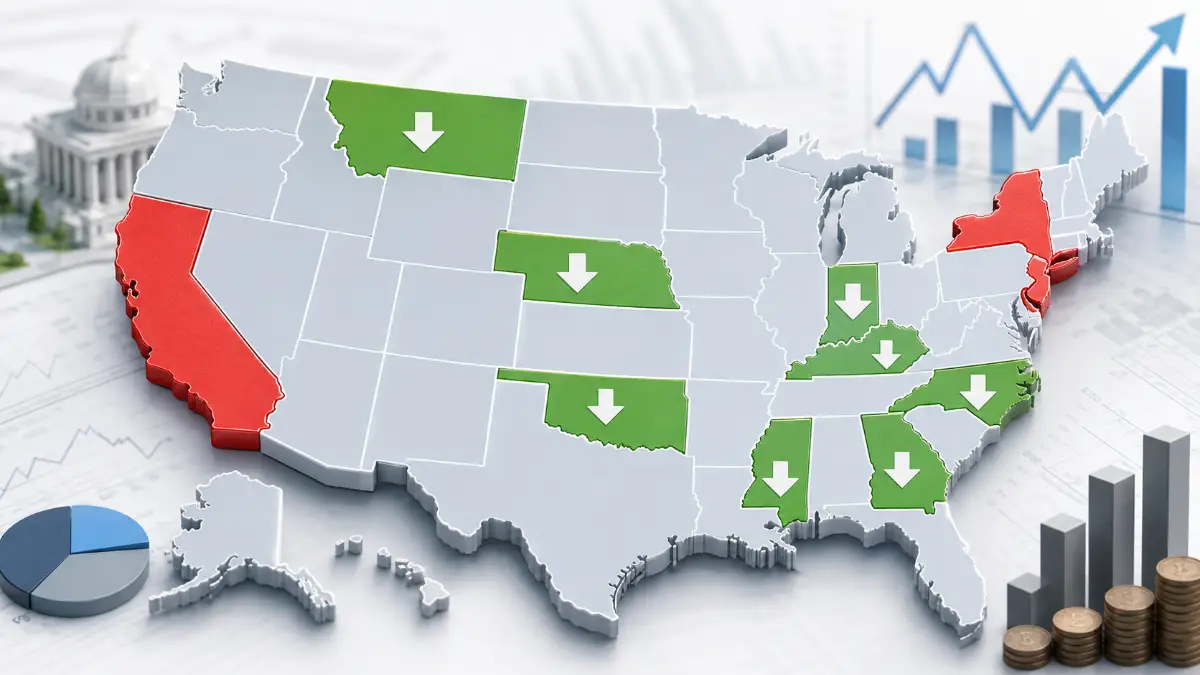


Three Types of State Income Tax Systems
Every state with an income tax falls into one of two structural categories — flat or graduated — and nine states fall into a third category: no wage income tax at all. Understanding which category your state (and any state you work in, commute to, or are considering moving to) falls into is the foundation for everything else.
No income tax (9 states): Alaska, Florida, Nevada, South Dakota, Tennessee, Texas, Washington, Wyoming, and New Hampshire (which fully phased out its tax on interest and dividend income after 2024, joining the wage-tax-free group completely) charge no state tax on wage income. Washington is a partial exception — it has no wage income tax but does impose a 7% tax on long-term capital gains above $250,000, making it "no income tax" in the traditional wage sense but not entirely tax-free for investors.
Flat tax (15 states): A flat tax charges every taxpayer the same percentage regardless of income level. As of 2026, approximately 15 states use a flat rate — including Arizona (2.5%), Indiana (2.95%), Ohio (2.75% above an untaxed threshold), Pennsylvania (3.07%), Kentucky (3.5%), Louisiana (3.0%), Iowa (3.8%), North Carolina (3.99%), Mississippi (4.0%), Michigan (4.25%), Georgia (5.09%), Illinois (4.95%), and others. Flat taxes are simpler to calculate and file — there's no bracket-stacking math — but "flat" doesn't mean "low": Illinois at 4.95% applies the same rate to a $30,000 earner and a $3,000,000 earner alike.
Graduated/progressive tax (26 states + DC): The remaining states use multiple brackets where higher portions of income are taxed at higher rates — the same conceptual structure as the federal system, but with entirely different numbers. California has 9 brackets running from 1% to 12.3% (plus a 1% surcharge above $1 million, producing the well-known 13.3% top rate). Hawaii has 12 brackets — the most of any state. New York has 9 brackets, topping at 10.9% for income above $25 million. Minnesota, New Jersey, Oregon, and many others use graduated structures with their own specific thresholds.
Key Highlights
- 2026 state income tax structures: 9 states have no wage income tax, 15 states use a single flat rate, and 26 states plus DC use graduated brackets — for a total of 41 states levying an individual income tax.
- State income tax rates in 2026 range from 0% (nine states) to 13.3% (California's 12.3% top bracket plus its 1% surcharge on income above $1 million).
- "No income tax" does not mean "low total tax" — Texas has no income tax but a property tax rate around 1.6% (roughly $6,400/year on a $400,000 home); Florida has a 6% base sales tax; Washington taxes capital gains above $250,000 at 7%.
- States generally start their tax calculation from federal adjusted gross income (AGI) and apply state-specific additions, subtractions, deductions, and credits — meaning your state taxable income is rarely identical to your federal taxable income.
- Your state of residence almost always taxes your worldwide income. The state where you physically work may also tax income earned there — creating potential double taxation that's typically resolved through a resident-state tax credit.
- 17 states plus DC have reciprocity agreements (as of 2026: DC, IA, IL, IN, KY, MD, MI, MN, MT, ND, NJ, OH, PA, VA, WI, WV, and others) — letting commuters who live in one state and work in another pay tax only to their resident state, avoiding dual withholding entirely.
- States without reciprocity require withholding in the work state, with the resident state providing a credit for taxes paid — but the credit doesn't always fully eliminate the second state's tax if rates differ.
- New York's "convenience of the employer" rule can require a remote worker to pay New York tax on 100% of their income — even if they never set foot in New York — if their employer is based there and the remote arrangement is for the employee's own convenience rather than the employer's necessity.
- The 2026 federal SALT deduction cap is $40,400 ($20,200 MFS) under OBBBA — covering the combined total of state income tax, local income tax, and property tax for itemizers, phasing down toward a $10,000 floor above $500,000 MAGI.
- 36+ states have enacted Pass-Through Entity Tax (PTET) elections, letting partnership and S-corp owners pay state tax at the entity level — a workaround that bypasses the individual SALT cap entirely for that portion of income.
2026 State Income Tax Structures — The Three Categories
The table below organizes representative states from each structural category, showing how dramatically the approach to income taxation varies even among states that do tax income.
| Category | How It Works | Representative States (2026) | Key Characteristic |
|---|---|---|---|
| No income tax | Wages are not taxed at the state level at all | Alaska, Florida, Nevada, New Hampshire, South Dakota, Tennessee, Texas, Washington, Wyoming | 9 states total. Washington taxes capital gains above $250,000 at 7% despite no wage tax — a notable exception |
| Flat tax | A single rate applies to all taxable income regardless of amount | Arizona (2.5%), Ohio (2.75% above $26,050), Indiana (2.95%), Louisiana (3.0%), Kentucky (3.5%), Iowa (3.8%), North Carolina (3.99%), Mississippi (4.0%), Michigan (4.25%), Illinois (4.95%), Georgia (5.09%), Pennsylvania (3.07%) | ~15 states in 2026. Simple to calculate, but a flat rate can still produce a high bill — Illinois's 4.95% applies equally to a $40,000 earner and a $4,000,000 earner |
| Graduated / progressive tax | Multiple brackets — higher portions of income taxed at progressively higher rates, like the federal system but with state-specific numbers | California (9 brackets, 1%–12.3% + 1% surcharge = 13.3%), Hawaii (12 brackets, most of any state), New York (9 brackets, top 10.9% above $25M), Minnesota (top 9.85% above $183,340 single), New Jersey (top 10.75% above $1M), Nebraska (top 4.55%), Montana (top 5.65%), Oklahoma (top 4.5%, 3 brackets) | 26 states + DC in 2026. Bracket counts and thresholds vary enormously — a "top rate" comparison alone is misleading without knowing where that top bracket starts |
Sources: Tax Foundation 2026 State Income Tax Rates and Brackets, state revenue departments — May 2026. State classifications and exact rates shift as legislation takes effect; verify current-year figures for any specific state before filing or planning.
The single most common misunderstanding about state taxation is treating "no income tax" as synonymous with "low total tax burden." States fund government services somehow — and the nine states with no wage income tax generally make up the difference through higher property taxes, higher sales taxes, or industry-specific revenue (Alaska's oil revenue and Permanent Fund, Nevada's gaming and tourism taxes, Wyoming's mineral extraction revenue). Texas is the clearest example: no income tax, but a property tax rate around 1.6% — on a $400,000 home, that's approximately $6,400 per year, every year, regardless of income. Florida's base sales tax is 6% (with local add-ons pushing many areas higher), applied to every taxable purchase. Washington has no wage income tax but imposes a 7% capital gains tax on long-term gains above $250,000 — a real and substantial tax for investors and business owners with significant gains, even though wage-earners see nothing. The right comparison is never "income tax rate" alone — it's total state and local tax burden as a share of income, which accounts for property tax, sales tax, and any targeted taxes like Washington's capital gains tax, weighted by your specific spending, property ownership, and income composition.
Reverse Formula — How State Taxable Income Is Calculated
State taxable income is not simply "your income, taxed at the state rate." Each state starts from a federal figure and applies its own modifications — meaning the number that actually gets multiplied by the state's rate (or run through the state's brackets) can differ substantially from your federal taxable income.
Common state-specific additions include: interest from other states' municipal bonds (most states tax this even though it's federally exempt), and certain business income add-backs. Common subtractions include: state tax refunds included in federal income (most states subtract these back out), Social SecurityIs Social Security Taxable in 2026? Thresholds + Senior Deduction benefits (many states fully or partially exempt these even though the federal return may tax up to 85%), and state-specific retirement income exclusions (several states, including Mississippi and Missouri, are phasing in broader exemptions for retirement income).
Step-by-Step: Determining Which State(s) Tax Your Income
Reverse Sales Tax Calculator
Global Reverse Tax Tool (VAT & GST) 2026 — Remove tax from any total and calculate the original price in seconds.
Real-World State Income Tax Scenarios — 2026
Scenario 1: Flat Tax vs Graduated Tax — Same Income, Different Math
Situation
Two single filers each earn $90,000 in state taxable income in 2026. One lives in Illinois (flat 4.95%); the other lives in Nebraska (graduated, with a top rate of 4.55% applying only above a certain threshold, and lower brackets below that).
Illinois (flat 4.95%): $90,000 × 4.95% = $4,455 — straightforward, no bracket math required. Every dollar of taxable income is taxed at exactly 4.95%, whether this filer earns $90,000 or $900,000.
Nebraska (graduated): The calculation requires applying each bracket to its portion of the $90,000 — lower brackets (e.g., 2.46%, 3.51%, etc., depending on Nebraska's specific 2026 thresholds) apply to the first portions of income, with the 4.55% top rate applying only to income above Nebraska's top bracket threshold. The result for $90,000 is likely an effective rateHow Federal Tax Brackets Work: Marginal vs Effective Rate Explained (2025) somewhat below 4.55% — potentially in a similar range to Illinois's flat 4.95%, or lower, depending on exactly where Nebraska's brackets fall.
Key lesson: A flat rate of 4.95% (Illinois) and a graduated top rate of 4.55% (Nebraska) cannot be compared directly — Illinois's 4.95% applies to 100% of taxable income, while Nebraska's 4.55% applies only to income above its top bracket threshold, with lower rates on the income below that. At $90,000, Nebraska's effective rate is very likely below 4.55% — possibly making Nebraska's actual tax bill at this income level lower than Illinois's, despite Illinois having the lower "headline" top rate. Always calculate the actual tax owed, not just compare headline rates.
Scenario 2: Reciprocity in Action — Indiana Resident Working in Ohio
Situation
A worker lives in Indiana (flat 2.95%) and commutes to a job in Ohio (flat 2.75% above $26,050). Both Indiana and Ohio appear in the 2026 reciprocity network.
Without reciprocity (hypothetical): Ohio would withhold on wages earned while physically working in Ohio. The worker would file an Ohio non-resident return reporting Ohio-source wages, and an Indiana resident return reporting all income (including the Ohio wages) with a credit for Ohio tax paid — two returns, two sets of withholding to reconcile.
With reciprocity (actual, assuming Indiana-Ohio agreement applies): The worker files Ohio's nonresident exemption form (IT 4NR) with their employer. Ohio withholds nothing. The employer withholds only Indiana tax (2.95% flat) on all wages. At filing, the worker files only an Indiana resident return — reporting 100% of wages, taxed at Indiana's 2.95% flat rate. No Ohio filing is required at all.
Key lesson: Reciprocity isn't automatic — it requires the employee to proactively file the work-state's exemption certificate with their employer. An employee who doesn't file the form may have Ohio withholding taken anyway, requiring them to file a non-resident Ohio return solely to claim a refund of the over-withheld amount — an unnecessary extra filing that the exemption certificate would have avoided entirely. Always confirm with payroll/HR whether the certificate is on file when starting a new cross-border commuting arrangement.
Scenario 3: No Reciprocity — New York / New Jersey Commuter
Situation
A worker lives in New Jersey (graduated, top rate 10.75% above $1 million — but lower brackets apply at most income levels) and commutes to a job in New York City (graduated state rate up to 10.9%, plus NYC's local income tax for residents — though NYC's local tax generally does NOT apply to non-resident commuters, only NY State tax does for non-residents).
New York non-resident withholding: The employer withholds New York State income tax on wages earned while the employee physically works in New York — at New York's graduated rates applicable to the worker's income level. The worker files a New York non-resident return (Form IT-203) reporting New York-source wages.
New Jersey resident return: New Jersey taxes the worker's full income (including the New York-source wages) as part of worldwide income at New Jersey's graduated rates. New Jersey then provides a credit for the tax paid to New York on that same income — but the credit is capped at the lesser of New York's tax on that income or New Jersey's tax on that same income.
Potential residual tax: If New York's effective rate on the commuter's income is higher than New Jersey's effective rate on that same income, the credit doesn't fully offset — the worker pays New Jersey's full resident tax plus the excess of New York's tax over what New Jersey's credit covers, a form of partial double taxation that NY-NJ commuters have dealt with for decades in the absence of a reciprocity agreement between these two specific states.
Key lesson: The credit mechanism reduces but does not always eliminate double taxation when no reciprocity agreement exists — and New York and New Jersey, despite sharing one of the largest commuter corridors in the country, have never established reciprocity with each other. Two annual returns (one resident, one non-resident) are simply part of the deal for NY-NJ commuters.
Scenario 4: Remote Work and "Convenience of the Employer" — New York Employer, Texas Resident
Situation
A software engineer is hired remotely by a company headquartered in New York City. The engineer lives and works entirely from their home in Texas (no state income tax), and has never set foot in the New York office.
General rule (most states): Under the standard source-based approach, the engineer's wages are sourced to where the work is physically performed — Texas. Texas has no income tax. The engineer's resident state (Texas) imposes $0 in state income tax, and the work-location state (also Texas) is the same state — no multi-state issue at all under the general rule.
New York's "convenience of the employer" rule: New York applies a different test for employees of New York-based employers. If the remote arrangement exists for the employee's convenience — rather than because the employer requires the work to be performed outside New York for a legitimate business reason (the "necessity" exception) — New York can treat the days worked remotely as New York workdays for income sourcing purposes. In the most aggressive application, this could mean New York asserts a claim on a portion or all of this engineer's wages, even though they've never worked in New York physically.
Practical outcome: Whether New York successfully asserts this claim depends on the specific facts — whether the remote arrangement was the employee's choice or a documented employer requirement (e.g., the employer has no New York office for this role, or there's a documented business necessity for remote work). Employees in this situation should retain documentation supporting any "necessity" argument, and should not assume that working from a no-income-tax state automatically means zero state tax exposure if their employer is headquartered in a state — like New York — known for aggressive convenience-of-the-employer enforcement.
Key lesson: Remote work doesn't automatically mean "taxed only where I sit." Employer location matters in specific states with convenience-of-the-employer rules, and New York is the most prominent — and most aggressively enforced — example. This is one of the few scenarios where a no-income-tax state of residence doesn't guarantee zero state income tax liability.
Residency Rules — Domicile, Statutory Residency, and Part-Year Filing
Determining "which state is my resident state" sounds simple but involves several distinct legal concepts that can produce overlapping or unexpected results.
| Concept | Definition | Tax Consequence | Common Pitfall |
|---|---|---|---|
| Domicile | The state you intend as your permanent home — where you'd return after being away. Generally one domicile at a time. | Your domicile state taxes you as a full resident on worldwide income, regardless of how much time you spend there in a given year. | Domicile is based on intent and connections (voter registration, driver's license, primary home, family ties) — not just where you spend the most days. |
| Statutory residency | Triggered by spending a threshold number of days (commonly 183) in a state during the year, often combined with maintaining a "permanent place of abode" there. | A statutory resident is taxed as a full resident — on worldwide income — by that state, EVEN IF domiciled elsewhere. | Dual-residency: someone domiciled in Florida who keeps a New York apartment and spends 184+ days in New York in a given year can be a New York statutory resident AND a Florida domiciliary simultaneously — both states may claim worldwide-income taxation. |
| Part-year residency | Applies when you move your domicile from one state to another during the tax year. | Each state taxes you as a resident only for the portion of the year you were domiciled there, and as a non-resident (if at all) for income sourced to that state during the other portion. | Most states require prorating income — typically based on days or wages earned in each state — between the part-year-resident periods. The proration method varies by state and can produce different results for the same facts. |
| Non-resident with source income | You're domiciled elsewhere and not a statutory resident, but you have income "sourced" to the state — typically wages for work physically performed there. | The state taxes only the source-income portion — not your worldwide income — via a non-resident return. | Confusing "non-resident with source income" (limited tax) with "statutory resident" (full worldwide-income tax) — the day-count thresholds and "permanent place of abode" tests that trigger each are different and easy to misjudge. |
Sources: State-by-state residency statutes and department of revenue guidance, Tax Foundation, Wealthvieu State Income Tax Guide 2026 — May 2026. Residency rules are among the most fact-specific and litigated areas of state tax law; specific facts should be reviewed against the exact rules of each state involved.
Reciprocity States vs Non-Reciprocity States — What Changes for Commuters
| Feature | States WITH Reciprocity (e.g., IN-OH, PA-NJ, MD-VA) | States WITHOUT Reciprocity (e.g., NY-NJ, MA-CT, CA) |
|---|---|---|
| Withholding | Work state withholds NOTHING (with exemption certificate on file); resident state withholding only | Work state withholds on source income; resident state also withholds on full income — double withholding during the year |
| Returns required | One — resident state return only | Two — resident return (worldwide income) plus non-resident return (work-state source income) |
| Tax owed | Resident state's rate on all income — work state's rate is irrelevant | Work state's rate on source income, PLUS resident state's rate on worldwide income, MINUS a credit (capped at the lesser of the two states' tax on the overlapping income) |
| Risk of residual double taxation | None — reciprocity eliminates the work state's claim entirely | Possible — if the work state's effective rate exceeds the resident state's effective rate on that income, the credit doesn't fully offset |
| Action required | File the work state's nonresident exemption form with employer (e.g., PA REV-419, IN WH-47, OH IT 4NR) — a one-time or annual administrative step | No exemption form exists — withholding and dual filing are simply how the system works for this state pair |
| Local taxes | Reciprocity covers STATE income tax only — local wage taxes (e.g., certain PennsylvaniaPennsylvania Sales Tax: 6.00% or Ohio municipalities) may still apply independently | N/A — local tax treatment is a separate question regardless of state-level reciprocity status |
Who Benefits From Each Type of State Tax Structure
Advantages of each structure type
- No-income-tax states — straightforward for wage earners: zero state income tax filing, zero state withholding to track. Particularly advantageous for high-income wage earners who don't have offsetting high property or sales tax exposure (e.g., renters in low-property-tax areas of no-income-tax states)
- Flat-tax states — simplicity and predictability. No bracket math, easy to estimate withholding, and (for states like Ohio with an untaxed threshold) can provide meaningful relief at lower income levels while remaining simple at higher ones
- Graduated-tax states — lower effective rates for lower-income filers, since early brackets are taxed at rates well below the "headline" top rate. A graduated state's top rate can look alarming in isolation but apply to almost no one at typical income levels
- Reciprocity states — commuters get single-state simplicity: one return, one withholding stream, no credit calculations, regardless of which side of a state line they live and work on
- States with PTET elections — pass-through business owners (partnerships, S-corps) in the 36+ states offering Pass-Through Entity Tax elections can have the entity pay state tax directly, bypassing the individual SALT cap for that portion of income entirely
Disadvantages and pitfalls of each structure type
- No-income-tax states — the "no income tax" framing can mask high property or sales tax burdens that hit homeowners and high-spenders harder than the income tax framing suggests
- Flat-tax states — a flat rate applies the same percentage to a low earner and a high earner; what looks like a "low" headline rate (e.g., 4.95%) may be higher than a graduated state's effective rate at moderate incomes, where the graduated state's lower brackets dominate
- Graduated-tax states — more complex to calculate by hand, and "top rate" comparisons between states are frequently misleading without knowing exactly where each state's top bracket begins (a state with a lower top rate but a much lower threshold for that rate can produce a higher bill than a state with a higher top rate that only kicks in at very high incomes)
- Non-reciprocity commuter pairs — two annual filings, dual withholding to manage during the year, and potential residual double taxation if the work state's rate exceeds the resident state's rate on the overlapping income
- Convenience-of-the-employer states (notably New York) — remote workers with employers based in these states face genuine uncertainty about their tax exposure that doesn't exist under the standard source-based rule used by most other states
Expert Tip — Ritu Sharma
"The question I get that surprises people most is from remote workers who took a job with a New York company specifically because they could 'live anywhere' — often choosing a no-income-tax state like Texas or Florida for exactly that reason. They're often shocked to learn that New York's convenience-of-the-employer rule means their employer's location can still matter, even if they've never been to New York and even though Texas itself has zero income tax. I always tell clients in this situation: don't assume your state of residence is the end of the analysis just because it has no income tax. Ask where your employer is incorporated and headquartered, and specifically whether that state has a convenience rule. If it's New York, document — in writing, ideally in your offer letter or remote work policy — that the remote arrangement exists because the employer doesn't maintain an office requiring your presence, not merely because you personally prefer to work from home. That documentation is the difference between a clean 'no New York tax' position and a contested one if New York ever looks at the return."
Who Needs to Understand These Rules Most Closely?
- Cross-border commuters near state lines — anyone whose home and workplace are in different states should determine, before their first paycheck, whether their two states have a reciprocity agreement and, if so, file the appropriate exemption certificate. Skipping this step means over-withholding in the work state for the entire year, followed by filing a non-resident return solely to claim a refund — an unnecessary complication that the certificate would have prevented from day one. The 2026 reciprocity network covers DC, IA, IL, IN, KY, MD, MI, MN, MT, ND, NJ (with PA specifically), OH, PA, VA, WI, and WV in various pairings — but notably excludes NY-NJ, NY-CT, MA-NH, MA-CT, MA-RI, and any pairing involving CA, TX, FL, or WA.
- Remote workers whose employer is headquartered in a different state than where they live — this is now one of the largest categories of multi-state tax confusion, accelerated by the post-pandemic normalization of remote work. The default rule (tax follows where the work is physically performed) means most remote workers owe tax only to their state of residence on their wages — but employees of New York-based employers specifically should understand the "convenience of the employer" rule and gather documentation supporting any "necessity" argument if they want to contest a New York sourcing claim.
- People who maintain homes in two states — particularly common for retirees who split time between a high-tax state (where they may have lived for decades, with family, doctors, and social connections) and a low- or no-tax state (often Florida). Statutory residency rules — often triggered at 183 days plus maintaining a "permanent place of abode" — mean that simply spending "less than half the year" in the higher-tax state isn't always sufficient; the specific day count and the nature of the property maintained both matter, and the rules vary by state.
- Anyone relocating mid-year — part-year residency requires prorating income between the old and new states of domicile, using each state's specific proration method (commonly based on days of residency or wages earned during each period). The proration isn't automatic or uniform — two states with different methods can produce different total allocations for the exact same facts, and the part-year resident may need to track exactly which income was earned during which residency period with more precision than a full-year resident ever would.
- Pass-through business owners (partnerships, S-corps) in states with PTET elections — with 36+ states now offering Pass-Through Entity Tax elections, business owners whose state income tax would otherwise be limited by the $40,400 federal SALT cap (2026, under OBBBA) can potentially have the entity itself pay the state tax, which is then deductible at the entity level without being subject to the individual SALT cap. This is one of the most consequential state tax planning tools available to pass-through owners in 2026, and whether to elect PTET treatment (where available) should be evaluated annually given that state-specific election deadlines and mechanics vary.
- Anyone evaluating a relocation based on "which state has lower taxes" — as covered in depth in our companion piece on 2026's biggest state tax rate movers, headline rate comparisons are only the starting point. The full picture requires: the specific state's definition of taxable income (starting from AGI, with state-specific additions and subtractions), the specific deduction and exemption amounts, whether the state uses flat or graduated rates (and if graduated, where the brackets fall), and the non-income-tax factors — property tax, sales tax, and any targeted taxes — that complete the total burden picture.
State tax rules that were correct for your situation last year may not be correct this year if anything material changed: a new job with a different employer location, a move (even within the same metro area, if it crosses a state line), a new remote-work arrangement, or simply a state's reciprocity agreements or rate structure changing (as happened for nine states in 2026). The reciprocity exemption certificate filed with a prior employer doesn't automatically transfer to a new employer — it must be filed fresh with each employer where it applies. Someone who moved from a reciprocity-eligible commute (e.g., Indiana resident working in Ohio) to a non-reciprocity commute (e.g., the same Indiana resident takes a new job in Michigan — also reciprocal with Indiana, so this example would still work, but illustrates the point) needs to re-evaluate from scratch. The safest practice: any time your work location, employer's location, or state of residence changes, treat it as a fresh multi-state tax question rather than assuming continuity from your prior arrangement — even if the new situation seems superficially similar.
Common State Income Tax Mistakes
Assuming federal taxable income equals state taxable income: Most states start from federal AGI — not federal taxable income — and apply entirely separate state-specific standard deductions, personal exemptions, and itemized deduction rules. The federal standard deduction ($16,100 single / $32,200 MFJ for 2026 under OBBBA) does not carry over to the state return. Each state has its own deduction amount, which can be dramatically different (CaliforniaCalifornia Sales Tax: 7.25%'s 2026 standard deduction is $5,706 single — a fraction of the federal figure). Using federal taxable income directly on a state return, without applying the state's own deduction and exemption rules, produces an incorrect result.
Comparing "top rate" between a flat-tax state and a graduated-tax state without context: A flat-tax state's single rate applies to 100% of taxable income. A graduated-tax state's "top rate" applies only to income above that bracket's threshold — which can be very high (New York's 10.9% applies only above $25 million) or relatively moderate (Nebraska's 4.55% top rate applies at a much lower threshold). At any given income level below a graduated state's top bracket, that state's effective rate is below its headline top rate — sometimes well below a flat-tax state's single rate, sometimes above it, depending entirely on the specific numbers.
Not filing the reciprocity exemption certificate, leading to unnecessary dual filings: Reciprocity isn't automatic — it requires the employee to file a specific exemption form with their employer (forms vary by state: PA uses REV-419, Indiana uses WH-47, Ohio uses IT 4NR, Maryland uses MW507, Virginia uses VA-4, and others). Without the form, the work state withholds as if no reciprocity existed, and the employee must file a non-resident return purely to claim a refund of the over-withheld amount — an avoidable extra filing.
Assuming "no income tax" means zero state tax exposure regardless of employer location: A remote worker living in a no-income-tax state (Texas, Florida, etc.) generally owes no state income tax on their wages under the standard source-based rule. But if their employer is headquartered in a state with a "convenience of the employer" rule — most notably New York — that state may still assert a claim on the wages, depending on whether the remote arrangement meets the "necessity" exception. This is the one scenario where residing in a no-income-tax state doesn't automatically guarantee zero state income tax liability.
Overlooking the resident-state credit cap when working in a higher-tax state without reciprocity: The resident-state credit for taxes paid to a non-reciprocity work state is capped at the LESSER of the two states' tax on the overlapping income — not a dollar-for-dollar offset of whatever was paid to the work state. If the work state's effective rate on that income exceeds the resident state's effective rate, the credit won't fully eliminate the work-state tax, and the worker effectively pays the higher of the two rates on that portion of income — a detail easily missed when assuming the credit "handles" double taxation completely.
Expert Insight and Market Impact
The structural diversity of US state income tax systems — nine no-tax states, fifteen flat-tax states, and twenty-six-plus graduated states, each with its own deduction, exemption, and bracket rules — reflects decades of independent state-level policy evolution rather than any coordinated design. This diversity has become increasingly consequential as remote work has detached, for a meaningful share of the workforce, the question of "where do I live" from "where is my employer" and "where do I physically perform my work" — three questions that, for most of the 20th century, had the same answer for most workers and now frequently do not.
The trend toward flat taxes — ten states have converted from graduated to flat systems since 2021, with Ohio's 2026 conversion being the most recent — represents one response to this complexity: a flat rate is simpler to communicate, simpler for payroll systems to withhold correctly, and simpler for taxpayers to estimate without needing bracket tables. But the underlying multi-state questions (residency, reciprocity, source-of-income, convenience-of-the-employer) exist independently of whether a state's rate structure is flat or graduated — converting to a flat tax doesn't simplify any of the cross-state questions, only the within-state calculation once the relevant state and income amount have been determined.
The federal SALT cap — now $40,400 under OBBBA for 2026, up from the TCJA-era $10,000 — has driven the rapid adoption of Pass-Through Entity Tax elections across 36+ states. This workaround, which allows business income to be taxed at the entity level (bypassing the individual SALT cap for that portion of income), represents one of the more significant state-level responses to federal tax policy in recent years — and its continued availability and mechanics remain an active area of state legislative attention as the interaction between federal and state tax policy continues to evolve.
Final Verdict
State income tax in 2026 is not one system but 41 different ones — nine states charge nothing on wages, fifteen use a single flat rate, and the remaining 26 (plus DC) use graduated brackets with their own thresholds, rates, and numbers of brackets. Every state that does tax income starts its calculation from federal AGI and applies its own additions, subtractions, deductions, and exemptions — meaning the number that actually gets taxed is never simply "your federal taxable income at a different rate."
Beyond rates, the question of which state taxes you at all depends on residency (domicile and/or statutory residency, which can overlap across two states), source of income (where you physically work), reciprocity agreements (which eliminate dual filing for 17 states plus DC in various pairings), and — for remote workers with employers in certain states — convenience-of-the-employer rules that can override the standard source-based approach entirely. "No income tax" doesn't mean "low total tax" once property tax, sales tax, and targeted taxes like WashingtonWashington Sales Tax: 6.50%'s capital gains levy are factored in. Before drawing any conclusion about your state tax situation — whether for filing, withholding, or a relocation decision — verify your specific state combination, your specific residency facts, and run the actual numbers through your state's specific deduction and bracket structure rather than relying on headline rate comparisons alone.