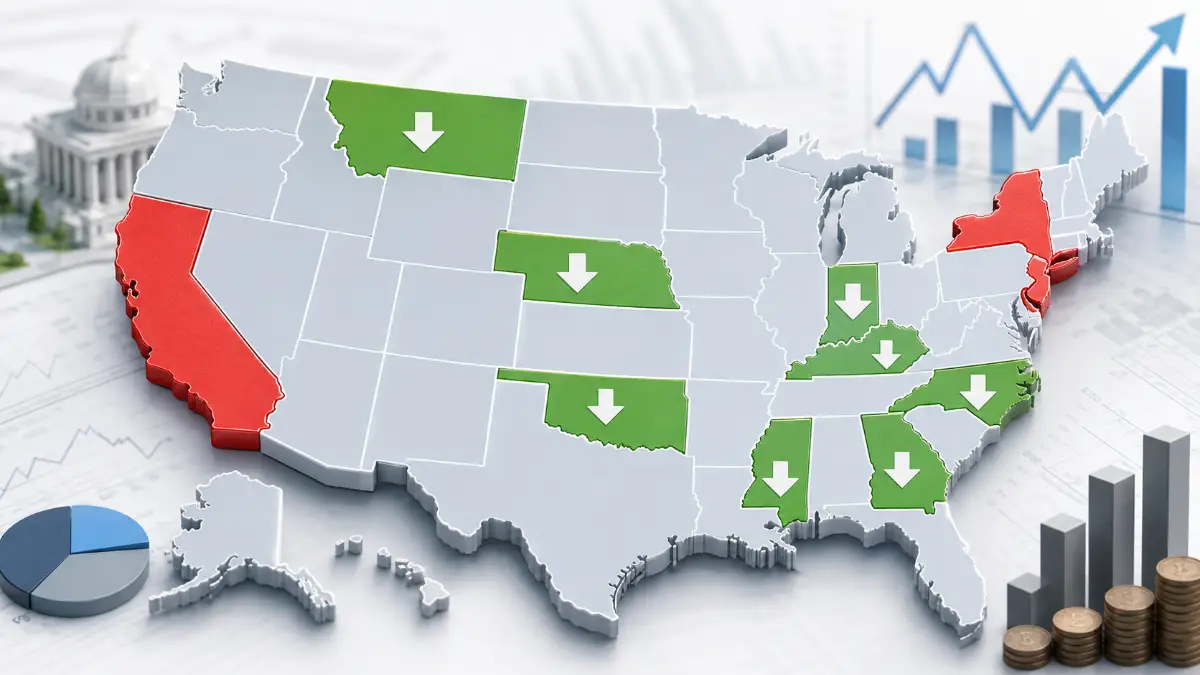


The Nine No-Income-Tax States — and What They Actually Tax Instead
Nine states impose no broad-based individual income tax on wages: Alaska, Florida, Nevada, New Hampshire, South Dakota, Tennessee, Texas, Washington, and Wyoming. But "no income tax" doesn't mean the same thing in all nine states — each funds government services through a different combination of other revenue sources, and those differences directly affect whether the relocation math works in your favor.
New Hampshire completed the full repeal of its Interest and Dividends Tax effective January 1, 2025, making it fully income-tax-free for the first time — a meaningful change for retirees with dividend-heavy portfolios who previously had to account for New Hampshire's 5% I&D tax. Tennessee eliminated its equivalent Hall Income Tax on dividends and interest in 2022. Both states now belong in the clean no-income-tax category for all types of income.
Washington is the most important caveat in the list. While Washington taxes no wage income, it enacted a 7% capital gains tax on long-term gains above $262,000 in 2022 — with a separate 9.9% rate for gains above $1 million, effective 2024. A further millionaire income surtax is legislatively scheduled for 2028. For investors, business owners, and founders expecting large capital events, Washington is not a straightforward no-tax destination — it's increasingly a partial-tax destination with ongoing legislative risk of further expansion.
Key Highlights
- Nine states have no broad-based individual income tax in 2026: Alaska, Florida, Nevada, New Hampshire, South Dakota, Tennessee, Texas, Washington, and Wyoming. New Hampshire fully repealed its Interest & Dividends Tax in 2025, making all nine states fully free of wage and investment income tax — except Washington.
- Washington taxes long-term capital gains above $262,000 at 7% and above $1 million at 9.9% — with a millionaire income surtax scheduled for 2028. For investors and business owners, Washington is no longer a clean no-income-tax destination.
- Texas has the 6th-highest effective property tax rate in the nation at approximately 1.60% — producing an annual property tax bill of roughly $9,600 on a $600,000 home and $14,400 on a $900,000 home. California's effective property tax rate is approximately 0.76% — roughly half of Texas's rate on the same home value.
- Florida's homeowners insurance has reached $5,000–$8,000+ per year in coastal counties due to hurricane risk and insurer exits from the Florida market — a cost that is essentially zero in states like California and Texas outside of specific high-risk zones. Flood insurance (separate from standard homeowners policies) adds further cost in many Florida coastal and inland markets.
- High-income earners ($200,000+) benefit most from relocation — income tax savings scale with income while property and sales tax differentials are largely fixed costs that don't grow proportionally. A $500,000 earner moving from California to Texas saves roughly $35,000–$51,000 annually in state income tax; a $90,000 earner saves $4,000–$6,000 — a materially different risk-adjusted calculation.
- Retirees benefit substantially from no-income-tax states because wages, pension distributions, IRA withdrawals, and Social Security are all state-income-tax-free — while high-tax states can tax retirement income at rates reaching 13.3% (California) on otherwise-identical distributions.
- The New York "convenience of the employer" rule means a remote worker moving to Florida but keeping a New York employer can still owe New York income tax on those wages — making the relocation's tax benefit conditional on either changing employers, having the employer document a business necessity for remote work, or establishing a fact pattern that supports the "necessity" exception.
- California aggressively audits high-income former residents who claim domicile change but maintain significant California connections — business clients, board positions, property, professional licenses. Physical absence and a changed mailing address alone are insufficient to establish domicile change under California's fact-based residency analysis.
- The federal SALT deduction cap is $40,400 ($20,200 MFS) under OBBBA for 2026 — meaning the deduction benefit of state income taxes and property taxes combined is capped for most high earners, reducing the federal tax offset for remaining state tax obligations and changing the comparative math for taxpayers near or above the phaseout threshold.
- Wyoming and South Dakota consistently rank among the lowest total-tax-burden states — combining no income tax with lower-than-average property taxes and moderate sales taxes — making them genuinely low-burden destinations for high earners not tied to a specific metro area.
All Nine No-Tax States — Revenue Sources, Rates, and Trade-offs
Each of the nine no-income-tax states compensates for the absent revenue stream differently. Understanding the specific trade-off for each is essential before narrowing a relocation decision.
| State | How It Funds Services | Effective Property Tax Rate | Avg. Combined Sales Tax | Key Trade-off |
|---|---|---|---|---|
| Alaska | Oil revenues, Permanent Fund dividends (residents receive annual dividend — $1,702 in 2024); no state sales tax (local taxes vary up to ~7.5%) | ~1.02% | ~1.82% (local only) | Among the most genuinely tax-advantaged states — residents even receive a dividend check. Major downsides: very high cost of living for goods (remote supply chain), extreme climate, limited healthcare access outside Anchorage |
| Florida | Strong property tax base and 6% base state sales tax (~7.02% combined with local taxes) | ~0.89% | ~7.02% | Moderate property taxes, but homeowners insurance has reached $5,000–$8,000+ annually in coastal counties. Flood insurance adds further cost. Housing prices in Miami and coastal markets have risen dramatically since 2020, eroding the cost-of-living advantage vs. California |
| Nevada | Gaming and tourism taxes fund a large share of state revenue; 6.85% state sales tax (~8.23% combined) | ~0.55% | ~8.23% | Low property taxes, but higher sales taxes. Las Vegas metro has seen significant home price appreciation. Generally a solid all-around no-tax destination for high earners who can work remotely or build Nevada-based business connections |
| New Hampshire | Property taxes (among the highest in the nation) and vehicle registration fees; no state sales tax and no general income tax as of 2025 | ~1.87% | 0% | High property taxes materially offset income tax savings for homeowners. No sales tax is genuinely valuable for high spenders. Best for high-income renters or those with modest property values; less attractive for homeowners in a high-value NH market |
| South Dakota | Conservative fiscal approach with relatively low spending; 4.5% state sales tax (~6.4% combined) | ~1.18% | ~6.40% | One of the cleanest total-burden no-tax states — no income tax, moderate property taxes, moderate sales tax, no estate tax. Sparse population and limited metro areas make it impractical for many professionals |
| Tennessee | Among the highest combined sales tax rates in the country (~9.55% combined) — the primary revenue engine | ~0.65% | ~9.55% | Very low property taxes but very high sales taxes. Nashville area offers a genuine metro with amenities, but high spenders and lower-income households feel the 9.55% combined sales tax more than high earners. Net benefit is still strongly positive for high-income wage earners |
| Texas | Primarily property taxes — one of the highest effective property tax rates in the country (~1.60%). 8.20% combined sales tax | ~1.60% | ~8.20% | Clearest example of income tax savings offset by property taxes. At $600,000 home: ~$9,600/year Texas property tax vs. ~$4,560 California. Strong metro infrastructure (Austin, Dallas, Houston) makes Texas viable for most professionals, but the property tax offset is real and substantial for homeowners |
| Washington | 6.50% state sales tax (~9.38% combined) plus 7% capital gains tax (gains above $262,000) and 9.9% tier (gains above $1M) | ~0.94% | ~9.38% | Not a clean no-income-tax state for investors or business owners with capital events. Millionaire income surtax scheduled for 2028 adds legislative risk. Moderate property taxes but high sales taxes. Best for wage-only earners with no significant capital gains exposure |
| Wyoming | Mineral extraction taxes (coal, oil, gas) fund a significant share of state government; 4.0% state sales tax (~5.44% combined) | ~0.55% | ~5.44% | One of the most genuinely low-burden states — no income tax, low property taxes, low sales tax. Jackson Hole area is a high-cost exception. Limited metro infrastructure makes it impractical for many professionals, but for those with true location flexibility, Wyoming consistently ranks as one of the lowest total-burden states in the country |
Sources: Tax Foundation, levyio.com Total Tax Burden Analysis 2026, SuperMoney No-Income-Tax States 2026, state revenue department data — May 2026. Property tax rates are effective (actual bills ÷ home value) and vary by county and municipality. Insurance costs reflect 2025–2026 market conditions.
Washington was historically one of the most attractive no-income-tax states for high earners because it combined no wage income tax with a tech-heavy economy (Seattle, Bellevue, Redmond), access to major employers, and a relatively diverse economic base. That calculus changed meaningfully in 2022 when Washington enacted a 7% capital gains tax on long-term gains above $262,000, and again in 2024 when a second tier of 9.9% was added for gains above $1 million. Founders selling companies, investors realizing large capital events, and executives with substantial stock compensation now face a meaningful Washington capital gains tax that didn't exist before 2022. Additionally, Washington's legislature has a millionaire income surtax scheduled for 2028 — a provision that, if enacted as currently written, would further erode Washington's no-income-tax status for the highest earners. Anyone evaluating Washington as a relocation destination specifically to avoid income tax should model the capital gains exposure under their specific anticipated income composition, not simply note that Washington has "no income tax" and proceed from there.
Reverse Formula — Calculate Your Real Net Savings
The headline income tax saving is only the starting point. The real net annual saving from a relocation requires subtracting — or adding — the difference in property tax, sales tax, insurance, and any other state-specific costs between the origin and destination states.
The scaling asymmetry is the critical insight: income tax savings grow proportionally with income, while property tax differentials are fixed based on home value. A $100,000 earner moving from California to Texas saves roughly $4,500 in income tax but may pay $3,000–$5,000 more in property tax annually — a marginal or even negative net outcome. A $500,000 earner making the same move saves roughly $35,000 in income tax while facing the same $3,000–$5,000 property tax increment — a clearly positive net outcome. The break-even income level below which a Texas relocation from California may not produce net savings depends heavily on home value and is commonly estimated at $100,000–$150,000 for average-value Texas homes.
Step-by-Step: How to Model Your Real Relocation Savings
Reverse Sales Tax Calculator
Global Reverse Tax Tool (VAT & GST) 2026 — Remove tax from any total and calculate the original price in seconds.
Real-World Relocation Savings Scenarios — 2026
Scenario 1: California to Texas — $300,000 Earner, $800,000 Home
Situation
A single professional earns $300,000 per year in wages. Currently in California (approximately 9.3% marginal bracket for most of this income, effective rate approximately 8.5%). Planning to buy an $800,000 home in Austin, Texas.
Income tax saving: California state income tax at $300,000 ≈ $25,500 (effective rate ~8.5%). Texas: $0. Annual income tax saving: approximately $25,500.
Property tax differential: Austin area Texas effective rate approximately 1.60%: $800,000 × 1.60% = $12,800/year Texas property tax. California effective rate approximately 0.76% (Prop 13 applies to new purchases at assessed value): $800,000 × 0.76% = $6,080/year. Annual property tax increase in Texas: approximately $6,720.
Insurance differential: Texas homeowners insurance significantly below Florida coastal rates. Austin area annual premium: approximately $3,500–$4,500. California comparable home: approximately $2,000–$3,000. Additional Texas insurance cost: approximately $1,000–$1,500.
Sales tax: California combined average ~8.8%, Texas ~8.2% — Texas is approximately 0.6 percentage points lower. On $60,000 in annual taxable spending: approximately $360 annual sales tax saving.
Net annual saving (approximate): $25,500 (income tax) − $6,720 (property tax) − $1,250 (insurance) + $360 (sales tax) = approximately $17,890 net annual saving.
Key lesson: The income tax saving is real and substantial at this income level. But Texas property taxes consume approximately 26% of the headline income tax saving, and insurance adds another 5% — the real net saving is approximately 70% of the headline figure. Still highly significant at this income level, but the math is meaningfully more complex than "save $25,500 by moving to Texas."
Scenario 2: New York City to Florida — $250,000 Earner, Coastal Condo
Situation
A married couple filing jointly earns $250,000 combined, currently living in Manhattan (combined New York State + NYC income tax). Buying a $700,000 condo in Fort Lauderdale.
Income tax saving: New York State + NYC combined effective rate at $250,000 MFJ: approximately 10.5–11%. Estimated annual NY state + city income tax: approximately $26,000–$27,500. Florida: $0. Annual income tax saving: approximately $26,500.
Property tax: Florida effective property tax rate approximately 0.89%: $700,000 × 0.89% = $6,230/year. New York City residents are typically renters — if the couple previously rented in Manhattan, the relevant New York comparison is zero direct property tax. Annual Florida property tax added: approximately $6,230.
Florida homeowners insurance (coastal Broward County): Fort Lauderdale area: approximately $6,000–$9,000 annually for a $700,000 condo (wind, flood, and HOA-required coverage combined). Estimated annual insurance cost: approximately $7,000.
Sales tax: Florida combined average ~7.02% vs. New York City ~8.5% — Florida is approximately 1.48 percentage points lower. On $80,000 in annual taxable spending: approximately $1,184 annual sales tax saving.
Net annual saving (approximate): $26,500 (income tax) − $6,230 (property tax, compared to renter baseline) − $7,000 (insurance) + $1,184 (sales tax) = approximately $14,454 net annual saving.
Key lesson: For a former Manhattan renter, Florida's homeowners insurance is the single largest unexpected cost — and it can consume 25–30% of the income tax saving in coastal markets. The net saving is still meaningful at $14,454 annually, but the Florida-specific insurance crisis has substantially changed the math compared to five years ago when coastal Florida insurance was a fraction of current costs. Interior Florida markets (Orlando, Tampa Bay inland) have materially lower insurance premiums — the headline income tax saving is the same, but the insurance offset is significantly smaller.
Scenario 3: Moderate Earner — California to Texas at $90,000
Situation
A single teacher earns $90,000 per year in California. Planning to buy a $450,000 home in the Dallas suburbs.
Income tax saving: California incomeCalifornia Income Tax Brackets 2026: Rates, Deductions & 13.3% Top Rate tax at $90,000: approximately $4,600–$5,200 (effective rate ~5.1–5.8%). Texas: $0. Annual income tax saving: approximately $5,000.
Property tax differential: Dallas area Texas effective rate approximately 1.75%: $450,000 × 1.75% = $7,875/year Texas property tax. California at 0.76%: $450,000 × 0.76% = $3,420/year. Annual property tax increase: approximately $4,455.
Insurance differential: Texas homeowners insurance: approximately $3,000–$4,500/year in the Dallas area. California equivalent: approximately $1,800–$2,500/year. Additional Texas insurance cost: approximately $1,000–$2,000.
Net annual outcome (approximate): $5,000 (income tax saving) − $4,455 (property tax increase) − $1,500 (insurance increase) = approximately −$955 — a net cost, not a net saving.
Key lesson: At $90,000 income and a $450,000 home in Texas, the relocation from California can produce a negative net outcome — meaning the property tax increase alone can exceed the income tax saving. This is the scenario that validates the "no income tax" isn't universally beneficial framing. The break-even point for California-to-Texas relocation is roughly $100,000–$150,000 in income for an average-value Texas home, and rises further as home value increases. Renters face a very different calculation — without the direct property tax differential, the income tax saving is much more cleanly retained.
Scenario 4: Retiree with $200,000 in Annual Distributions — California to Wyoming
Situation
A retired couple receives $200,000 annually from IRA distributions, Social SecurityIs Social Security Taxable in 2026? Thresholds + Senior Deduction, and a small pension. Living in California (all distributions taxed as ordinary income at California rates). Moving to Jackson Hole, Wyoming, buying a $1,200,000 home.
Income tax saving: California taxes IRA distributions and pension income as ordinary income at rates up to 13.3%. At $200,000, effective California rate approximately 8%: California state tax approximately $16,000. Wyoming: $0. Annual income tax saving: approximately $16,000.
Social SecurityHow FICA Tax Works: Social Security and Medicare Explained (2025–2026) bonus: California taxes Social Security benefits at ordinary income rates. Wyoming does not. Depending on the Social Security amount, this could add $1,000–$3,000 in additional California tax avoided.
Property tax: Wyoming effective property tax rate approximately 0.55%: $1,200,000 × 0.55% = $6,600/year. California at 0.76%: $1,200,000 × 0.76% = $9,120/year. Wyoming is actually cheaper on property taxes at this price point: annual property tax saving of approximately $2,520.
Jackson Hole cost of living: The Jackson Hole area (Teton County) has extremely high housing costs, limited affordable housing stock, and high service costs — the "Wyoming" label obscures a very high-cost-of-living metro for the most sought-after areas of the state. However, for a household that is not income-constrained and is buying based on lifestyle preferences, the net tax picture is extremely favorable.
Net annual saving (approximate): $16,000 (income tax) + $2,000 (Social Security) + $2,520 (property tax, compared to California) = approximately $20,520 net annual saving — without any negative offsets from insurance or sales tax differences (Wyoming's sales tax is modest at ~5.44% combined).
Key lesson: For retirees with large distributions from pre-tax retirement accounts and Social Security, no-income-tax states with low property taxes (Wyoming, Nevada, Florida in non-coastal markets) offer the strongest total-picture case. The income tax saving on retirement income is often larger in absolute terms than the saving for equivalent investment-income earners, because retirement income is taxed at the state's ordinary rate with no preferential treatment available.
Establishing Domicile — What Your Old State Needs to See
Moving physically is necessary but not sufficient to change your tax domicile for state income tax purposes — particularly for California, New York, and New Jersey, all of which audit high-income former residents with aggressive fact-based residency inquiries.
| Domicile Establishment Step | What It Demonstrates | Why It Matters to Former High-Tax States |
|---|---|---|
| Obtain new state driver's license; surrender prior-state license | Objective administrative connection to new state | California and New York auditors specifically look for retention of the prior state's license as evidence of non-moved domicile — a key "flag" item |
| Register to vote in the new state | Legal declaration of residence | Voter registration is one of the clearest expressions of domicile intent — registering in two states or failing to change registration is a strong audit signal |
| File change-of-address with USPS, financial institutions, and employer | Administrative relocation of primary identity | Continuing to receive financial statements, legal documents, and official correspondence at a prior-state address suggests primary residence has not genuinely moved |
| Transfer banking relationships, safe deposit boxes, and investment accounts to new state | Financial home base relocation | California FTB Publication 1031 specifically identifies bank account location and safe deposit box location as domicile factors |
| Establish primary healthcare, dental, and other professionals in new state | Integration into the new community | Continuing to use prior-state doctors, dentists, lawyers, and accountants — especially for non-urgent matters that could be handled locally — suggests primary residence has not moved |
| Maintain fewer than 183 days in the prior state during each tax year after the move | Physical absence from prior state | California, New York, and New Jersey all use day-count tests to trigger statutory residency independent of domicile — spending 183+ days in the prior state can create a statutory resident claim even after domicile has technically moved |
| Eliminate or reduce prior-state connections — business clients, board seats, real property | Reduction of economic and social ties to prior state | Continuing to maintain a business with primarily California clients, or holding a board seat of a California company, or owning California real property — all suggest California connections that auditors weigh against the claimed domicile change |
| Keep a contemporaneous log of days spent in each state | Defense documentation for any audit inquiry | Without contemporaneous records (calendar, hotel receipts, credit card charges by location), reconstructing the day-count for an audit 2–3 years later is unreliable and more easily challenged |
Sources: California FTB Publication 1031 (Guidelines for Determining Resident Status), California FTB Publication 1100, New York Department of Taxation and Finance domicile guidelines — May 2026.
Who Benefits Most vs Least — The Break-Even Analysis
| Profile | Income Tax Saving | Property/Other Offset | Net Outcome | Verdict |
|---|---|---|---|---|
| High-income professional ($400,000+) leaving CA or NY, renter | $30,000–$55,000+/year | Minimal (renter, no property tax differential; sales tax modest) | ~$28,000–$52,000 net saving | Strong case — the clearest beneficiary of no-income-tax relocation; no property tax offset to absorb the saving |
| High-income professional ($400,000+) leaving CA or NY, homeowner in TX | $30,000–$55,000+/year | $5,000–$12,000 Texas property tax premium; $1,000–$2,000 insurance premium | ~$20,000–$40,000+ net saving | Strong case — property tax and insurance consume 20–30% of the headline saving but net saving remains substantial |
| Retiree with $200,000+ in distributions leaving CA/NY to FL/WY/NV | $14,000–$28,000+/year | FL coastal: $5,000–$9,000 insurance increase. WY/NV: minimal offset | FL coastal: $5,000–$20,000+. WY/NV: $14,000–$28,000+ | Strong case for WY/NV; moderate case for coastal FL (insurance offset significant); strong case for inland FL |
| Moderate earner ($80,000–$120,000) leaving CA to TX, homeowner | $4,000–$7,000/year | $3,500–$7,000 Texas property tax premium; $1,000–$2,000 insurance increase | Marginal to negative — property tax offset can exceed or equal income tax saving at average home values | Weak case unless renting — income tax saving is too small relative to property tax offset at this income and home value combination |
| Remote worker in FL/TX with NY employer (convenience-of-employer risk) | Potentially $0 for NY-taxable wages if NY asserts jurisdiction | Full property/insurance costs still apply | Potentially negative — all costs, no income tax saving | Requires employer documentation of business necessity for remote work, or a change of employer, before the income tax saving is real |
| Business owner selling company with large capital gain — leaving CA to WA | CA capital gains saved: potentially $60,000+ on a $500,000 gain | Washington capital gains tax: 7% on gains above $262,000 ($16,660 on $500,000 gain), 9.9% tier above $1M | CA → WA: still saves $43,000+ vs. staying in CA — but WA is no longer a clean $0 capital gains destination | Moderate case — WA is still better than CA for capital gains but not "free" as it was pre-2022; FL, TX, NV, WY remain the strongest capital gains no-tax destinations |
Strong Case vs Weak Case — When Relocation Makes Financial Sense
Strong case for moving to a no-income-tax state
- High earned income ($200,000+) leaving California (13.3% top) or New York + NYC (up to 14.8% combined) — the income tax saving is large enough to dominate any offsetting property or sales tax cost increase
- Retirement with large pre-tax distributions — IRA withdrawals, pension income, and Social Security are all state-income-tax-free in the destination state, compounding the benefit across each year of retirement
- Business owners with flexibility on domicile — particularly those expecting large capital events (company sale, RSU vesting, large capital gains) in the near future who can time their domicile change before the event
- True renters with no plans to purchase in the destination state — without the property tax differential, the income tax saving flows almost entirely to net benefit without the homeowner's offset
- Those choosing Wyoming, Nevada, or South Dakota over Texas or New HampshireNew Hampshire Sales Tax: 0.00% — the former group has both no income tax AND low property taxes, producing the strongest total-burden outcomes
Weak case or neutral case for moving to a no-income-tax state
- Moderate earners ($80,000–$130,000) buying a median-value home in Texas — at this income and home value combination, Texas property taxes frequently equal or exceed California income tax savings on a net basis
- Remote workers with employers headquartered in New York — the convenience-of-the-employer rule means the income tax saving may not materialize without a documented business necessity or employer change
- Coastal Florida buyers at any income level — homeowners insurance costs in Miami, Fort Lauderdale, Sarasota, and Naples have risen to the point where they consume a material share of the income tax saving, particularly for moderate earners
- Anyone with deep community ties, family, children in school, or an industry concentrated in the origin city — the financial analysis doesn't capture these real-world costs; a tax saving that requires uprooting a family and leaving a specialized professional network may not be worth it even when the net financial case is positive
- Investors considering Washington as a no-tax destination for capital gains — Washington now taxes gains above $262,000 at 7% (and above $1M at 9.9%), making it a materially worse destination for capital events than it was pre-2022
Expert Tip — Ritu Sharma
"The question I get most often from California clients considering a move to Texas is 'am I going to save $30,000 a year?' And for a high earner, the income tax piece says yes. But I always ask three questions before we call it a win: Are you buying a home in Texas, and if so at what price? Because that property tax differential is real and recurring — not a one-time cost. Is your employer still California-based? Because if you're keeping California clients, serving California board seats, or running a California-incorporated business, the FTB doesn't just accept a new Texas address as evidence of domicile change. And third: are you prepared to keep a day log for every year after you move? The 183-day audit starts immediately after you file a part-year California return, and for clients leaving with more than $500,000 of California income in the move year, the FTB is going to look. A clean move is worth doing. A half-move creates years of uncertainty and potentially a California tax bill on income you thought you'd escaped."
Who Should Run the Full Model Before Making a Relocation Decision?
- California residents earning above $200,000 — California's top rate of 13.3% produces one of the highest state income tax bills in the country at high income levels, and the income tax saving from relocating to Florida, Texas, Nevada, or Wyoming is substantial enough to warrant a careful full-picture analysis. At $400,000 in income, the California income tax bill alone is approximately $28,000–$35,000 per year — moving to any no-tax state eliminates that entirely. The comparison question becomes whether the destination state's property tax, insurance, and cost-of-living profile produces an acceptable net saving after those offsets. For most high earners above $200,000 with at least moderate location flexibility, the California case is strong — but destination choice matters significantly (Wyoming or Nevada over Texas for homeowners; Florida's inland vs. coastal markets produce very different net outcomes).
- New York City residents earning above $150,000 — the combined New York State and New York City income tax rates produce one of the highest combined income tax burdens in the country for city residents. At $250,000, combined state + city effective rates can reach 10.5–11%. At $500,000, effective rates approach 12–13% — comparable to California, and with the additional complexity of New York's aggressive "convenience of the employer" rule for remote workers. The relocation analysis for NYC residents should specifically account for: whether a future employer is headquartered in New York (which would trigger convenience-of-the-employer risk even after moving), and whether the new state's cost structure changes the housing equation (Miami's housing prices have converged toward New York's in many segments, reducing the cost-of-living benefit significantly).
- High-net-worth individuals planning a capital event in the next 1–3 years — a business sale, large RSU vesting event, or significant investment realization is the scenario where domicile change produces the most concentrated benefit: a single-year income tax saving on a large, lumpy income event that can represent $100,000–$1,000,000+ in state income tax depending on income size and origin state rates. The planning window for a domicile change before a large capital event requires establishing domicile in the new state with sufficient time to satisfy that state's residency requirements before the event occurs. California and New York both look closely at the timing of large capital events relative to claimed domicile changes — a sale that closes 30 days after a claimed move-out date will face significant scrutiny. Most advisors recommend completing the domicile change at least 6–12 months before the capital event to establish a credible and well-documented residency timeline.
- Pre-retirees optimizing where they'll spend retirement — the no-income-tax benefit for retirees is particularly durable because it applies to every dollar of annual distribution across every year of retirement. A couple expecting $200,000 per year in combined retirement income from IRAs, Social Security, and a pension in California faces approximately $12,000–$16,000+ in annual California state income tax on those distributions, indefinitely. Moving to Florida, Nevada, Wyoming, or another no-tax state before retirement begins eliminates that annual tax drag — worth $240,000–$320,000 over 20 years in nominal savings at those rates, before accounting for the investment return on the freed cash flow. For retirees specifically, the Wyoming or Nevada option is often superior to Florida because it combines no income tax with meaningfully lower property taxes and, outside the Jackson Hole market, lower overall housing costs.
- Pass-through business owners who can relocate their legal domicile and their business's primary operations — moving personal domicile to a no-income-tax state while keeping a business incorporated or operating primarily in a high-tax state creates ongoing state income tax exposure. A California S-corporation with primarily California clients still generates California-sourced income regardless of where the owner lives. For a pass-through business relocation to produce its full income tax savings, both the owner's domicile and a meaningful portion of the business's operations and client base must migrate to the new state. Owners who can genuinely relocate both personal and business domicile — particularly those in consulting, technology, finance, or other service businesses with client flexibility — often produce the strongest net savings from a relocation.
- Anyone weighing Texas vs. another no-tax state as a destination — Texas is the most common destination in California-to-no-tax-state relocation analyses, but it's not the most tax-efficient no-income-tax state for most profiles. Texas's approximately 1.60% property tax rate means that the property tax saving comparison with California (0.76%) is particularly unfavorable for homeowners. Nevada's combination of no income tax, low property taxes (~0.55%), and access to a major metro (Las Vegas), or Wyoming's ultra-low property taxes (~0.55%), generally produce a better net total tax outcome than Texas for homeowners at equivalent income levels. Texas wins on metro infrastructure, job market, and overall economic scale — but its property tax structure means it's not the optimal net-tax destination for homeowners who are purely optimizing on tax savings.
Most relocation tax analyses compare state income tax in Year 1 against property tax and other costs in Year 1, and the comparison looks straightforward. But a five-year model reveals important dynamics that a single-year comparison misses. First, income grows — a $200,000 earner who becomes a $350,000 earner over five years sees their income tax saving grow from ~$17,000 to ~$30,000 annually in the California comparison, while property tax stays roughly fixed (barring a home refinance or major renovation). The net savings improve over time as income rises, even if property tax costs stay constant. Second, one-time moving costs — hiring movers, breaking a lease or selling a home, establishing new professional relationships, potential loss of California-specific job or business income — are real costs that should be amortized across the years of benefit. A $50,000 one-time moving and transition cost is recovered in approximately 18 months for a high-income professional saving $30,000/year net — but takes 5+ years for a moderate earner saving only $2,000/year net. Third, Florida insurance costs have trended upward over the past five years and are expected to continue doing so — a five-year model that uses today's $7,000 insurance cost and projects it forward at even 5% annual growth produces a meaningfully different picture than assuming costs hold constant. Build the five-year model. The Year-1 analysis is a starting point, not a decision tool.
Common Mistakes in Relocation Tax Planning
Treating the move as complete before domicile is legally established: The most expensive relocation mistake is timing a large income event — a company sale, RSU acceleration, capital gain recognition — too close to a claimed domicile change date. California and New York both apply a facts-and-circumstances test that examines the totality of connections to the state, not just a move-out date. A sale that closes two months after a claimed domicile change, with the seller still maintaining California business clients, a California professional license, and a California-registered vehicle, will almost certainly face an FTB inquiry asserting that California domicile was not actually abandoned before the income event.
Not accounting for remote work nexus risk: The "move to Florida, keep the New York job, pay $0 in state income tax" assumption is not universally true. New York's convenience-of-the-employer rule means that remote work performed for a New York employer may still be sourced to New York if the remote arrangement exists for the employee's own convenience rather than the employer's business necessity. Before assuming a Florida or Texas relocation eliminates New York income tax, verify: Is there documentation in writing (offer letter, remote work policy) that the work is performed outside New York for a business necessity? Or is the remote arrangement simply a personal preference accommodation? The former supports the "not New York-sourced" position; the latter risks New York's convenience rule.
Comparing income tax rates without adjusting for the SALT deduction interaction: Under OBBBA, the federal SALT deduction cap is $40,400 for 2026 (phasing toward $10,000 above $500,000 MAGI). For high earners who are already at or above the SALT cap due to property taxes, the "additional" income tax paid in a high-tax state may be partially deductible federally — meaning the effective cost of state income tax is somewhat less than the statutory rate for itemizers below the cap. Moving to a no-income-tax state reduces state income tax to $0, but may also reduce the SALT deduction value (if the prior state income tax was contributing meaningfully to the deductible amount) — the federal tax impact of that change should be factored into the net savings calculation for itemizers.
Choosing Texas over Nevada or Wyoming without accounting for property tax: Texas is the most commonly chosen no-income-tax destination from California, partly because of cultural familiarity and strong metro job markets (Austin, Dallas, Houston). But Texas's approximately 1.60% effective property tax rate is significantly higher than Nevada's (~0.55%) or Wyoming's (~0.55%). At $800,000 home value, Texas property tax is approximately $12,800/year versus Nevada's $4,400/year — a $8,400 annual difference that, over 10 years, represents $84,000 in additional property tax paid in Texas versus Nevada. For remote workers with true metro-agnosticism, Nevada and Wyoming consistently produce better total-burden outcomes than Texas for homeowners, even though Texas gets more attention in popular relocation coverage.
Expert Insight and Market Impact
The migration of high-income earners from California and New York to Florida, Texas, and Nevada has been one of the most consistent and data-confirmed demographic trends in US state-level tax analysis for the past decade — and the 2024–2026 period has, if anything, intensified the pattern. Florida attracts more domestic migrants than any other state, with a particular concentration of high-net-worth individuals from the New York metro and California leaving for Miami, Palm Beach, and Naples. A New York City resident earning $300,000 annually can save over $25,000 per year in combined state and city income taxes by establishing Florida domicile — a saving that compounds meaningfully over a multi-year or career-length horizon.
At the same time, the full-picture analysis has become more complex than it was five years ago. Florida's all-in cost proposition has deteriorated — particularly for coastal homeowners, where Florida homeowners pay the highest home insurance premiums in the continental US, averaging $5,000–$8,000+ annually in coastal counties. This insurance dynamic has shifted the optimal Florida relocation toward inland markets (Orlando metro, Sarasota inland areas, Lakeland, Ocala) where both home prices and insurance costs are significantly lower than coastal equivalents. Washington, once considered among the cleanest "no-income-tax" destinations for tech workers, has seen its competitive position erode with the introduction of a tiered capital gains tax structure and pending legislation that could expand the income tax scope further.
The states that consistently rank best in total-burden analysis for high-income earners — Wyoming, Nevada, South DakotaSouth Dakota Sales Tax: 4.50%, and Tennessee for most profiles — tend to be underrepresented in popular relocation coverage relative to their actual tax advantage. Wyoming and Nevada specifically combine no income tax with property tax rates roughly one-third of Texas's, producing a total-burden outcome that is superior to Texas for most homeowner profiles at equivalent income levels. The persistence of Texas and Florida as the dominant relocation narratives, despite Wyoming and Nevada's superior total-tax outcomes, likely reflects metro infrastructure, job market, and cultural preference factors that are real but not tax-specific.
Final Verdict
Moving to a no-income-tax state produces genuine, significant tax savings for high earners — particularly those leaving CaliforniaCalifornia Sales Tax: 7.25% (13.3% top rate) or New York City (combined rates approaching 14.8%). But the savings are rarely as clean or as large as the headline rate comparison implies. Texas property taxes at ~1.60% consume a meaningful share of the income tax saving for homeowners at most California income levels. Florida's coastal homeowners insurance at $5,000–$8,000+ per year has become one of the most significant costs in the relocation analysis. Washington's capital gains tax (7% above $262,000, 9.9% above $1 million) makes it a poor destination for investors despite its no-wage-income-tax status.
The strongest net-benefit profiles are: high earners ($200,000+) who rent in the destination state rather than buy (eliminating the property taxAn annual ad valorem tax levied by local governments (counties, cities, school districts) on real... differential); retirees with large pre-tax distribution income who choose Wyoming, Nevada, or inland Florida over coastal Florida or Texas; and business owners with timing flexibility to establish domicile well before a large capital event. The weakest profiles are: moderate earners buying a median-value home in Texas (where property tax can exceed income tax saving), remote workers whose employer is headquartered in New York (convenience-of-the-employer risk), and anyone who underestimates the time and documentation required to cleanly establish domicile in the new state and terminate the prior state's claim. Run the five-year model — not just the year-one tax rate comparison — before making a relocation decision that will shape your tax profile for years.