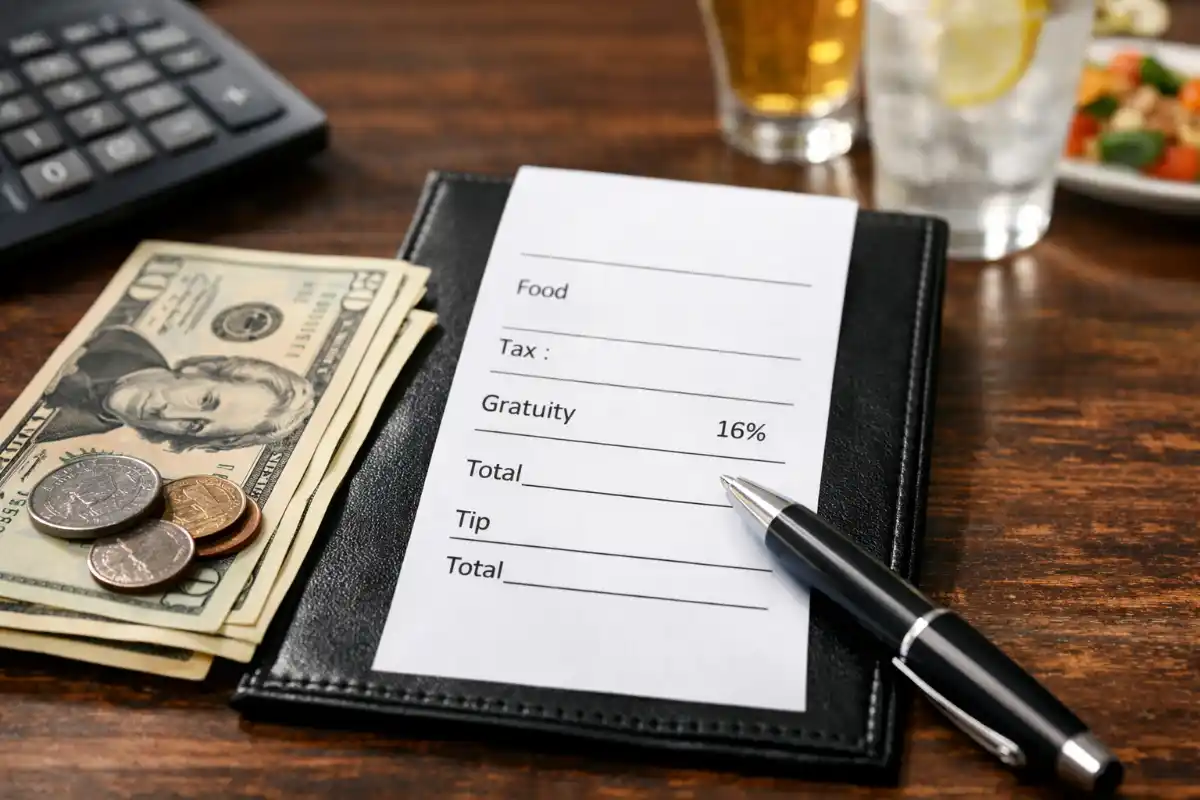


What Does "Tip Before or After Tax" Actually Mean?
Every restaurant bill — and many service bills — contains two separate numbers: the pre-tax subtotal (the cost of the food, drinks, or service before any tax is added) and the post-tax total (the subtotal plus applicable sales tax). When you tip, you choose which of these two numbers your percentage applies to.
Tipping before tax means you calculate your tip percentage against the pre-tax subtotal only. If your food and drinks cost $80 before tax, a 20% tip on that number is $16.00 — regardless of what the tax adds to the final bill.
Tipping after tax means you calculate your tip percentage against the total that already includes sales tax. If that same $80 subtotal becomes $86.80 after an 8.5% combined sales tax rate, a 20% tip on the post-tax total is $17.36 — $1.36 more than the pre-tax method produces.
Neither method is technically wrong. The choice is personal, situational, and — in most cases — makes a far smaller dollar difference than people assume. But understanding both methods gives you confidence at every checkout, and makes sure your server, driver, or service provider receives a tip that reflects what you actually intended to give.
Key Highlights
- Tipping before tax applies your tip percentage to the pre-tax subtotal — the lower of the two numbers on your bill.
- Tipping after tax applies your tip percentage to the tax-included total — the higher number.
- On a $50 bill at a 20% tip, the difference between pre-tax and post-tax tipping is approximately $0.85 — less than a dollar.
- On a $200 bill, the same difference grows to approximately $3.40 — still modest but more noticeable.
- Most etiquette experts and financial advisors say tipping on the pre-tax subtotal is perfectly correct and widely practiced.
- Most restaurant servers — when surveyed — prefer customers tip on the post-tax total, since it results in a slightly higher amount.
- In high-tax cities like New York City (8.875% combined rate) and Chicago (10.25%), the difference between methods is larger than in low-tax states.
- The "double the tax" shortcut — popular in cities with roughly 8–9% sales tax rates — produces a tip close to 17–18%, not exactly 20%.
- For large bills — catered events, group dinners, hotel stays — the method you choose can produce a $20–$50 difference.
- Digital payment apps (Square, Toast, Clover) default to calculating suggested tip amounts on the post-tax total in most configurations.
The Core Debate — What Etiquette Experts Actually Say
The question of whether to tip before or after tax has never been formally standardized in the United States. There is no federal rule, no IRS guidance, and no universal industry standard. What exists instead is a range of positions from etiquette authorities, financial advisors, and hospitality industry organizations — most of which converge on a consistent answer, even if that answer is softer than most people expect.
| Authority / Source | Recommendation | Reasoning Given |
|---|---|---|
| Emily Post Institute | Tip on the pre-tax subtotal | The tip compensates for service rendered — the tax is a government charge unrelated to service quality |
| The Emily Post Institute (updated guidance) | Either method is acceptable | The difference is small enough that both approaches fall within the range of polite tipping behavior |
| Consumer Reports | Tip on the pre-tax amount | Sales tax is not a measure of service — calculating tips on pre-tax is the technically correct approach |
| Hospitality industry surveys | Post-tax preferred by servers | Higher resulting tip amount — even marginally — is preferred when the choice is left to the customer |
| Most financial advisors | Pre-tax is correct; post-tax is generous | Budgeting a tip percentage against the pre-tax subtotal is both mathematically and logically correct |
| IRS Publication 531 (tip income) | No preference stated | The IRS defines tips as voluntary — the calculation method is not addressed in tax guidance |
| Restaurant industry norm (2026) | Digital POS systems default to post-tax | Most point-of-sale systems (Toast, Square, Clover) present tip suggestions calculated on the post-tax total |
When you tap your card on a Square, Toast, or Clover terminal and see suggested tip amounts — typically labeled 18%, 20%, and 25% — those dollar amounts are almost always calculated against the post-tax total, not the pre-tax subtotal. This is the default configuration in most POS software because it produces a slightly higher tip amount, which benefits the establishment and the staff. If you accept the suggested amount without reviewing the math, you are already tipping on the post-tax total whether you intended to or not. This is worth knowing — not because the difference is outrageous, but because it means most Americans who use digital payment terminals are already de facto post-tax tippers, often without realizing it.
The Tip Calculation Formula — Both Methods
Whether you tip before or after tax, the arithmetic is the same — only the base number changes. Here are both formulas in their simplest form.
The only practical difference between the two methods is whether sales tax is included in the base number you multiply. Since sales tax is always a positive number, Method 2 always produces a higher tip amount than Method 1 — by exactly (Sales Tax Amount × Tip Percentage).
Step-by-Step: How to Calculate Your Tip Either Way
Follow these steps to calculate a tip accurately at any table, checkout screen, or app — using whichever method you prefer.
Reverse Sales Tax Calculator
Global Reverse Tax Tool (VAT & GST) 2026 — Remove tax from any total and calculate the original price in seconds.
Real-World Tip Calculations — Pre-Tax vs Post-Tax
Here are four practical scenarios showing the exact dollar difference between tipping on the pre-tax subtotal versus the post-tax total — across different bill sizes, tax rates, and tip percentages common in the United States in 2026.
Example 1: Casual Dinner for Two — Moderate Tax City
Scenario
A couple dines at a casual restaurant in Dallas, Texas. Pre-tax subtotal: $65.00. Texas combined sales tax rate: 8.25%.
Tax amount: $65.00 × 8.25% = $5.36
Post-tax total: $65.00 + $5.36 = $70.36
20% tip — Pre-tax method: $65.00 × 20% = $13.00
20% tip — Post-tax method: $70.36 × 20% = $14.07
Difference: $1.07
Final total (pre-tax tip): $70.36 + $13.00 = $83.36
Final total (post-tax tip): $70.36 + $14.07 = $84.43
Key lesson: On a typical casual dinner bill, the difference between both methods is approximately $1. Neither approach is noticeably more or less generous at this bill size.
Example 2: Business Dinner — High-Tax City
Scenario
A business dinner in New York City. Pre-tax subtotal: $210.00. New York City combined sales tax rate: 8.875%.
Tax amount: $210.00 × 8.875% = $18.64
Post-tax total: $210.00 + $18.64 = $228.64
20% tip — Pre-tax method: $210.00 × 20% = $42.00
20% tip — Post-tax method: $228.64 × 20% = $45.73
Difference: $3.73
Final total (pre-tax tip): $228.64 + $42.00 = $270.64
Final total (post-tax tip): $228.64 + $45.73 = $274.37
Key lesson: In high-tax cities, the difference between methods grows. On a $210 business dinner in NYC, the post-tax method adds $3.73 to the tip. Still modest — but noticeable across a month of business entertaining.
Example 3: The "Double the Tax" Shortcut — Does It Work?
Scenario
A popular restaurant hack: "just double the sales tax line on your bill to get your tip." A $90 pre-tax bill in a city with an 8.5% combined rate.
Tax amount on bill: $90.00 × 8.5% = $7.65
"Double the tax" tip: $7.65 × 2 = $15.30
What percentage is that? $15.30 ÷ $90.00 = 17.0% of pre-tax
True 20% tip (pre-tax): $90.00 × 20% = $18.00
True 20% tip (post-tax): $97.65 × 20% = $19.53
Shortfall vs 20% pre-tax: $18.00 − $15.30 = $2.70 less than a 20% tip
Key lesson: The "double the tax" method produces approximately 17% in cities with 8.5% tax rates — not 20%. It is a useful quick estimate, but it underperforms the 20% standard. In lower-tax states (5–6%), doubling the tax produces only a 10–12% tip — well below the standard range.
Example 4: Large Group Catered Event — Where Method Choice Matters Most
Scenario
A 30-person corporate luncheon catered in Chicago, Illinois. Pre-tax subtotal: $1,800.00. Chicago combined sales tax rate: 10.25%.
Tax amount: $1,800.00 × 10.25% = $184.50
Post-tax total: $1,800.00 + $184.50 = $1,984.50
20% tip — Pre-tax method: $1,800.00 × 20% = $360.00
20% tip — Post-tax method: $1,984.50 × 20% = $396.90
Difference: $36.90
Key lesson: On large event bills in high-tax cities, the difference between pre-tax and post-tax tipping becomes significant — nearly $37 in this example. For event planning and budget management, knowing which method you intend to use before the event is important. Note that catering contracts frequently include a mandatory service charge (often 18–22%) that is separate from — and in addition to — any voluntary tip.
Tip Percentage Quick Reference — Pre-Tax vs Post-Tax Dollar Amounts
The tables below show exact tip amounts under both methods across common bill sizes and tip percentages, using a representative 8.5% combined sales tax rate.
| Pre-Tax Bill | Tax (8.5%) | Post-Tax Total | 15% Pre-Tax Tip | 15% Post-Tax Tip | Difference |
|---|---|---|---|---|---|
| $25.00 | $2.13 | $27.13 | $3.75 | $4.07 | $0.32 |
| $50.00 | $4.25 | $54.25 | $7.50 | $8.14 | $0.64 |
| $100.00 | $8.50 | $108.50 | $15.00 | $16.28 | $1.28 |
| $150.00 | $12.75 | $162.75 | $22.50 | $24.41 | $1.91 |
| $200.00 | $17.00 | $217.00 | $30.00 | $32.55 | $2.55 |
| $300.00 | $25.50 | $325.50 | $45.00 | $48.83 | $3.83 |
| $500.00 | $42.50 | $542.50 | $75.00 | $81.38 | $6.38 |
| Pre-Tax Bill | Tax (8.5%) | Post-Tax Total | 20% Pre-Tax Tip | 20% Post-Tax Tip | Difference |
|---|---|---|---|---|---|
| $25.00 | $2.13 | $27.13 | $5.00 | $5.43 | $0.43 |
| $50.00 | $4.25 | $54.25 | $10.00 | $10.85 | $0.85 |
| $100.00 | $8.50 | $108.50 | $20.00 | $21.70 | $1.70 |
| $150.00 | $12.75 | $162.75 | $30.00 | $32.55 | $2.55 |
| $200.00 | $17.00 | $217.00 | $40.00 | $43.40 | $3.40 |
| $300.00 | $25.50 | $325.50 | $60.00 | $65.10 | $5.10 |
| $500.00 | $42.50 | $542.50 | $100.00 | $108.50 | $8.50 |
Sales Tax Rates by State — How They Affect the Tip Difference (2026)
The higher the sales tax rate in your state and city, the larger the gap between pre-tax and post-tax tipping. Here is how major states compare on a $100 pre-tax bill at a 20% tip percentage.
| State / City | Combined Sales Tax Rate | Tax on $100 Bill | 20% Pre-Tax Tip | 20% Post-Tax Tip | Annual Difference (dining out 3x/week) |
|---|---|---|---|---|---|
| Oregon / Montana / New Hampshire | 0.00% | $0.00 | $20.00 | $20.00 | $0.00 — no difference (no sales tax) |
| Hawaii | 4.00% | $4.00 | $20.00 | $20.80 | ~$124/year |
| California (LA) | 10.25% | $10.25 | $20.00 | $22.05 | ~$319/year |
| Texas (major cities) | 8.25% | $8.25 | $20.00 | $21.65 | ~$256/year |
| New York City | 8.875% | $8.88 | $20.00 | $21.78 | ~$275/year |
| Chicago, Illinois | 10.25% | $10.25 | $20.00 | $22.05 | ~$319/year |
| Florida (Miami) | 7.00% | $7.00 | $20.00 | $21.40 | ~$218/year |
| Washington (Seattle) | 10.25% | $10.25 | $20.00 | $22.05 | ~$319/year |
Annual difference estimate based on $100 average pre-tax bill, dining out 3 times per week (156 meals/year), 20% tip. Provided for illustration only — individual spending varies.
Pre-Tax vs Post-Tax Tipping — Complete Comparison
| Factor | Tip on Pre-Tax Subtotal | Tip on Post-Tax Total |
|---|---|---|
| Mathematically correct? | Yes — tips are for service, not government tax | Yes — both methods produce a valid tip |
| Socially acceptable? | Yes — widely practiced and endorsed by etiquette experts | Yes — slightly more generous, preferred by servers |
| Dollar amount | Lower — by exactly (Tax Amount × Tip %) | Higher — by exactly (Tax Amount × Tip %) |
| Difference on $100 bill (8.5% tax, 20% tip) | $20.00 | $21.70 (+$1.70) |
| What digital POS systems default to | Rarely — most systems default to post-tax | Yes — most POS terminal tip suggestions use post-tax |
| Recommended by etiquette authorities | Yes — Emily Post Institute, Consumer Reports | Acceptable but not specifically recommended |
| Best for budget-conscious diners | Yes — produces the lower tip amount | No — produces the higher tip amount |
| Best for rewarding excellent service | Either — a higher percentage pre-tax is equivalent to post-tax | Yes — slightly higher amount for same percentage |
| Effect in no-sales-tax states | Identical to post-tax — no difference | Identical to pre-tax — no difference |
| Matters most when | Large bills, high-tax cities, frequent dining | Large bills, high-tax cities, frequent dining |
Pros and Cons — Both Tipping Methods
Arguments for Tipping on Pre-Tax Subtotal
- Logically correct — sales tax is a government charge, not a measure of service received
- Endorsed by the Emily Post Institute and Consumer Reports as the technically appropriate standard
- Allows more precise budgeting — the tip percentage you intend reflects exactly your satisfaction with service
- In high-tax cities, produces a meaningfully lower out-of-pocket cost at the same stated percentage
- Simple mental math — the pre-tax subtotal is usually a round or near-round number
- No financial disadvantage to the server relative to what a stated "20% tip" genuinely means
Arguments for Tipping on Post-Tax Total
- Marginally more generous — results in a slightly higher dollar amount for the server at the same stated percentage
- Matches what most digital POS tip prompts already calculate — accepting the suggested amount is already post-tax
- Simpler in practice — one number (the total) rather than two (subtotal vs total)
- Preferred by most service workers when surveyed — even the small additional amount adds up over many tables
- Standard in some international markets where the post-tax total is the only number shown on the bill
- No etiquette authority actively discourages it — it is universally considered acceptable
Expert Tip — Ritu Sharma
"The tipping debate in America has quietly shifted from a question of etiquette to a question of personal finance — and most people have not noticed the shift. When digital payment terminals became the norm and tip prompts became universal, restaurants and service businesses made a quiet decision: default to post-tax tip calculations. That decision costs the average American who dines out regularly somewhere between $150 and $400 per year in additional tip spending compared to pre-tax tipping at the same stated percentage — not because they chose to be more generous, but because they accepted whatever the screen suggested without checking the math. My practical advice is simple: know the formula, run the two-second mental calculation, and decide for yourself. Pre-tax is correct. Post-tax is generous. Both are acceptable. The only unacceptable choice is the one made by inertia rather than intention."
When Does the Method Choice Actually Matter?
- Large group restaurant bills — when a table of eight splits a $400 check, the difference between pre-tax and post-tax tipping at 20% in a high-tax city like Chicago can exceed $8 on the tip alone — noticeable when divided across the table or when one person is covering the full amount
- High-tax city dining — in cities with combined ratesSales Tax by State 2026: Combined Rates, Exemptions & What You Owe above 9% (Chicago, Los Angeles, Seattle), the gap between methods is large enough to affect regular dining budgets meaningfully over the course of a month or year, particularly for frequent diners or business entertainers
- Catered events and private dining — where pre-tax subtotals frequently run into four or five figures, the method choice can produce differences of $30, $50, or more on the tip alone — worth clarifying with the caterer or event planner before the event
- States with no sales tax — Oregon, Montana, New Hampshire, Delaware, and Alaska have no statewide sales tax, which means pre-tax and post-tax tipping produce identical results — the debate is entirely irrelevant in these states
- Travelers dining internationally — many countries either do not have a tipping culture or include service charges automatically; in countries that do tip, the bill often shows only a tax-inclusive total, making the choice between methods academic — you tip on the only number shown
- Frequent restaurant-goers or food delivery app users — the cumulative annual difference between methods can reach $200–$400 for someone who dines out or orders delivery three or more times per week in a high-tax city, making the method choice a genuine personal finance consideration over time
The fastest way to calculate a 20% tip on any bill — without using your phone and without worrying about whether to use the pre-tax or post-tax number — is the move-the-decimal method. Take whatever number you are using as your base (pre-tax subtotal or post-tax total), move the decimal one place to the left, and double it. For a $78 subtotal: move the decimal to get $7.80, double it to get $15.60 — that is your 20% pre-tax tip. For the post-tax total of $84.63: move the decimal to get $8.46, double it to get $16.92 — that is your 20% post-tax tip. If you want 18% instead of 20%, calculate 20% first and then subtract 10% of that number ($15.60 − $1.56 = $14.04 for 18%). This works for any base, at any tax rate, in under five seconds — no calculator required.
Situations Where the Standard Rules Do Not Apply
Automatic gratuity (auto-grat): Many restaurants automatically add an 18–20% service charge for parties of six or more. This charge appears on the bill as "gratuity" or "service charge" and is typically calculated on the pre-tax subtotal. When auto-grat is present, you are not expected to add an additional tip — though you may add one for exceptional service. Confirm with your server whether the gratuity line is a mandatory charge or a suggested amount before adding anything extra.
Service charges vs tips: In an increasing number of restaurants — particularly in cities that have raised the minimum wage — bills include a mandatory "service charge" of 3–5% that goes to the establishment (not directly to the server) and is separate from the tip line. These charges are calculated on the pre-tax subtotal in most cases. You are still expected to leave a tip on the tip line even when a service charge is present, unless the menu or bill explicitly states otherwise.
Delivery app tip structures: Rideshare and food delivery apps (DoorDash, Uber Eats, Instacart, Lyft) typically calculate suggested tip amounts on the base fare or subtotal before fees and taxes — but the interface does not always make this transparent. The 20% suggestion you see on a DoorDash checkout screen is generally 20% of the food subtotal, not 20% of the full total including delivery fee, service fee, and taxes. If you want to tip 20% of the total cost you are actually paying, you will need to calculate a custom tip amount rather than accepting the default suggestion.
International visitors dining in the US: Visitors from countries where tipping is not standard — JapanJapan Tax: 10% (Consumption Tax), much of Europe, China — frequently underestimate the expected tip range in the United States. In US restaurants, 15% is the floor for adequate service and 20% is the widely accepted standard. Tipping 10% or less is generally considered insulting to the server, regardless of whether the calculation is pre-tax or post-tax. The method question is secondary to ensuring the percentage is within the expected range.
Expert Insight — What the Tipping Debate Reveals About Modern Personal Finance
The question of whether to tip before or after tax seems trivial in isolation — and on any individual bill, it genuinely is. But the broader tipping conversation in the United States has undergone significant change since 2020. The expansion of tip prompts to counter service, coffee shops, takeout windows, and self-checkout kiosks — combined with the default presentation of those prompts on post-tax totals — has meaningfully increased what the average American spends on tips annually without any corresponding change in the social agreement about what constitutes appropriate tipping.
A 2024 survey by Bankrate found that 66% of Americans have a negative view of the expansion of tip culture to contexts where tipping was not previously expected. A separate 2025 Pew Research survey found that 72% of Americans believe businesses should pay workers enough that tips are not necessary — yet 85% report continuing to tip in restaurants out of a sense of social obligation. The pre-tax vs post-tax debate exists within this larger context: most Americans are tipping more, in more places, on larger and larger base amounts, often without consciously choosing the method being applied to their bill.
For personal finance purposes, the most actionable insight is simple: understand what you are doing and do it deliberately. If you dine out frequently, know which method you prefer, understand the dollar difference, and make a conscious choice rather than defaulting to whatever the terminal suggests. Over the course of a year of regular dining in a high-tax city, that deliberate choice is worth real money — not life-changing money, but money that belongs to you and that you are entitled to spend or give with intention rather than inertia.
Final Verdict
Tipping on the pre-tax subtotal is the technically correct approach, endorsed by etiquette authorities including the Emily Post Institute and Consumer Reports. The tip exists to compensate for service — the sales taxA state and local consumption tax imposed on retail sales of tangible personal property and, in... is a government levy that has nothing to do with how well your server, driver, or service provider performed.
That said, tipping on the post-tax total is universally considered acceptable, is preferred by service workers, and matches what most digital payment terminals already calculate by default. If you are accepting the suggested tip amount on a restaurant terminal without reviewing the math, you are almost certainly already tipping on the post-tax total.
On a typical dining bill, the dollar difference between methods is small enough that either choice is defensible. On large bills, high-tax cities, catered events, and frequent dining budgets, the method choice produces a real and cumulative difference worth understanding. Know the formula, run the quick mental math, and tip what you intend to tip — on whichever base you consciously choose.
The most important number in any tipping decision is not which base you use — it is the percentage you select. A genuine 20% tip on the pre-tax subtotal is a perfectly appropriate and generous response to good service, anywhere in the United States, in 2026.