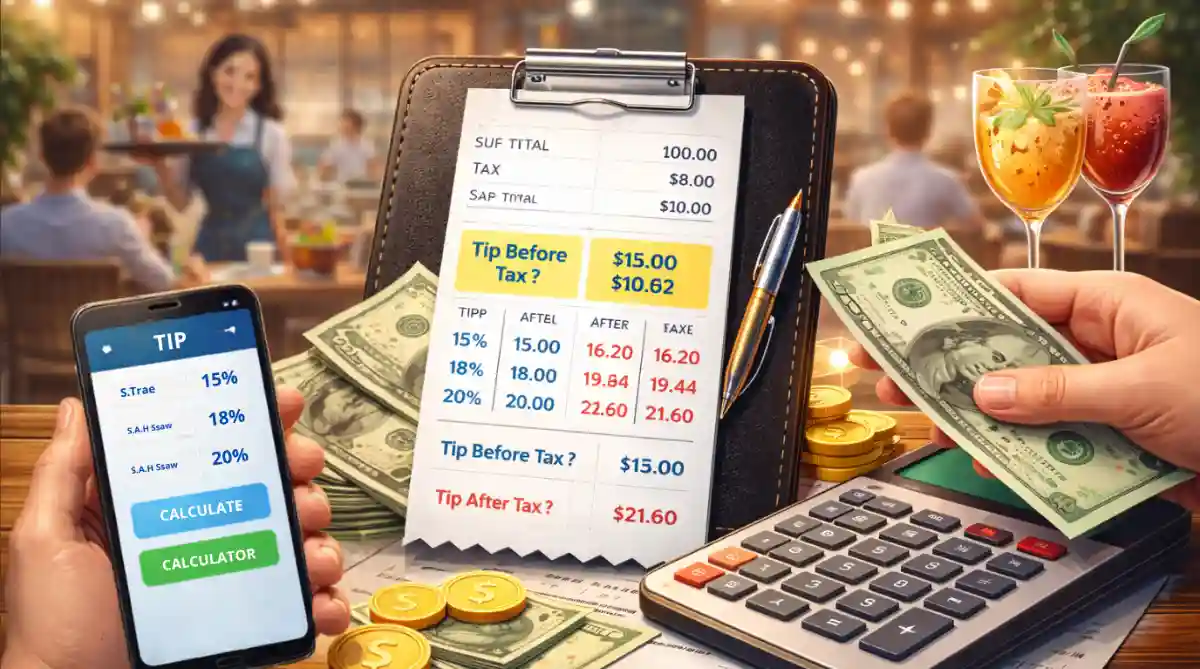

The Core Question — Is a Tip Part of the Taxable Sale?
Sales tax on restaurant bills is calculated on the taxable sale — meaning the food and beverages. Whether a tip is also part of that taxable sale depends entirely on one distinction: was the tip voluntary or mandatory?
A voluntary tip is money a customer freely chooses to add after receiving service. The customer decides the amount. Nothing on the menu or bill obligates them to pay it. Under IRS rules and the laws of most US states, a genuinely voluntary tip is not part of the restaurant's taxable sale — it flows directly to the staff and the restaurant does not owe sales tax on it.
A mandatory gratuity — sometimes called an automatic gratuity, service charge, or auto-grat — is a fixed amount the restaurant adds to the bill, typically for large parties. Because the customer has no choice about paying it, most states treat it as part of the restaurant's revenue, making it subject to sales tax just like the food itself.
In 2026, with the new federal "No Tax on Tips" income tax deduction under the One Big Beautiful Bill Act making tips a hot topic nationally, understanding the sales tax side of the equation has never been more relevant — for both diners verifying their bills and restaurant workers understanding how their income is taxed.
Key Highlights
- Voluntary tips left by the customer are generally NOT subject to sales tax in most US states.
- Mandatory or automatic gratuity added by the restaurant IS subject to sales tax in most states.
- The legal test in most states is whether the customer could change or remove the gratuity — if not, it is taxable as a service charge.
- New York has a specific 3-part test for mandatory gratuity to be exempt — failing any one condition makes the full gratuity taxable.
- California treats any automatically added charge as a service charge subject to sales tax — regardless of how it is labeled on the bill.
- Washington state taxes mandatory gratuity as part of the restaurant's gross receipts under its B&O tax rules.
- The 2026 federal "No Tax on Tips" law applies to income tax — not sales tax. These are two separate tax systems.
- If sales tax was applied to a voluntary tip you left on a receipt, the restaurant has made an error — you may request a correction.
- Reverse calculation verifies any restaurant bill: Pre-Tax Food Amount = Total ÷ (1 + Tax Rate) — applied to the correct taxable base.
- Restaurant POS systems sometimes incorrectly calculate tax on the post-tip total — this is one of the most common receipt errors in the food service industry.
Voluntary Tip vs Mandatory Gratuity — The Key Distinction
The entire question of sales tax on tips hinges on a single legal distinction that most diners never think about. Understanding it clearly is the foundation for reading any restaurant bill correctly.
| Feature | Voluntary Tip | Mandatory / Automatic Gratuity |
|---|---|---|
| Who decides the amount? | The customer — freely chosen | The restaurant — fixed percentage |
| Can the customer change it? | Yes — any amount or zero | No — it is already on the bill |
| Where does it appear? | Blank tip line on the receipt | Pre-printed line on the bill |
| IRS classification | Tip income — reported separately | Service charge — treated as wages |
| Subject to sales tax? | Generally NO in most states | Generally YES in most states |
| Common situations | Standard restaurant dining, delivery | Large parties (6+), banquets, hotel dining, catering |
| Shown on receipt as | "Tip" — written in by customer | "Auto gratuity," "Service charge," "Mandatory gratuity" |
The One Big Beautiful Bill Act signed in 2025 created a federal income tax deduction of up to $25,000 for qualified tip income. This law applies only to federal income tax — it has zero effect on sales tax. Sales tax and income tax are completely separate systems. A restaurant worker can deduct tip income from their federal income tax return under the new law, but the question of whether a restaurant must collect sales tax on mandatory gratuity from customers is governed entirely by state sales tax law — and those rules have not changed. When you see your restaurant bill, the sales tax line is a state matter. The "no tax on tips" federal law is about what the server files on their personal return.
Reverse Formula — Verify Any Restaurant Bill in Seconds
Whether you want to check that sales tax was applied only to the food (not the tip) or verify the correct rate was used, the reverse formula gives you the exact answer from any restaurant receipt.
The key is identifying the correct taxable base before applying the formula. If your voluntary tip was not supposed to be taxed, the taxable base is the food and beverage subtotal only. If an automatic gratuity was added and your state taxes it, the taxable base is food plus the mandatory gratuity. Always check what amount the tax was calculated on before accepting the bill as correct.
Step-by-Step: How to Verify Your Restaurant Bill
Follow these five steps to verify whether sales tax was applied correctly to your restaurant bill — including whether your tip was incorrectly taxed.
Reverse Sales Tax Calculator
Global Reverse Tax Tool (VAT & GST) 2026 — Remove tax from any total and calculate the original price in seconds.
Real-World Restaurant Bill Scenarios
Here are four practical scenarios showing how sales tax applies to different restaurant situations — including how to spot and correct errors using reverse calculation.
Example 1: Standard Dining — Voluntary Tip, Tax Applied Correctly
Scenario
A couple dines in Dallas, Texas. Food subtotal: $85.00. They write in a voluntary $17.00 tip on the receipt. Sales tax (8.25% Dallas combined rate) appears on the bill as $7.01. Total charged: $109.01.
Was the tax correct?
Expected tax on food only: $85.00 × 8.25% = $7.01 ✓
Tax on voluntary tip ($17.00): Should be $0 — voluntary tips are not part of the taxable sale in Texas ✓
Bill is correct. Tax was applied only to the $85 food subtotal. The voluntary $17 tip added no additional tax. Total $109.01 = $85.00 food + $7.01 tax + $17.00 tip.
Example 2: Large Party — Mandatory Gratuity Taxed in California
Scenario
A party of 10 dines in Los Angeles. Food subtotal: $400.00. The restaurant adds an automatic 18% gratuity: $72.00. Total before tax: $472.00. Sales tax charged: $44.84. Combined LA rate: 9.50%.
Was the tax correct?
In California, automatically added charges are treated as service charges subject to sales tax.
Expected tax on $472.00 (food + mandatory gratuity): $472.00 × 9.50% = $44.84 ✓
Bill is correct — California law requires tax on mandatory gratuity. Grand total: $400 + $72 + $44.84 = $516.84
If the group had voluntarily tipped instead: Tax would have been $400 × 9.50% = $38.00 — saving the group $6.84 in sales tax on the same meal.
Example 3: New York — Mandatory Gratuity That Qualifies as Exempt
Scenario
A banquet in New York City. Food total: $1,200.00. Restaurant adds a stated 20% gratuity: $240.00. The gratuity is labeled "gratuity" on the bill, is separately stated, and 100% goes to the service staff. NYC combined tax rate: 8.875%.
New York's 3-part test for exempt mandatory gratuity:
✅ Identified as "gratuity" on the bill — not "service charge"
✅ Separately stated from the food charges
✅ 100% distributed to the service employees
All 3 conditions met — gratuity is NOT taxable in this case.
Tax on food only: $1,200.00 × 8.875% = $106.50
Total: $1,200 + $240 + $106.50 = $1,546.50
If the gratuity had been labeled "service charge": Tax would have applied to $1,440 total = $127.80 — an additional $21.30 in tax on the same event.
Example 4: POS System Error — Voluntary Tip Incorrectly Taxed
Scenario
A diner in Chicago, Illinois. Food subtotal: $62.00. Voluntary tip written in: $12.40. The receipt shows tax of $7.59 and a total of $81.99. Chicago combined rate: 10.25%.
Checking the math — was the tip taxed?
Tax on food only: $62.00 × 10.25% = $6.36
Tax shown on receipt: $7.59
Difference: $7.59 − $6.36 = $1.23 extra tax
Reverse check: $1.23 ÷ 10.25% = $12.00 — the POS system taxed approximately $12 of the voluntary tip.
This is an error. Illinois does not tax voluntary tips. The restaurant's POS system calculated tax on the food + tip total ($74.40) instead of the food only ($62.00). The diner was overcharged $1.23 in tax.
Correct total should be: $62.00 + $6.36 + $12.40 = $80.76 — not $81.99.
Action: Show the manager. Request a $1.23 refund or correction on the bill before paying.
Sales Tax on Tips — State-by-State Rules (2026)
The rules for when mandatory gratuity is subject to sales tax vary by state. The table below covers the most important states for restaurant diners.
| State | Voluntary Tip Taxable? | Mandatory Gratuity Taxable? | Key Rule |
|---|---|---|---|
| California | No | Yes — always | Any automatically added charge = service charge = taxable, regardless of label |
| New York | No | Depends — 3-part test | Exempt only if labeled "gratuity," separately stated, AND 100% goes to employees |
| Texas | No | Yes — if not clearly voluntary | Mandatory gratuity is part of taxable sale; voluntary tips are exempt |
| Florida | No | Yes — if mandatory | Service charges added by the establishment are taxable as part of the selling price |
| Illinois | No | Yes — if mandatory | Mandatory gratuity taxable; voluntary tips are not part of receipts |
| Washington | No | Yes — always | Mandatory gratuity taxable under both B&O and retail sales tax when not clearly voluntary |
| Pennsylvania | No | Yes — if mandatory | Mandatory service charges are part of the selling price and taxable |
| Ohio | No | Yes — if mandatory | Mandatory gratuity included in taxable price; voluntary tips excluded |
| Georgia | No | Yes — if mandatory | Service charges included in gross sales subject to tax |
| Nevada | No | Yes — if mandatory | Mandatory gratuity is part of the taxable sales price |
Source: State Departments of Revenue and IRS Publication guidance — 2026. Always verify current rules with your state's tax authority.
Voluntary Tip vs Mandatory Gratuity — Full Tax Impact Comparison
| Factor | Voluntary Tip (Customer Writes In) | Mandatory Gratuity (Auto-Added by Restaurant) |
|---|---|---|
| Sales tax owed on it? | No — in most states | Yes — in most states |
| IRS income tax treatment | Tip income — deductible under OBBBA up to $25,000 | Service charge — treated as regular wages, not tip income |
| FICA (Social SecurityIs Social Security Taxable in 2026? Thresholds + Senior Deduction + Medicare)? | Yes — employee pays on reported tips | Yes — treated as regular wages |
| Who reports to IRS? | Employee reports tips to employer | Employer reports as wages on W-2 |
| Qualifies for "No Tax on Tips" 2026? | Yes — if occupation qualifies | No — mandatory gratuity is not "qualified tips" |
| Customer can change amount? | Yes — total control | No — fixed by restaurant policy |
| Typically used for | Standard restaurant dining | Large parties (6+), events, banquets |
Pros and Cons of Automatic Gratuity — for Restaurants and Diners
Why Restaurants Add Automatic Gratuity
- Guarantees fair compensation for servers on large tables that require significant effort
- Reduces the risk of large parties leaving no tip after receiving full service
- Simplifies bill splitting — the gratuity is already included before the group divides the check
- Covers the cost of extra service staff assigned specifically to large party tables
- Industry standard for banquets, events, and corporate dining where service expectations are higher
- Predictable revenue for staff scheduling and payroll planning
What Diners Should Know Before Paying
- Mandatory gratuity triggers sales tax in most states — meaning you pay tax on the service charge
- Mandatory gratuity does not qualify for the 2026 federal "No Tax on Tips" income deduction for workers
- You cannot adjust the amount even if service was poor — though you can speak to management
- POS systems sometimes incorrectly calculate tax on top of the total including your voluntary tip — always check
- Some restaurants add automatic gratuity for smaller parties than the disclosed threshold — check the menu
- Online review platforms may not reflect that the stated menu prices do not include mandatory gratuity
Expert Tip — Ritu Sharma
"The restaurant sales tax error I see most often is not in the dining room — it is in the POS configuration. A restaurant that sets its system to calculate tax on the post-tip total rather than the pre-tip food subtotal is systematically overcharging sales tax on every single transaction where customers add a voluntary tip. On a restaurant doing $1 million in annual revenue with an average 18% voluntary tip rate and a 9% combined tax rate, this misconfiguration produces approximately $16,200 per year in overcollected tax — all of which gets remitted to the state. The customers overpaid, the restaurant remitted correctly, and no one ever catches it because the individual overcharge on each bill is under $2. If you manage a restaurant, audit your POS tax configuration today. The taxable base should be set to the food subtotal before any voluntary tip — not the final total including gratuity. If you are a diner, run the reverse check on your next restaurant receipt. The formula takes 30 seconds and tells you immediately whether the tax was calculated correctly."
Who Needs to Understand Sales Tax on Tips?
- Restaurant diners in large groups who want to verify that the sales tax on their bill was calculated on the food subtotal only — not on a voluntary tip they added, and to understand when mandatory gratuity correctly triggers additional tax
- Restaurant servers, bartenders, and tipped workers who need to understand the difference between a voluntary tip (which qualifies for the 2026 federal income tax deduction) and a mandatory service charge (which does not qualify) — the distinction affects how much federal income tax they owe
- Restaurant and hospitality managers who configure POS systems and need to ensure the system correctly identifies the taxable base — applying sales tax to food and mandatory gratuity but not to voluntary customer-added tips
- Event planners and corporate clients booking banquets or catering who need to accurately budget the full cost including sales tax on mandatory service charges — which can add 8–10% on top of the already-added gratuity percentage
- Accountants and bookkeepers reconciling restaurant expense reports who need to correctly separate the pre-tax food cost, the tax paid, and the tip from total receipt amounts for accurate expense reporting
- Travelers and tourists visiting high-tax cities like New York (8.875%), Chicago (10.25%), or Seattle (10.25%) where the combined effect of sales tax on food plus potential tax on mandatory gratuity can add 19–28% to the base menu price at a large party table
Most restaurants that add automatic gratuity for large parties disclose their policy on the menu — typically in fine print at the bottom of the last page. The typical threshold is parties of six or more, with the most common auto-grat percentage being 18–20%. Before ordering, confirm three things: the party size threshold that triggers automatic gratuity, the percentage being added, and your state's rule on whether mandatory gratuity is taxable. In a city like Los Angeles with a 9.50% combined rate, a $500 dinner for eight with 18% mandatory gratuity ($90) would produce $55.10 in sales tax applied to the full $590 — significantly more than the $47.50 you would pay on the food alone. Knowing this in advance lets you decide whether to book a smaller table or adjust your budget accordingly.
Common Errors and Risks
POS system calculating tax on total including voluntary tip: This is the most common restaurant receipt error related to tips. When a server enters the final total — food plus the voluntary tip the customer wrote in — some POS systems calculate tax on the combined amount rather than the pre-tip subtotal. The resulting tax overcharge is small on individual meals but adds up significantly across hundreds of transactions. If you notice the tax on your receipt seems higher than expected, use the reverse formula: Tax ÷ Tax Rate = Taxable Base. If the result is significantly higher than your food subtotal, your tip was incorrectly included in the tax calculation.
Confusing the 2026 "No Tax on Tips" federal law with sales tax: The One Big Beautiful Bill Act's tip deduction is an income tax provision — it allows tipped workers to deduct up to $25,000 in qualified tip income from federal taxable income. It has no effect on sales tax collected at restaurants. Diners who ask restaurants to "not charge tax on tips" because of the new law are referring to a completely different tax system. Sales tax is a state matter; the federal tip deduction is a personal income tax matter for the worker.
Assuming all gratuity labeled "gratuity" is exempt in New York: New York's 3-part test requires that the gratuity be labeled correctly, separately stated, AND that 100% goes to the employees — including not being used to cover the employer's share of FICA taxes. If even one condition is not met, the entire mandatory gratuity becomes taxable. Restaurants that use gratuity pools managed through union contracts or that retain any portion for administrative costs may fail this test.
States without specific guidance: Not all states have published explicit guidance on the taxability of mandatory gratuity in every situation. When state guidance is absent, the general rule applies — if the customer cannot choose not to pay it, it is likely part of the taxable selling price. When in doubt, the state's Department of Revenue is the authoritative source.
Expert Insight and Market Impact
The question of sales tax on tips has gained national attention in 2026 alongside the "No Tax on Tips" federal legislation. While the federal law deals with income tax, it has prompted millions of restaurant workers and diners to examine tip-related taxes more carefully — including the sales tax dimension that existed long before the new federal law.
Restaurant industry data consistently shows that tip-related POS configuration errors are among the most common source of sales tax discrepancies in state audits of food service businesses. A restaurant that configures its system to calculate tax on the post-tip total — rather than the pre-tip food subtotal — is systematically overcollecting sales tax on every transaction where customers voluntarily tip. Over a year of operations, this overcollection can reach thousands of dollars, all of which was collected from customers but must be remitted to the state regardless of the error in calculation.
For large party diners in high-tax cities, the combined cost of mandatory gratuity plus sales tax on that gratuity represents a meaningful addition to the bill. In Chicago at 10.25%, an auto-grat of 18% on a $300 table means $54 in mandatory gratuity plus $5.54 in sales tax on that gratuity — for a combined additional charge of $59.54 on top of the base food price. Understanding this math before the bill arrives is the most practical financial benefit of knowing how sales tax on tips actually works.
Final Verdict
Whether sales tax applies to your restaurant tip depends on one question: was it voluntary or mandatory? Voluntary tips you write in yourself are not subject to sales tax in most US states — they are personal gifts to the server, not part of the restaurant's taxable sale. Mandatory or automatic gratuity added by the restaurant is treated as part of the selling price in most states and is fully subject to sales tax.
To verify any restaurant bill, use the reverse formula: divide the tax charged by the tax rate to find the taxable base. If that number is significantly higher than your food subtotal alone, your voluntary tip may have been incorrectly taxed — a common POS error worth correcting before you pay. And remember: the 2026 federal2026 Federal Tax Brackets Explained: Rates, Thresholds & How They Work "No Tax on Tips" income deduction is a completely separate system from sales tax. It helps tipped workers on their personal tax returns — it does not change what restaurants charge at the table.