
What Is Texas Sales Tax?
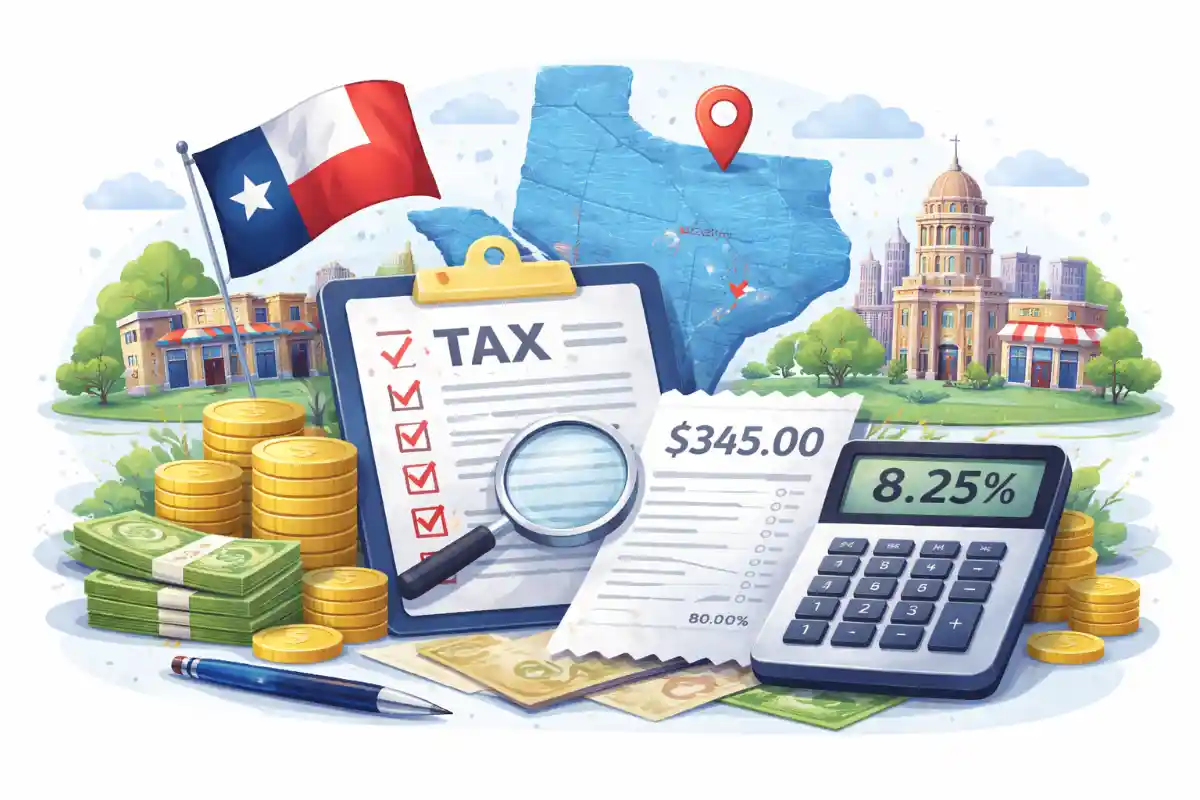
Texas sales tax is a consumption tax levied on the retail sale of most tangible personal property and certain services within the state. It is composed of two layers: a mandatory state-level tax set by the Texas Legislature, and an optional local-level tax that cities, counties, transit authorities, and special purpose districts may impose up to a combined maximum of 2%.
The Texas state sales tax rate is 6.25% — one of the higher state-level rates in the country, though Texas offsets this with no personal income tax. Most Texas residents and businesses pay a combined rate of 8.25%, which is the legal maximum allowed under Texas law, because most major cities and counties have adopted the full 2% local add-on.
Sales tax in Texas is administered by the Texas Comptroller of Public Accounts, which handles registration, collection, remittance, auditing, and enforcement for all sales tax activity in the state.
Key Highlights
- Texas state sales tax rate: 6.25% — local taxes add up to 2% for a maximum combined rate of 8.25%.
- Most major cities — Houston, Dallas, Austin, San Antonio, Fort Worth — charge the full 8.25% combined rate.
- Formula: Tax Amount = Pre-Tax Price × Tax Rate (as decimal).
- Reverse formula: Pre-Tax Price = Total Price ÷ (1 + Tax Rate) — useful for verifying receipts.
- Unprepared grocery food, prescription drugs, and agricultural items are exempt from Texas sales tax.
- Texas holds an annual Sales Tax Holiday — August 21–23, 2026 — for qualifying clothing, school supplies, and backpacks.
- Texas does not tax most services — only specific services enumerated in the Tax Code are taxable.
- Businesses must collect tax at the destination rate — the rate applicable to where the buyer takes possession of the goods.
- Texas Economic Nexus threshold: $500,000 in Texas sales in the preceding 12-month period for remote sellers (post-Wayfair).
- Sales tax returns are due monthly, quarterly, or annually based on the business's annual tax liability.
Texas Sales Tax Rates — State vs Local (2026)
Texas law sets the state sales tax rate at 6.25%. Local jurisdictions — cities, counties, transit authorities (MTA/SPD), and special districts — may impose additional local sales taxes, but the combined local rate cannot exceed 2%. This means the maximum combined rate any Texas consumer can be charged is 8.25%.
| Tax Layer | Rate | Who Sets It | Statutory Authority |
|---|---|---|---|
| State sales tax | 6.25% | Texas Legislature | Texas Tax Code § 151.051 |
| City sales tax | Up to 2% | City Council | Texas Tax Code § 321 |
| County sales tax | Up to 0.5% | County Commissioners Court | Texas Tax Code § 323 |
| Transit authority (MTA/SPD) | Up to 1% | Transit Authority Board | Texas Tax Code § 451/452 |
| Special purpose district | Up to 2% | District Board | Texas Tax Code §§ 377–379 |
| Maximum combined rate | 8.25% | State + all local combined | Texas Tax Code § 151.054 |
Texas Sales Tax Rates by City (2026)
The table below shows the combined sales tax rate — state plus all applicable local taxes — for the most populous Texas cities in 2026. The large majority of major Texas cities charge the maximum combined rate of 8.25%.
| City | State Rate | Local Rate | Combined Rate | County |
|---|---|---|---|---|
| Houston | 6.25% | 2.00% | 8.25% | Harris |
| San Antonio | 6.25% | 2.00% | 8.25% | Bexar |
| Dallas | 6.25% | 2.00% | 8.25% | Dallas |
| Austin | 6.25% | 2.00% | 8.25% | Travis |
| Fort Worth | 6.25% | 2.00% | 8.25% | Tarrant |
| El Paso | 6.25% | 2.00% | 8.25% | El Paso |
| Arlington | 6.25% | 2.00% | 8.25% | Tarrant |
| Corpus Christi | 6.25% | 2.00% | 8.25% | Nueces |
| Plano | 6.25% | 2.00% | 8.25% | Collin |
| Lubbock | 6.25% | 2.00% | 8.25% | Lubbock |
| Laredo | 6.25% | 2.00% | 8.25% | Webb |
| Garland | 6.25% | 2.00% | 8.25% | Dallas |
| Irving | 6.25% | 2.00% | 8.25% | Dallas |
| Amarillo | 6.25% | 2.00% | 8.25% | Potter/Randall |
| McKinney | 6.25% | 2.00% | 8.25% | Collin |
| Frisco | 6.25% | 2.00% | 8.25% | Collin/Denton |
| Waco | 6.25% | 2.00% | 8.25% | McLennan |
| Killeen | 6.25% | 2.00% | 8.25% | Bell |
| Pasadena | 6.25% | 2.00% | 8.25% | Harris |
| Unincorporated areas | 6.25% | 0–1.5% | 6.25–7.75% | Varies |
While most major Texas cities charge 8.25%, rates in unincorporated areas, smaller towns, and areas that span multiple taxing jurisdictions can vary. The Texas Comptroller's Sales Tax Rate Locator tool (available at comptroller.texas.gov) allows you to look up the exact combined rate for any Texas address or ZIP code. For businesses, using the correct destination-based rate for each customer ZIP code is a legal compliance requirement — not an option.
How to Calculate Texas Sales Tax — The Formula
Calculating Texas sales tax requires three pieces of information: the pre-tax price of the item, the applicable combined tax rate for the location of sale, and the correct formula. For most Texas purchases, the combined rate is 8.25%, which converts to 0.0825 as a decimal.
Step-by-Step: How to Calculate Texas Sales Tax
Follow these five steps to accurately calculate Texas sales tax for any purchase or business transaction.
Reverse Sales Tax Calculator
Remove tax from any total and calculate the original price in seconds.
Real-World Texas Sales Tax Calculation Examples
The following four examples walk through Texas sales tax calculations across different purchase types — showing the formula applied in real consumer and business scenarios.
Example 1: Consumer Electronics Purchase in Dallas
Scenario
Item: Laptop computer | Pre-tax price: $899.99 | Location: Dallas, TX | Combined rate: 8.25%
Step 1 — Is it taxable? Yes. Electronics are tangible personal property and fully taxable in Texas.
Step 2 — Tax calculation:
Tax = $899.99 × 0.0825 = $74.25
Step 3 — Total:
$899.99 + $74.25 = $974.24
Breakdown: State tax (6.25%) = $56.25 | Local tax (2%) = $18.00 | Total tax = $74.25
Example 2: Restaurant Meal in Houston (Prepared Food)
Scenario
Item: Restaurant meal for two | Pre-tax price: $78.50 | Location: Houston, TX | Combined rate: 8.25%
Step 1 — Is it taxable? Yes. Prepared food sold by a restaurant is taxable in Texas at the full combined rate.
Step 2 — Tax calculation:
Tax = $78.50 × 0.0825 = $6.48
Step 3 — Total before tip:
$78.50 + $6.48 = $84.98
Note: Tips are not subject to sales tax — only the food and beverages. Alcoholic beverages served at restaurants are taxable at the same 8.25% combined rate.
Example 3: Grocery Shopping — Mixed Taxable and Exempt Items
Scenario
Location: San Antonio, TX | Combined rate: 8.25%
A shopper buys: Fresh apples $4.50 (exempt) | Chicken breast $12.00 (exempt) | Bottled water $3.00 (exempt) | Prepared rotisserie chicken $9.99 (taxable) | Vitamins/supplements $18.50 (taxable) | Paper towels $6.75 (taxable)
Total exempt items: $4.50 + $12.00 + $3.00 = $19.50 (no tax)
Total taxable items: $9.99 + $18.50 + $6.75 = $35.24
Tax on taxable items: $35.24 × 0.0825 = $2.91
Total paid: $19.50 + $35.24 + $2.91 = $57.65
Key point: Texas exempts most unprepared food items — raw meat, fresh produce, dairy, bread — from sales tax. Prepared food (hot deli items, rotisserie chicken, sushi), dietary supplements, and non-food items like paper towels remain fully taxable.
Example 4: Reverse Calculation — Verifying Tax on a Receipt
Scenario
Receipt total: $162.50 | Location: Austin, TX | Combined rate: 8.25%
You want to verify: What was the pre-tax price, and how much tax was charged?
Step 1 — Apply the reverse formula:
Pre-Tax Price = $162.50 ÷ 1.0825 = $150.12
Step 2 — Calculate tax paid:
Tax Paid = $162.50 − $150.12 = $12.38
Verification: $150.12 × 0.0825 = $12.38 ✓
Use case: This reverse formula is useful for consumers verifying receipts, accountants reconciling expense reports, and businesses auditing their own tax collection accuracy before filing quarterly returns.
What Is Exempt from Texas Sales Tax?
Texas law provides a significant number of sales tax exemptions. Understanding what is and is not taxable is essential for both consumers budgeting purchases and businesses correctly configuring their POS systems and sales tax returns.
| Category | Exempt Items | Taxable Items in Same Category |
|---|---|---|
| Food & Grocery | Most unprepared food items: raw meat, fresh produce, dairy, bread, canned goods, frozen food, cooking ingredients | Prepared food (hot or ready-to-eat), food sold with utensils, candy, soft drinks, snack items |
| Prescription drugs | All prescription drugs dispensed by a licensed pharmacist with a valid prescription | Cosmetic medications, lifestyle drugs without medical necessity (varies) |
| Over-the-counter medications | Human OTC drugs and medicines — pain relievers, cold medicine, antacids, allergy medication | Vitamins, supplements, personal care products (shampoo, lotion) not classified as drugs |
| Agricultural | Farm equipment, seeds, fertilizer, pesticides used in agricultural production; livestock and poultry feed | Farm equipment used primarily for non-agricultural purposes; lawn and garden products for residential use |
| Manufacturing | Machinery and equipment used directly in manufacturing, processing, or fabricating products for sale | Office equipment, administrative machinery, maintenance and repair equipment |
| Services | Most professional services: legal, medical, accounting, consulting, personal services (haircuts, dry cleaning) | Specifically enumerated taxable services: amusement/entertainment, data processing, telecommunications, internet access, cable TV, security monitoring, information services |
| Resale | Items purchased for resale to customers — requires a valid Texas Sales and Use Tax Resale Certificate (Form 01-339) | Items purchased for resale but used personally or converted to business use |
| Nonprofit organizations | Qualifying purchases by exempt organizations (religious, educational, charitable 501(c) organizations with a Texas exemption letter) | Purchases by nonprofit employees for personal use; purchases not directly related to the exempt purpose |
Texas Sales Tax Holiday 2026
Texas holds an annual Sales Tax Holiday on the third weekend of August. In 2026, the Sales Tax Holiday falls on August 21–23, 2026 (Friday through Sunday). During this three-day period, qualifying items are exempt from both state and local sales tax.
| Item Category | Price Threshold | Exempt in 2026? |
|---|---|---|
| Clothing and footwear | Under $100 per item | Yes — exempt |
| School supplies | Under $100 per item | Yes — exempt |
| Backpacks | Under $100 per item | Yes — exempt (first 10 backpacks per person) |
| Clothing over $100 | $100 or more per item | No — fully taxable at 8.25% |
| Electronics (computers, phones) | Any price | No — not included in Texas holiday |
| Jewelry, accessories | Any price | No — fully taxable |
A family buying three pairs of shoes at $79 each and two backpacks at $45 each during the Texas 2026 Sales Tax Holiday saves: (3 × $79 + 2 × $45) × 8.25% = ($237 + $90) × 0.0825 = $327 × 0.0825 = $26.98 saved compared to purchasing the same items outside the holiday weekend. Multiply this across a family's school supply shopping list and the holiday represents a meaningful saving on back-to-school expenses.
Texas vs Other Major States — Sales Tax Rate Comparison
| State | State Rate | Max Combined Rate | Grocery Tax? | Income Tax? | Sales Tax Holiday? |
|---|---|---|---|---|---|
| Texas | 6.25% | 8.25% | No (most food exempt) | No | Yes — August |
| CaliforniaCalifornia Tax: 7.25% | 7.25% | 10.75% | No (most food exempt) | Yes (up to 13.3%) | No |
| FloridaFlorida Tax: 6.00% | 6.00% | 8.50% | No (most food exempt) | No | Yes — multiple |
| New YorkNew York Tax: 4.00% | 4.00% | 8.875% | No (most food exempt) | Yes (up to 10.9%) | No |
| WashingtonWashington Tax: 6.50% | 6.50% | 10.60% | No (most food exempt) | No | No |
| IllinoisIllinois Tax: 6.25% | 6.25% | 11.50% | Yes (1% reduced rate) | Yes (4.95% flat) | Yes — August |
| TennesseeTennessee Tax: 7.00% | 7.00% | 9.75% | Yes (4% reduced rate) | No | Yes — multiple |
| Oregon | 0.00% | 0.00% | N/A — no sales tax | Yes (up to 9.9%) | N/A |
Texas Sales Tax for Businesses — Key Rules (2026)
For businesses operating in Texas — whether retail, wholesale, service-based, or e-commerce — sales tax compliance involves more than knowing the rate. The following rules govern how Texas businesses collect, report, and remit sales tax in 2026.
- Destination-based sourcing: Texas uses destination-based sourcing for sales tax. For in-store sales, the rate is determined by the location of the store. For delivery sales — including e-commerce — the rate is determined by the location where the buyer receives the goods. A Dallas retailer shipping to a customer in a city with a 7.5% combined rate must collect 7.5%, not 8.25%.
- Economic nexus threshold: Remote sellers with more than $500,000 in Texas sales in the preceding 12-month calendar year are required to register, collect, and remit Texas sales tax — regardless of physical presence. This threshold was established following the 2018 South DakotaSouth Dakota Tax: 4.50% v. Wayfair Supreme Court ruling.
- Filing frequency: Texas assigns filing frequency based on annual tax liability. Businesses remitting $500 or more per month file monthly (due the 20th of the following month). Businesses remitting $500–$1,500 per quarter file quarterly. Businesses remitting under $1,500 annually file annually. Failure to file by the deadline results in a 5% penalty for the first 30 days and 10% thereafter.
- Resale certificates: Businesses purchasing items for resale must provide vendors with a completed Texas Sales and Use Tax Resale Certificate (Form 01-339). Accepting a properly completed resale certificate protects the selling business from liability if the buyer later misuses the certificate. Certificates must be retained for audit purposes.
- Use tax: Texas businesses that purchase taxable items from out-of-state vendors who do not collect Texas sales tax owe Texas use tax at the same combined rate applicable to their location. Use tax is self-assessed and reported on the business's regular sales tax return.
- SaaS and digital products: Texas taxes data processing services and certain electronically delivered software. SaaS platforms with Texas customers must evaluate taxability carefully — Texas has a broad view of taxable data processing services, and many SaaS products fall within the taxable category.
Pros and Cons of Texas Sales Tax Structure
Advantages for Consumers & Businesses
- No personal state income tax — sales tax is the trade-off for no income tax burden
- Most unprepared grocery items are exempt — reducing tax burden on everyday food purchases
- 8.25% maximum combined rate is capped by state law — rates cannot increase beyond this without legislative change
- Annual Sales Tax Holiday in August provides meaningful savings on clothing and school supplies
- Broad exemptions for agricultural, manufacturing, and resale transactions support business operations
- Relatively straightforward filing and remittance process via the Texas Comptroller's online portal
Limitations & Considerations
- 8.25% combined rate is higher than many states — visible at point of sale on every taxable purchase
- Regressive tax structure — lower-income households pay a higher proportion of income in sales tax than higher-income households
- Taxable services list (telecommunications, data processing, amusement) creates complexity for service businesses
- SaaS and digital product taxability rules are broad and create compliance burden for tech companies
- Use tax self-assessment is widely underreported by businesses purchasing from out-of-state vendors
- E-commerce sellers must track destination ZIP code rates across all Texas jurisdictions — not one single rate
Expert Tip — Ritu Sharma
"The single most expensive Texas sales tax mistake I see — especially among e-commerce businesses — is collecting at the 6.25% state rate instead of the full 8.25% combined rate. The business collects less than it owes, remits 6.25% to the Comptroller, and when audited, faces an assessment for the 2% local tax it should have collected — plus penalties and interest. The business cannot go back to customers to collect the difference. It comes directly out of margin. The fix takes five minutes: use the Texas Comptroller's Rate Locator in your checkout flow, or configure your sales tax automation software to use destination-based ZIP code rates for Texas. The second mistake I see frequently is missing the $500,000 economic nexus threshold. This triggers automatically — there is no notice from the state. Once you cross $500,000 in Texas revenue, registration and collection are legally required from that point forward. I advise every growing online business to track Texas revenue monthly and register proactively before crossing that line rather than discovering the obligation during an audit."
Who Should Pay Close Attention to Texas Sales Tax?
- E-commerce businesses selling to Texas customers — any seller exceeding $500,000 in Texas annual sales must register and collect using destination ZIP code combined rates. Using only the 6.25% state rate is non-compliant and a frequent audit trigger.
- Restaurant and food service operators — the line between taxable prepared food and exempt grocery food requires careful point-of-sale configuration. Selling hot items, items with utensils, or combo meals shifts the entire transaction into taxable territory.
- SaaS and software companies — Texas broadly taxes data processing services. Many software platforms with Texas customers are surprised to learn that their product falls within the taxable category. A compliance review before operating in Texas is essential.
- Contractors and construction businesses — the allocation of charges between taxable materials and non-taxable labor on construction contracts is a frequent audit issue. Texas has specific rules governing when a contractor is the consumer of materials (and owes tax) versus when they pass tax collection to the property owner.
- Retailers selling mixed-taxability products — any business selling both taxable and exempt items (grocery stores, pharmacies, general merchandise retailers) must correctly classify each product in their POS system to ensure accurate tax collection and reporting.
- Out-of-state businesses with Texas economic nexus — crossing the $500,000 threshold triggers a registration and collection requirement. Operating without registration after crossing the threshold creates accruing liability including penalties and interest from the date nexus was established.
The Texas Comptroller's Sales Tax Rate Locator at comptroller.texas.gov/taxes/sales/rates/ allows any business or consumer to look up the exact combined sales tax rate for any Texas address or ZIP code. For e-commerce businesses, this tool is the authoritative source for determining the correct rate to charge Texas customers — and using it correctly is the most effective way to avoid the most common e-commerce audit finding in Texas: applying the wrong rate to customer orders. Bookmark it, use it in your checkout configuration, and verify rates quarterly as local rate changes take effect.
Common Texas Sales Tax Mistakes and How to Avoid Them
Applying only the 6.25% state rate: The most frequent mistake made by new or out-of-state businesses is collecting only the 6.25% state rate while ignoring local additions. In cities like Dallas, Houston, and Austin, the correct rate is 8.25%. Collecting 6.25% when 8.25% is owed means the business is under-collecting — creating liability for the uncollected local tax that the business must pay out of pocket.
Misclassifying food items: Texas has detailed rules about which food items are exempt and which are taxable. Prepared food, candy, soft drinks, and dietary supplements are taxable; most unprepared food is exempt. Retailers that misclassify taxable food as exempt under-collect tax. Retailers that misclassify exempt food as taxable over-collect — creating customer service issues and potential liability for over-collected amounts that were not remitted.
Missing the economic nexus threshold: Online businesses often do not track their Texas revenue until they are well past the $500,000 threshold. From the moment the threshold is crossed, collection and registration are legally required — retroactive liability accrues from that date forward.
Not retaining exemption certificates: Businesses that sell to exempt buyers (resellers, nonprofits, government agencies) must retain the completed exemption certificate for each buyer. Auditors consistently request these certificates — an exempt sale without a certificate on file is treated as a taxable sale, creating assessed tax, penalties, and interest on every uncertified transaction.
Expert Insight and Market Impact
Texas remains one of the most commercially significant sales tax jurisdictions in the United States. With no personal income tax, Texas generates a large portion of its state revenue from sales tax — making the Comptroller's audit program one of the most active and well-resourced in the country. The Texas Comptroller collected approximately $43 billion in sales tax revenue in fiscal year 2025, making it by far the largest single revenue source for the state.
The post-Wayfair expansion of economic nexus has significantly increased the number of registered Texas sales tax taxpayers. Businesses that previously had no Texas presence and thus no collection obligation now face registration requirements once they exceed the $500,000 threshold. The Texas Comptroller has invested in data analytics to identify out-of-state sellers with Texas nexus who have not yet registered — cross-referencing marketplace sales data, 1099-K information, and shipping records to identify non-compliant sellers.
For consumers, the 8.25% rate in most Texas cities is a consistent part of daily purchase budgeting. Texas's decision to exempt most grocery items and prescription drugs from the sales tax base means that the tax is primarily felt on discretionary spending — clothing, electronics, furniture, dining, and entertainment — rather than on essential everyday expenditures. This design is consistent across most states that maintain a general sales tax while seeking to reduce the regressivity impact on lower-income households.
Final Verdict
Calculating Texas sales tax is straightforward once you know three things: the combined rate for your location (8.25% for most major cities), what is taxable (tangible goods and enumerated services), and the correct formula (Pre-Tax Price × 0.0825 = Tax Amount; Total = Pre-Tax Price × 1.0825).
For consumers, the practical takeaway is simple: budget an additional 8.25% on top of any price tag for taxable purchases in major Texas cities, know that most grocery staples are exempt, and take advantage of the August Sales Tax Holiday for clothing and school supply purchases.
For businesses, the requirements are more demanding: register once you establish nexus, collect at the correct destination-based combined rate for each customer ZIP code, retain exemption certificates for every exempt sale, and file returns on time according to your assigned frequency. Using the Texas Comptroller's Rate Locator tool and keeping up with quarterly rate change announcements are the two most effective practices for maintaining compliance with minimal effort.