
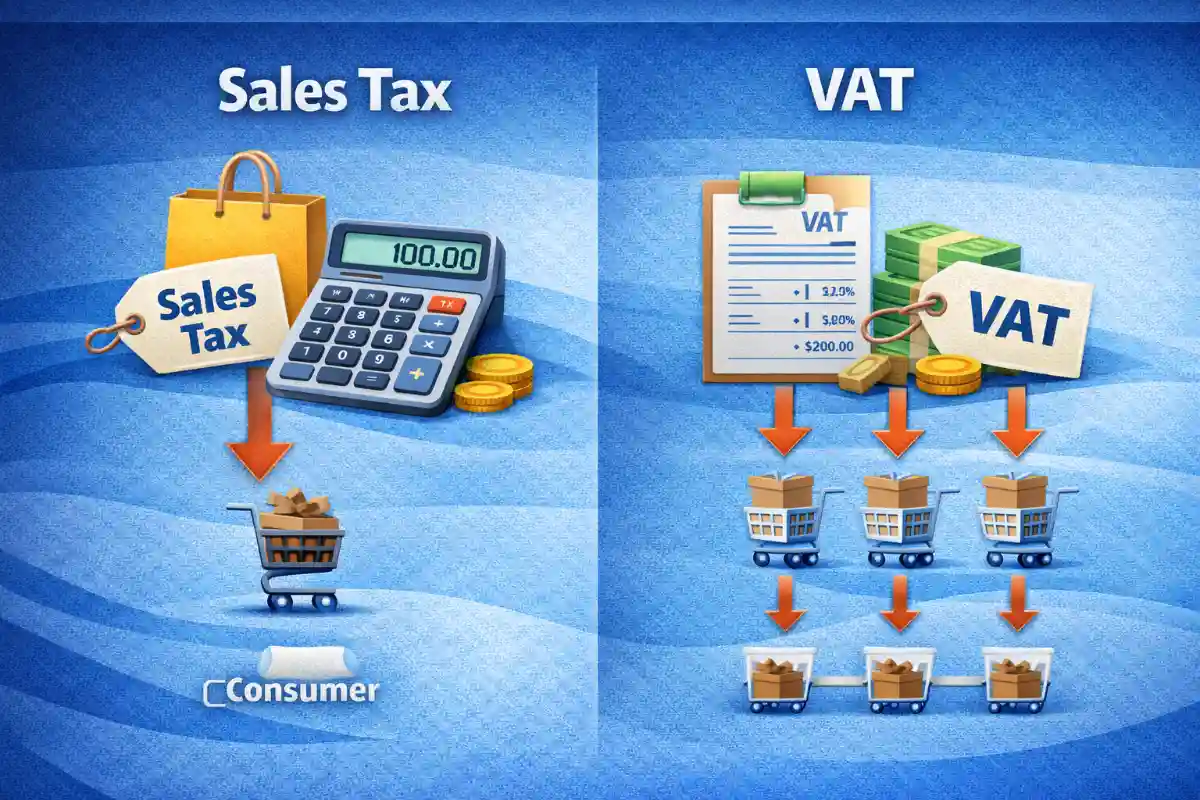
What Is Sales Tax?
Sales tax is a one-time consumption tax applied at the final point of sale. When you buy a phone in Texas or purchase clothing in New York, the retailer adds a percentage on top of the listed price at checkout. That extra charge is the sales tax.
The critical point: the tax is collected just once, at the very end of the transaction chain, from the consumer. Businesses that buy materials, inventory, or supplies for resale purposes are typically exempt from paying sales tax on those purchases by using resale or exemption certificates.
The United States has no federal-level sales tax. Instead, each state sets its own rules. As of 2026, 45 states and Washington D.C. levy a state sales tax, while Alaska, Delaware, Montana, New Hampshire, and Oregon do not collect any state-level sales tax.
There are more than 13,000 individual sales tax jurisdictions in the United States — each with its own rates, rules, and exemptions. This makes US sales tax compliance one of the most complex in the world for multi-state businesses.
What Is VAT (Value-Added Tax)?
VAT stands for Value-Added Tax. It is a multi-stage consumption tax applied at every step in the production and distribution chain — from the raw material supplier, to the manufacturer, to the wholesaler, to the retailer, and finally to the consumer.
Unlike sales tax, VAT is not collected in one lump sum at the end. Instead, each business in the supply chain collects VAT on its sales (called output VAT) and deducts the VAT it already paid on its own purchases (called input VAT). Only the net difference goes to the government.
The result: the consumer ultimately pays the full VAT embedded in the final retail price, but the tax revenue is collected gradually across every stage of production — creating a natural audit trail that governments find much easier to enforce.
How Each System Works — Step by Step
How US Sales Tax Works
How VAT Works
Key Differences: Sales Tax vs. VAT
At a glance, both systems tax consumption. But the way they operate, who bears the compliance burden, and how governments enforce them are fundamentally different.
| Feature | US Sales Tax | VAT |
|---|---|---|
| Where it applies | United States (state & local) | 170+ countries (national) |
| Collection point | Final sale to consumer only | Every stage of the supply chain |
| Who collects it | Retailer remits to state/local authority | Each business in the chain |
| Business exemption | Yes — via resale/exemption certificates | Yes — via input tax credits |
| Rate structure | Varies by 13,000+ jurisdictions | Set nationally; one consistent rate |
| Average rate (2026) | 6.44% combined (US average) | 15–22% (EU average ~21%) |
| Audit trail | Weak — single stage only | Strong — multi-stage paper trail |
| Federal equivalent in US | None | Standard in most countries |
| Compliance complexity | Very high (multi-jurisdiction) | Moderate (national rules) |
| Consumer visibility | Shown separately at checkout | Often embedded in listed price |
| Enforceable at high rates? | Difficult above 10% | Yes — up to 25%+ in some countries |
| Used by | 45 US states + DC | OECD, EU, UK, Canada (GST/HST), India (GST) |
Real-World Calculation Example
Let's say a product moves through a supply chain with a final retail price of $150. The manufacturer produces it for $60, the wholesaler marks it up to $100, and the retailer sells it at $150. Here is what happens under each tax system.
Under US Sales Tax (8% Rate)
| Transaction | Sale Price | Tax Charged | Tax Remitted to Gov. |
|---|---|---|---|
| Manufacturer → Wholesaler | $60.00 | $0.00 | $0.00 |
| Wholesaler → Retailer | $100.00 | $0.00 | $0.00 |
| Retailer → Consumer | $150.00 | $12.00 | $12.00 |
| Total | $162.00 paid by consumer | $12.00 | $12.00 (from 1 party) |
Under VAT (20% Rate)
| Transaction | Sale Price | VAT Charged | Input VAT Deducted | Net Remitted |
|---|---|---|---|---|
| Manufacturer → Wholesaler | $60.00 | $12.00 | $0.00 | $12.00 |
| Wholesaler → Retailer | $100.00 | $20.00 | $12.00 | $8.00 |
| Retailer → Consumer | $150.00 | $30.00 | $20.00 | $10.00 |
| Total | $180.00 paid by consumer | $30.00 (from 3 parties) |
Impact on US Consumers & Businesses in 2026
For US Consumers
Most US consumers encounter sales tax every single day without giving it much thought. The price on the tag does not include tax in the US, which means the real cost of a purchase is always slightly higher than advertised. This surprises international visitors accustomed to VAT-inclusive price tags.
US taxpayers who itemize their federal tax return can deduct state and local sales taxes paid during the year. For the 2026 tax year, the SALT deduction cap has been raised to $40,400 for most filers, making accurate tracking of sales tax payments more valuable than ever.
For US Businesses Selling Internationally
Any American business selling goods or digital services into VAT countries — including all EU member states, the UK, Canada, Australia, and India — must understand VAT registration requirements. A single sale into the EU can trigger a VAT registration obligation, with rates between 17% and 27% depending on the destination country.
Failure to comply with foreign VAT obligations can result in penalties, back taxes, and blocked access to those markets. US businesses expanding globally cannot afford to treat VAT as someone else's problem.
For International Businesses Entering the US
Foreign companies selling into the US face a different challenge. After the 2018 South Dakota v. Wayfair Supreme Court ruling, economic nexusWhat Is Economic Nexus? Post-Wayfair Guide rules now require non-US sellers to collect and remit sales tax once they cross certain thresholds — typically $100,000 in sales or 200 transactions in a single state. With 50 states having different rules, compliance is a genuine operational challenge.
Expert Tip — Umesh Kant Sharma
"The biggest mistake US e-commerce businesses make when expanding internationally is assuming their domestic sales tax experience prepares them for VAT. It does not. VAT is a fundamentally different system. You are not just collecting a tax at checkout — you are tracking input credits at every purchase your business makes, filing periodic VAT returns, and in many EU countries, you need fiscal representation. Start your VAT compliance setup before your first international sale, not after your first audit notice arrives."
Pros & Cons of Each System
US Sales Tax
Advantages
- Simple for consumers to see and understand
- States and localities retain full fiscal control
- Businesses can exempt purchases for resale
- Five states charge zero state sales tax
- Easy for consumers to compare pre-tax prices
Limitations
- 13,000+ jurisdictions make compliance extremely complex
- No federal standardization
- Businesses cannot reclaim tax on taxable inputs
- Practically unenforceable above 10% rates
- Wayfair ruling added multi-state compliance burden
VAT System
Advantages
- Consistent national rate — easier cross-border compliance
- Businesses reclaim input VAT on purchases
- Strong multi-stage audit trail — harder to evade
- Enforceable at higher rates (20–27%)
- Predictable and stable government revenue stream
Limitations
- Typically higher rates than US sales tax
- Requires detailed invoicing at every transaction stage
- Non-residents face immediate registration requirements
- Can be burdensome for very small businesses
- Consumer prices include hidden tax in listed price
Global VAT Rates vs. US Sales Tax Rates (2026)
| Country / State | Tax Type | Standard Rate | Collected By |
|---|---|---|---|
| United States (avg.) | Sales Tax | 6.44% (combined) | State / Local |
| Tennessee / Louisiana | Sales Tax | 9.55% (highest US) | State / Local |
| Oregon / Delaware | Sales Tax | 0.00% | N/A |
| United Kingdom | VAT | 20% | HMRC (Federal) |
| Germany | VAT | 19% | Federal |
| France | VAT | 20% | Federal |
| Sweden | VAT | 25% | Federal |
| Hungary | VAT | 27% (highest globally) | Federal |
| Switzerland | VAT | 8.1% (lowest EU) | Federal |
| Canada (GST/HST) | VAT-style | 5–15% | Federal / Provincial |
| India (GST) | VAT-style | 5–28% | Federal / State |
| Australia (GST) | VAT-style | 10% | Federal |
Expert Insight and Market Impact
The US sales tax system is increasingly under strain in the digital economy. The 2018 Wayfair Supreme Court decision expanded nexus to include economic activity, forcing thousands of online businesses to register in multiple states overnight.
Most countries have found that retail sales tax rates above 10 percent are practically unenforceable because buyers and retailers both have strong incentives to avoid the tax. This is one reason all state sales tax rates remain below 10 percent.
Meanwhile, the VAT system's built-in audit trail makes it far more enforceable at higher rates. This structural advantage is one reason why economists and tax policy experts frequently discuss the idea of the US adopting a federal VAT to broaden its tax base.
Effective January 1, 2026, IllinoisIllinois Sales Tax: 6.25% eliminated its one percent sales tax on food items, though many local jurisdictions chose to impose their own local food taxes, highlighting the ongoing tension between state simplification efforts and local fiscal independence.
As global commerce grows, US businesses that ignore VAT obligations abroad face real financial and legal risk. VAT rates of 20 to 25 percent in major trading partners like the UK, France, and GermanyGermany VAT: 19.00% represent a significant cost factor in international pricing strategies.
Final Verdict
Sales taxA state and local consumption tax imposed on retail sales of tangible personal property and, in... and VAT are two different approaches to taxing consumption. Neither system is perfect.
The US sales tax model gives states and cities fiscal independence, but creates a compliance nightmare for businesses operating across state lines or selling internationally.
The VAT model, used by over 170 countries, is more enforceable, reduces fraud, and gives businesses a clear mechanism to reclaim taxes on their inputs. But it typically comes at higher rates and demands rigorous documentation at every step.
For American consumers, the practical difference is mostly invisible. You pay tax at checkout either way.
For American businesses expanding globally, or international businesses entering the US market, understanding these two systems is not optional. It is essential.