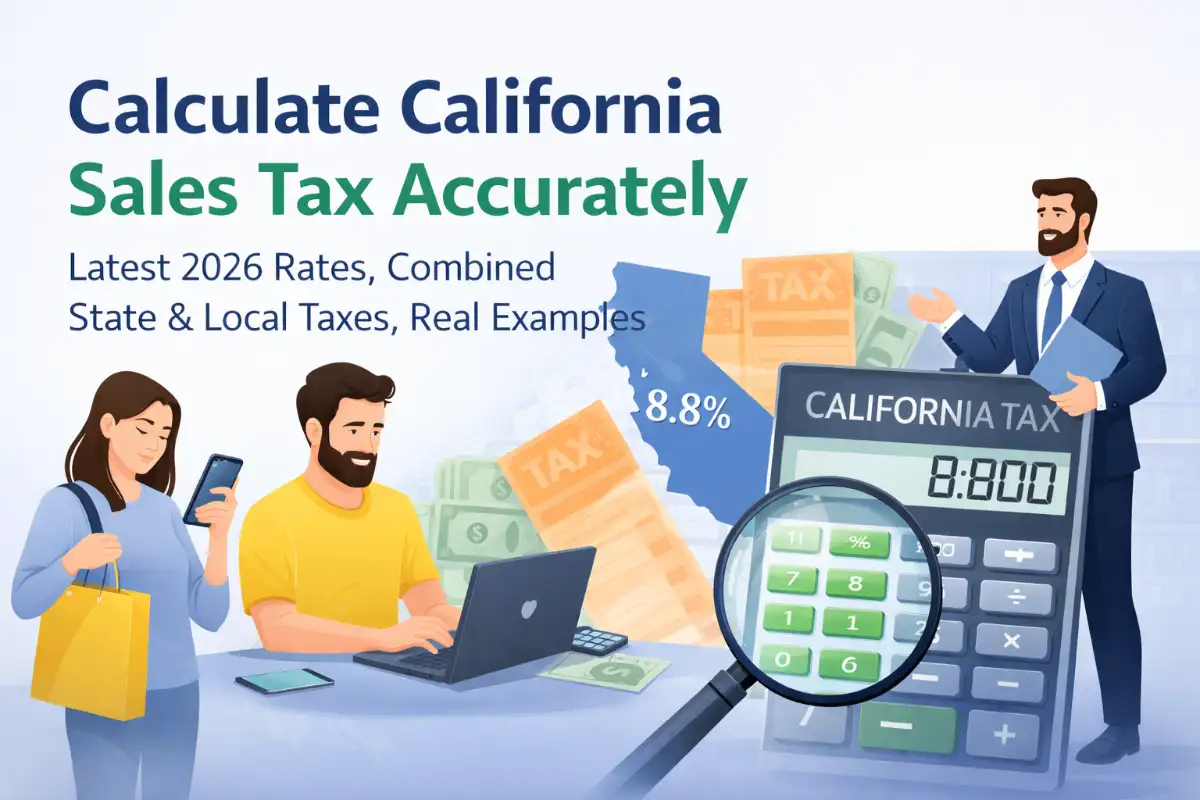
What Is California Sales Tax?
California sales tax is a consumption tax levied on the retail sale of tangible personal property and certain services within the state. It is administered by the California Department of Tax and Fee Administration (CDTFA) — not the IRS or any federal agency.
Unlike most US states that apply a single combined rate, California's sales tax is built from multiple stacked layers: a mandatory statewide base rate, a county-level local rate, and optional district taxes added by cities, counties, and special districts independently.
In 2026, California's minimum combined rate is 7.25% — the highest state base rate in the country. Most Californians pay more. Over 500 individual tax jurisdictions exist within California, meaning two stores on opposite sides of the same street can legally charge different rates if they sit in different tax districts.
Key Highlights
- California's statewide base rate is 7.25% — the highest state base rate in the US.
- The maximum combined rate in California reaches 10.75% in cities like Santa Monica and Union City.
- California splits its tax into state, county, and district components stacked on top of each other.
- Groceries and prescription drugsSales Tax on Prescription Drugs & OTC Medications by State (2026) are fully exempt from California sales tax.
- Clothing is fully taxable in California — unlike many other US states.
- The reverse formula works the same way: Pre-Tax Price = Total Price ÷ (1 + Tax Rate).
- Over 500 individual tax jurisdictions exist within California alone.
- Out-of-state online sellers with over $500,000 in California sales must collect and remit California tax.
- The CDTFA provides a free ZIP-code-level rate lookup tool at cdtfa.ca.gov.
- Late filing in California triggers a 10% penalty plus interest — one of the steeper structures in the US.
How California Sales Tax Is Structured
California sales tax is not a single flat percentage. It is a combination of four separate components that stack on top of each other to produce your final combined rate.
| Component | Rate | Where It Goes |
|---|---|---|
| State Tax | 6.00% | California General Fund |
| Mandatory Local Rate | 1.00% | County Transportation Funds |
| State Fiscal Recovery | 0.25% | Local Revenue Fund |
| Local District Taxes | 0.00% – 3.50% | City / County / Special District |
| Minimum Combined Rate | 7.25% | Statewide floor — everyone pays at least this |
The 7.25% is the absolute floor. Every district tax added on top brings your actual rate higher — which is why verifying your exact ZIP code rate matters more in California than in almost any other state.
California Sales Tax Rates by Major City (2026)
The combined rate varies significantly by location. Here are the verified combined ratesSales Tax by State 2026: Combined Rates, Exemptions & What You Owe for the most populated California cities as of 2026.
| City | County | State Rate | District Tax | Combined Rate |
|---|---|---|---|---|
| Santa Monica | Los Angeles | 7.25% | 3.50% | 10.75% |
| Union City | Alameda | 7.25% | 3.50% | 10.75% |
| Oakland | Alameda | 7.25% | 3.00% | 10.25% |
| Los Angeles | Los Angeles | 7.25% | 2.25% | 9.50% |
| San Jose | Santa Clara | 7.25% | 2.00% | 9.25% |
| Sacramento | Sacramento | 7.25% | 1.00% | 8.25% |
| San Francisco | San Francisco | 7.25% | 1.25% | 8.625% |
| San Diego | San Diego | 7.25% | 0.50% | 7.75% |
| Anaheim | Orange | 7.25% | 0.50% | 7.75% |
| Unincorporated Areas | Various | 7.25% | 0.00% | 7.25% |
Sources: CDTFA City and County Tax Rates — January 2026. Rates subject to change. Always verify at cdtfa.ca.gov.
The Reverse Sales Tax Formula
To find the pre-tax price from a California receipt, you need two numbers: the total you paid and the combined tax rate for that location. The formula is the same regardless of which California city you are in.
For Los Angeles at 9.50%, divide the total by 1.095. For Oakland at 10.25%, divide by 1.1025. For the base statewide rate of 7.25%, divide by 1.0725. The divisor always equals 1 plus the decimal form of the rate.
Step-by-Step: How to Calculate California Sales Tax in Reverse
Follow these five steps for any California purchase, at any combined rate.
Reverse Sales Tax Calculator
Global Reverse Tax Tool (VAT & GST) 2026 — Remove tax from any total and calculate the original price in seconds.
Real-World California Calculation Examples
Here are four practical scenarios that show how the reverse formula applies to real California purchases across different cities and tax rates.
Example 1: Electronics Purchase in Los Angeles
Scenario
You buy a laptop in Los Angeles. Total on receipt: $548.50. LA's combined rate is 9.50%. What was the pre-tax price?
Pre-tax price: $548.50 ÷ 1.095 = $500.92
Tax paid: $548.50 − $500.92 = $47.58
Verification: $500.92 × 9.50% = $47.59 ✓ Correct (1 cent rounding)
Example 2: Restaurant Bill in San Francisco
Scenario
A dinner in San Francisco totals $108.63. San Francisco's combined rate is 8.625%. Was the right tax applied?
Pre-tax price: $108.63 ÷ 1.08625 = $100.00
Tax paid: $108.63 − $100.00 = $8.63
Verification: $100.00 × 8.625% = $8.63 ✓ Correct
Example 3: Small Business Daily Reconciliation in San Jose
Scenario
A San Jose retail store records $10,925.00 in total daily sales. San Jose's combined rate is 9.25%. How much tax must be remitted to the CDTFA?
Net revenue: $10,925.00 ÷ 1.0925 = $10,000.00
Tax to remit to CDTFA: $10,925.00 − $10,000.00 = $925.00
The business reports $10,000 as taxable revenue and remits $925 to the CDTFA.
Example 4: Online Order Shipped to Oakland
Scenario
An online order is shipped to Oakland. Total charged: $220.55. Oakland's combined rate is 10.25%. What was the item price before tax?
Pre-tax price: $220.55 ÷ 1.1025 = $200.05
Tax paid: $220.55 − $200.05 = $20.50
Note: For online orders, California taxes based on the destination ZIP code — where the item ships to, not where the seller is located.
What Is Exempt from California Sales Tax?
Not everything sold in California is taxable. Understanding these exemptions can save consumers and businesses a significant amount, especially on high-volume purchases.
| Item Category | Taxable in California? | Notes |
|---|---|---|
| Unprepared groceries | Exempt | Fruits, vegetables, meat, bread, canned goods sold for home prep |
| Prescription medications | Exempt | All FDA-approved prescription drugs |
| Medical devices (prescribed) | Exempt | Devices prescribed by a licensed physician |
| Clothing | Taxable | Fully taxable — unlike New York which exempts clothing under $110 |
| Restaurant meals / hot food | Taxable | Any food sold hot, with utensils, or prepared for immediate consumption |
| Candy and snack foods | Taxable | Taxable even when sold in a grocery store |
| Bottled water (under 1 gallon) | Taxable | Containers of 1 gallon or more are exempt |
| Digital downloads / SaaS | Varies | Rules differ by product type — verify with CDTFA for specific items |
If your California receipt contains both taxable and exempt items — for example, groceries and clothing bought together — you cannot apply the reverse formula to the full total. Separate the taxable items first, then apply the formula only to the taxable subtotal shown on the receipt.
California vs. Other High-Tax States (2026)
| State | Base Rate | Max Combined Rate | Clothing Taxable? | Groceries Taxable? |
|---|---|---|---|---|
| California | 7.25% | 10.75% | Yes | No |
| Tennessee | 7.00% | 9.75% | Yes | Yes (reduced) |
| Louisiana | 4.45% | 11.45% | Yes | Yes (partial) |
| Illinois | 6.25% | 10.25% | Yes | No (as of 2026) |
| New York | 4.00% | 8.875% | No (under $110) | No |
| Texas | 6.25% | 8.25% | Yes | No |
| Oregon | 0.00% | 0.00% | N/A | N/A |
Pros and Cons of California's Sales Tax System
Pros
- Clear statewide floor — 7.25% is always the minimum
- Free ZIP-code rate lookup tool from CDTFA
- Strong exemptions for groceries and prescriptions
- High nexus threshold ($500,000) protects small online sellers
- Consistent state-level exemption rules reduce guesswork
- CDTFA provides clear guidance and filing support
Cons
- Highest base state rate in the US at 7.25%
- Over 500 local jurisdictions create extreme rate variation
- Maximum combined rate of 10.75% is among the highest nationally
- Clothing is fully taxable — unlike many other states
- District tax changes happen frequently without broad notice
- 10% late-filing penalty is steeper than most other states
Expert Tip — Umesh Kant Sharma
"The most common mistake California businesses make is using the city name to look up their tax rate instead of the exact ZIP code. In Los Angeles County alone, the combined rate can range from 7.25% in unincorporated areas to 10.25% in certain district zones. A $100,000-per-month seller using the wrong rate by even half a percent is under-collecting $500 in tax every single month — which adds up to a $6,000 shortfall by year end. Always use the CDTFA's ZIP code lookup before setting your tax configuration."
Who Should Use California Reverse Sales Tax Calculation?
There are no eligibility rules. Anyone who made a purchase in California can use this formula. It delivers the most value to these groups.
- California residents who want to verify receipts or track total sales taxes paid for potential SALT federal deductions
- Small business owners in California who collect sales tax and must remit it accurately to the CDTFA on a monthly or quarterly basis
- E-commerce sellers shipping goods to California customers who have crossed or are approaching the $500,000 economic nexusWhat Is Economic Nexus? Post-Wayfair Guide threshold
- Freelancers and self-employed workers in California tracking deductible business expenses on Schedule C
- Accountants and bookkeepers auditing California receipts across multiple city and district tax jurisdictions
- Tourists and visitors to California who want to understand why their receipt total was higher than the listed price — or verify no tax was charged on exempt items like groceries
In California, the tax rate is set by jurisdiction boundaries, not city limits. A large city like Los Angeles contains multiple overlapping tax districts with different rates. Always look up the rate by the exact street address or ZIP code using the CDTFA's free tool — never rely on the city name alone.
Risks and Limitations
Using only the state rate: California's 7.25% state rate is the floor, not the ceiling. Using only the state rate for a Los Angeles or Oakland purchase will understate the actual tax collected by 2–3 percentage points and produce an inaccurate pre-tax figure.
Mixed-rate receipts: A California receipt that includes both taxable items (clothing, electronics) and exempt items (unprepared food, prescription drugs) cannot be reverse-calculated as a single total. The formula must be applied only to the taxable subtotal.
District tax changes mid-year: California cities frequently pass new district taxes through ballot measures that take effect mid-year. A rate that was accurate in January may have changed by July. Always verify the rate in effect on the actual date of the transaction.
Rounding differences: California uses specific rounding rules at the point of sale. A reverse calculation may produce a figure one or two cents off from the receipt amount — this is normal and not an error.
Expert Insight and Market Impact
California is home to over 39 million people and generates more sales tax revenue than any other US state. The CDTFA collected over $90 billion in sales and use tax in the 2024–25 fiscal year — making accurate calculation and timely compliance a genuine business priority, not just an accounting formality.
The 2018 Supreme Court ruling in South DakotaSouth Dakota Sales Tax: 4.50% v. Wayfair fundamentally changed who must collect California sales tax. Before the ruling, only sellers with a physical California presence were obligated to collect. Today, any out-of-state business that exceeds $500,000 in annual California sales — regardless of location — must register with the CDTFA and begin collecting. This threshold is the highest in the US, but the compliance obligations once triggered are among the most complex.
For CaliforniaCalifornia Sales Tax: 7.25% consumers filing federal taxes, tracking sales taxes paid through reverse calculation has real dollar value. Californians who itemize federal deductions and do not also pay high state income taxes in the same year can elect to deduct state and local sales taxes instead — up to the $10,000 SALT cap. Accurate reverse-calculation records are the only reliable way to substantiate the full amount claimed.
Final Verdict
California sales taxA state and local consumption tax imposed on retail sales of tangible personal property and, in... starts at 7.25% and can reach 10.75% depending on exactly where you buy. The reverse formula — Pre-Tax Price = Total Price ÷ (1 + Tax Rate) — works identically in every California ZIP code. The only California-specific step is confirming your exact combined rate by address before you calculate.
For consumers, this means verifying your receipt rate matches the CDTFA's published rate for that location. For businesses, it means monitoring district tax changes that can shift your combined rate mid-year without a direct notice from the state. In both cases, the CDTFA's free address-level lookup tool is the most reliable starting point available — and the formula above does the rest in under 30 seconds.