What Is Reverse Sales Tax?
Reverse tax calculation is the process of finding the original price of a product or service before sales tax was applied.
When a business charges you a tax-inclusive total, the tax is already baked into the final number. To find the base price, you work backward using the known tax rate.
This is different from calculating tax on top of a price. Reverse tax calculation starts with the final number and works back to the pre-tax amount. It is also called "backing out the tax" or "tax extraction."
Key Highlights
- The US has no federal sales tax — each state sets its own rate.
- The average combined state and local US sales tax rate is 6.44% in 2026.
- Four states — Oregon, New Hampshire, Montana, and Delaware — charge 0% sales tax.
- Louisiana and Tennessee both carry the highest combined rate at 9.55%.
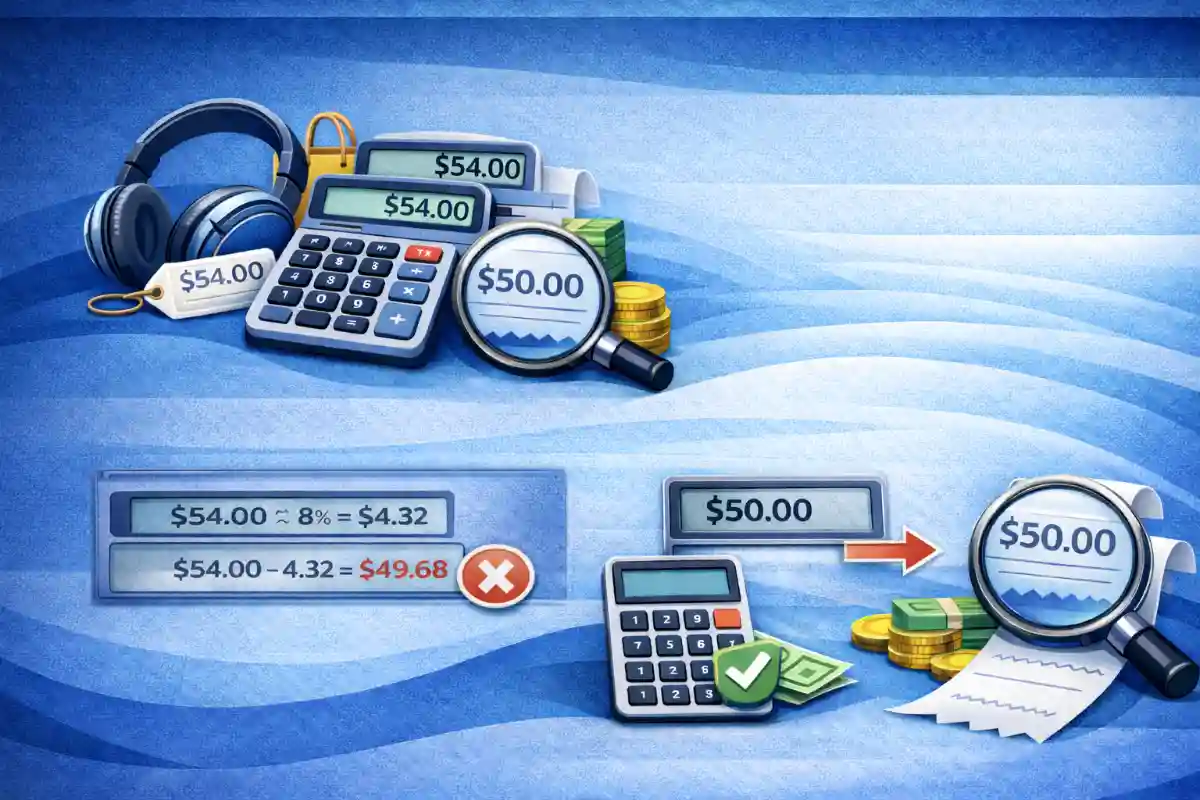
- The reverse formula: Pre-Tax Price = Total Price ÷ (1 + Tax Rate).
- Businesses, freelancers, and consumers all use this calculation daily.
The Reverse Sales Tax Formula
The math is straightforward once you know the formula.
Step-by-Step: How to Remove Tax from a Total Price
Follow these Six steps for any purchase, in any US state, at any sales tax rate.
That is it. You now have both the pre-tax price and the exact tax amount paid.
2026 US State Sales Tax Rates
Sales tax in the US is not a flat rate. It is a combination of state, county, city, and special district taxes stacked on top of each other.
| State | State Rate | Avg. Local Rate | Combined Rate | Level |
|---|---|---|---|---|
| Louisiana | 4.45% | 5.11% | 9.55% | Highest |
| Tennessee | 7.00% | 2.55% | 9.55% | Highest |
| Illinois | 6.25% | 2.49% | 8.74% | High |
| New York | 4.00% | 4.54% | 8.54% | High |
| California | 7.25% | 1.57% | 8.82% | High |
| Texas | 6.25% | 2.00% | 8.25% | Medium-High |
| Colorado | 2.90% | 4.99% | 7.89% | Medium |
| Florida | 6.00% | 1.01% | 7.01% | Medium |
| Oregon | 0.00% | 0.00% | 0.00% | No Tax |
| Montana | 0.00% | 0.00% | 0.00% | No Tax |
| New Hampshire | 0.00% | 0.00% | 0.00% | No Tax |
| Delaware | 0.00% | 0.00% | 0.00% | No Tax |
Sources: Tax Foundation, TaxRatesUSA.com — January 2026 data.
Real-World Calculation Scenarios
Below are real financial situations where reverse sales tax calculation helps verify receipts, reconcile business revenue, and correctly report taxes.
Scenario 1: Laptop Purchase in Texas
Texas Sales Tax — 8.25%
Total Price Paid
$1,082.50
Combined Tax Rate
8.25%
Divisor (1 + 0.0825)
1.0825
Pre-Tax Price ($1,082.50 ÷ 1.0825)
$1,000.00
Tax Paid
$82.50
Scenario 2: Restaurant Bill in Nashville, TN
Tennessee Sales Tax — 9.55%
Total Bill
$54.00
Combined Tax Rate
9.55%
Divisor (1 + 0.0955)
1.0955
Pre-Tax Price ($54.00 ÷ 1.0955)
$49.29
Tax Paid
$4.71
Scenario 3: Freelancer Invoice in Florida
Florida Sales Tax — 6.00%
Client Pays (Tax Inclusive)
$500.00
Combined Tax Rate
6.00%
Divisor (1 + 0.06)
1.06
Your Revenue ($500 ÷ 1.06)
$471.70
Tax to Remit to State
$28.30
Key Features and Benefits
For Consumers
Reverse tax calculation helps you verify your receipt is correct. If you were charged a different rate than what applies in your area, you can spot the discrepancy immediately without any special tools.
For Business Owners
When you record a sale, accounting rules often require you to separate revenue from tax collected. Reverse calculation makes this accurate and fast, reducing errors in financial statements.
For Freelancers and Self-Employed Workers
If you quote a tax-inclusive price to a client, you need to know exactly how much belongs to you and how much goes to the state. This formula gives you that answer instantly.
For Bookkeepers and Accountants
Clean financial records depend on accurate tax separation. This formula is used in every industry that handles sales tax, from retail to e-commerce to professional services.
Expert Tip — Umesh Kant Sharma
"One of the most common mistakes I see is businesses using only the state tax rate and ignoring local additions. In a city like Chicago, Illinois, the combined rate can reach over 10.25% — not the base 6.25% state rate. If you price products using the wrong rate, you end up either absorbing extra tax costs yourself or overcharging customers. Always verify the full combined rate for your specific ZIP code before running any reverse tax calculation."
Risks and Limitations
- Using the wrong rate: Sales tax rates vary by ZIP code, not just by state. Using an incorrect rate produces an inaccurate pre-tax figure.
- Mixed-rate purchases: If your receipt includes items taxed at different rates — for example, food versus electronics — you cannot apply a single formula to the whole total.
- Tax-exempt items: Groceries, prescription drugsSales Tax on Prescription Drugs & OTC Medications by State (2026), and clothing have varying tax treatments across states. Mixing taxable and non-taxable items complicates the calculation.
- Rate changes mid-year: States adjust sales tax rates frequently. Always confirm the rate that was in effect on the date of the transaction.
- Digital goods: Sales tax on streaming, software, and digital services expanded in several states in 2026, adding new complexity for online purchases.
Who Uses This Calculation?
Anyone who deals with tax-inclusive prices needs this formula. The most common users include:
- Everyday consumers who want to verify receipts or compare prices across state lines.
- Small business owners who collect sales tax and must remit it separately from revenue.
- Freelancers who quote all-inclusive prices and need to separate income from tax obligations.
- Accountants and bookkeepers who maintain accurate financial records for businesses.
- E-commerce sellers operating across multiple states, subject to economic nexusWhat Is Economic Nexus? Post-Wayfair Guide thresholds.
- Students and new graduates building basic financial literacy and tax awareness.
Method Comparison: Ways to Remove Tax from a Total
| Method | Best For | Tools Required | Accuracy | Cost |
|---|---|---|---|---|
| Manual Formula | One-time calculations | Calculator or pen | High (if rate is correct) | Free |
| Spreadsheet Formula | Repeated calculations | Excel or Google Sheets | High | Free |
| Online Tax Calculator | Quick lookups | Web browser | High | Free |
| Accounting Software | Business use | QuickBooks, Xero, etc. | Very High | $20–$80/mo |
| Point-of-Sale System | Retail and e-commerce | POS hardware/software | Very High | Varies |
For most individuals, the manual formula or a free online calculator is sufficient. For businesses processing many transactions daily, accounting software is the smarter long-term investment.
Pros and Cons
Pros
- Simple formula anyone can use
- Works for any tax rate in any state
- Completely free — no tools needed
- Useful for personal and business finances
- Confirms receipt accuracy instantly
- Separates tax from revenue for bookkeeping
Cons
- Requires knowing the exact tax rate
- Fails with mixed-rate receipts
- Rate changes cause errors if not updated
- Local rate lookup adds an extra step
- Does not apply to tax-exempt items
- Digital goods rules vary widely in 2026
Expert Insight and Market Impact
Sales tax complexity in the US is growing, not shrinking. Sales tax changes in 2026 expand digital taxability in several states, affecting streaming, software subscriptions, and SaaS products. This means more consumers and businesses face new tax line items on transactions that were previously tax-free.
IllinoisIllinois Sales Tax: 6.25% eliminated its 1% statewide grocery sales tax effective January 1, 2026, though many counties and municipalities replaced it with their own local levies on the same date — making ZIP-code-level verification more important than ever.
For businesses, the stakes are especially high. Using one incorrect rate in a high-volume jurisdiction can lead to under-collected tax, interest, penalties, and costly reconciliation work. The practical takeaway for 2026: always verify the combined rate — state plus local — before running any reverse tax calculation.
Final Verdict
Removing tax from a total price is one of the most practical financial calculations you can learn. The formula is simple: divide your total price by 1 plus the decimal tax rate. The result is your pre-tax price. Subtract to find exactly how much tax you paid. In 2026, with sales taxA state and local consumption tax imposed on retail sales of tangible personal property and, in... rates shifting across dozens of states and localities, using the correct combined rate for your specific ZIP code is the single most important step to getting this right.