What Is Economic Nexus?
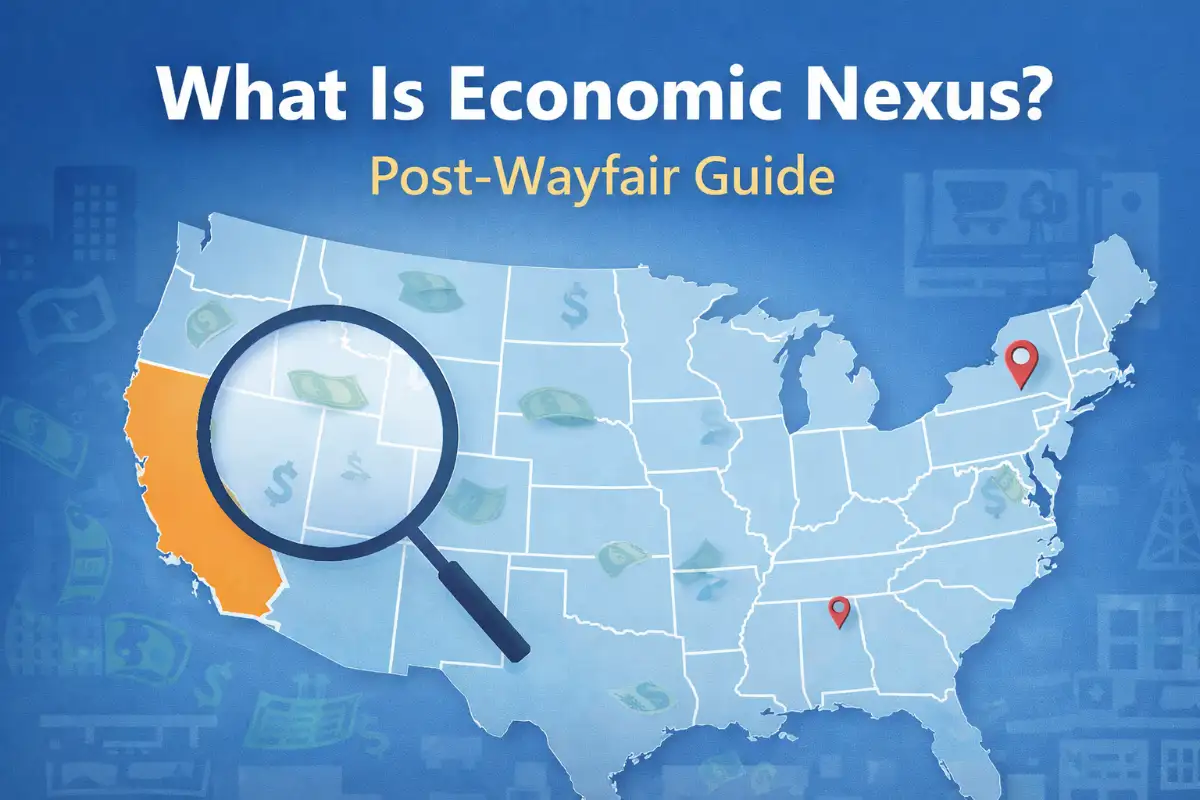
Nexus is a legal term meaning a sufficient connection between a business and a state that requires that business to collect and remit sales tax on sales made to customers in that state.
Traditionally, nexus was purely physical — you needed a store, warehouse, office, employee, or inventory in a state before that state could require you to collect its sales tax. A business operating entirely from one state could sell nationally and only collect sales tax in its home state.
Economic nexus changes that entirely. Under economic nexus laws, a sufficient volume of sales into a state — measured in dollars, transactions, or both — creates a tax collection obligation, even with zero physical presence.
In plain terms: if you sell enough into a state, that state now considers you a local business for sales tax purposes — regardless of where you actually operate.
Key Highlights
- Before Wayfair, only physical presence in a state triggered a sales tax obligation
- The Supreme Court’s 2018 Wayfair ruling allowed states to tax based on economic activity alone
- As of 2026, all 45 sales-tax-collecting states have enacted economic nexus laws
- The most common threshold is $100,000 in sales OR 200 transactions in a single state per year
- Missouri was the last state to enact economic nexus — effective January 1, 2023
- Marketplace facilitators like Amazon and Etsy now collect sales tax on behalf of sellers in most states
- Crossing a threshold means you must register, collect, file, and remit — in that state
- Penalties for non-compliance include back taxes, interest, and fines going back years
The Old Rule vs. The Wayfair Decision
To understand economic nexus, you need to understand the two Supreme Court cases that define it.
Quill Corp. v. North Dakota (1992) — The Old Rule
In 1992, the Supreme Court ruled in Quill Corp. v. North Dakota that a state could only require a business to collect sales tax if that business had a physical presence in the state. This ruling was based on the Constitution’s Commerce Clause, which limits how much states can burden interstate commerce.
For 26 years, this physical presence standard protected remote sellers — first mail-order catalogs, then internet retailers — from multi-state sales tax obligations. A business in Oregon could sell $5 million into Texas and collect zero Texas sales tax, legally.
South Dakota v. Wayfair, Inc. (2018) — Everything Changed
South Dakota passed a law in 2016 requiring out-of-state sellers to collect sales tax if they exceeded $100,000 in sales or 200 transactions into the state annually. Wayfair, Overstock, and Newegg challenged the law as unconstitutional under Quill.
The Supreme Court ruled 5–4 in favor of South Dakota on June 21, 2018. Quill was overturned. Economic nexus became constitutional. Every state with a sales tax moved quickly to enact its own threshold laws.
Within two years of the ruling, all 45 sales-tax states had active economic nexus legislation. Missouri, the last holdout, enacted its law effective January 1, 2023.
How Economic Nexus Works — Step by Step
Follow these six steps to understand and manage your economic nexus obligations in 2026.
Reverse Sales Tax Calculator
Global Reverse Tax Tool (VAT & GST) 2026 — Remove tax from any total and calculate the original price in seconds.
Economic Nexus Thresholds by State (2026)
The table below shows the current economic nexus threshold for all 45 sales-tax states. Always verify directly with each state’s department of revenue, as thresholds can change.
| State | Sales Threshold | Transaction Threshold | Measurement Period |
|---|---|---|---|
| Alabama | $250,000 | None | Previous calendar year |
| Alaska* | $100,000 | 200 transactions | Previous or current year |
| Arizona | $100,000 | None | Previous or current year |
| Arkansas | $100,000 | 200 transactions | Previous or current year |
| California | $500,000 | None | Previous or current year |
| Colorado | $100,000 | None | Previous or current year |
| Connecticut | $100,000 | 200 transactions | Previous 12 months |
| Florida | $100,000 | None | Previous calendar year |
| Georgia | $100,000 | 200 transactions | Previous or current year |
| Hawaii | $100,000 | 200 transactions | Previous or current year |
| Idaho | $100,000 | None | Previous or current year |
| Illinois | $100,000 | 200 transactions | Previous 12 months |
| Indiana | $100,000 | 200 transactions | Previous or current year |
| Iowa | $100,000 | None | Previous or current year |
| Kansas | $100,000 | None | Previous or current year |
| Kentucky | $100,000 | 200 transactions | Previous or current year |
| Louisiana | $100,000 | 200 transactions | Previous 12 months |
| Maine | $100,000 | 200 transactions | Previous or current year |
| Maryland | $100,000 | 200 transactions | Previous or current year |
| Massachusetts | $100,000 | None | Previous calendar year |
| Michigan | $100,000 | 200 transactions | Previous calendar year |
| Minnesota | $100,000 | 200 transactions | Previous 12 months |
| Mississippi | $250,000 | None | Previous 12 months |
| Missouri | $100,000 | None | Previous 12 months |
| Nebraska | $100,000 | 200 transactions | Previous or current year |
| Nevada | $100,000 | 200 transactions | Previous or current year |
| New Jersey | $100,000 | 200 transactions | Previous or current year |
| New Mexico | $100,000 | None | Previous calendar year |
| New York | $500,000 | 100 transactions | Previous 4 quarters |
| North Carolina | $100,000 | 200 transactions | Previous or current year |
| North Dakota | $100,000 | None | Previous or current year |
| Ohio | $100,000 | 200 transactions | Previous or current year |
| Oklahoma | $100,000 | None | Previous or current year |
| Pennsylvania | $100,000 | None | Previous 12 months |
| Rhode Island | $100,000 | 200 transactions | Previous calendar year |
| South Carolina | $100,000 | None | Previous or current year |
| South Dakota | $100,000 | None | Previous or current year |
| Tennessee | $100,000 | None | Previous 12 months |
| Texas | $500,000 | None | Previous 12 months |
| Utah | $100,000 | 200 transactions | Previous or current year |
| Vermont | $100,000 | 200 transactions | Previous 12 months |
| Virginia | $100,000 | 200 transactions | Previous or current year |
| Washington | $100,000 | None | Previous or current year |
| West Virginia | $100,000 | 200 transactions | Previous or current year |
| Wisconsin | $100,000 | None | Previous or current year |
| Wyoming | $100,000 | 200 transactions | Previous or current year |
*Alaska has no state sales tax but some localities have enacted economic nexus rules independently. Sources: State Departments of Revenue, Tax Foundation — January 2026. Always verify with the official state authority.
Real-World Scenarios
Here are three practical examples showing how economic nexus works in practice for different types of sellers.
Scenario 1: Small E-Commerce Seller — Under the Threshold
Situation
Sarah runs an online jewelry business from Oregon. Last year she sold $85,000 to California customers and completed 180 transactions into Illinois.
California threshold: $500,000 — Sarah is well under. No nexus.
Illinois threshold: $100,000 OR 200 transactions — Sarah is under both. No nexus.
Result: Sarah collects sales tax only in Oregon (her home state). But she must continue monitoring — if either threshold is crossed mid-year, nexus is established immediately.
Scenario 2: Growing Business — Threshold Crossed Mid-Year
Situation
Marcus sells home goods online from his Florida warehouse. In August 2025, his Texas sales crossed $500,000 for the rolling 12-month period.
Texas threshold: $500,000 — crossed in August.
Result: Economic nexus established in Texas as of that date. Marcus must register with the Texas Comptroller, configure his store to collect the correct combined rate per ZIP code, and begin filing Texas returns on schedule.
Tax to remit example — Texas 8.25% rate:
Total collected: $1,082.50 ÷ 1.0825 = $1,000.00 revenue — Tax to remit: $82.50
Scenario 3: SaaS Business — Digital Products
Situation
Priya runs a project management SaaS business with customers in 30 states. No physical product, no shipping — everything is delivered digitally.
Key issue: Most states now explicitly include SaaS, digital downloads, and software subscriptions as taxable. Economic nexus applies to digital productsSales Tax on Digital Products & Software the same way it applies to physical goods.
Result: Priya must evaluate her revenue in each state against that state’s threshold, confirm taxability of her software category per state, and register wherever she has crossed the threshold.
Physical Nexus vs. Economic Nexus
| Feature | Physical Nexus | Economic Nexus |
|---|---|---|
| What triggers it | Office, warehouse, employee, inventory in state | Dollar volume or transaction count into state |
| Established since | Pre-1992 (Quill ruling) | Post-2018 (Wayfair ruling) |
| Applies to | All businesses with physical presence | Remote sellers and e-commerce |
| Can you avoid it? | Only by removing physical presence | Only by staying under state thresholds |
| Threshold | None — any presence creates nexus | Typically $100,000 or 200 transactions |
| Most affects | Brick-and-mortar with multiple locations | Online sellers, SaaS, digital goods |
| Example | Your warehouse in Texas | Selling $150,000 of goods to Texas customers |
Marketplace Facilitator Laws
One of the most significant post-Wayfair developments is the rise of marketplace facilitator laws. As of 2026, all 45 sales-tax states require large marketplace platforms to collect and remit sales tax on behalf of their third-party sellers.
If you sell through Amazon, Etsy, eBay, or Walmart Marketplace, the platform itself collects and remits sales tax for your marketplace sales in most states — you do not need to do it yourself for those specific transactions.
However, this protection applies only to sales made through the marketplace. If you also sell through your own website or any other channel, you are still fully responsible for those sales tax obligations independently.
| Platform | Collects Tax on Your Behalf? | Applies To |
|---|---|---|
| Amazon | Yes — all 45 states | Marketplace sales only |
| Etsy | Yes — all 45 states | Marketplace sales only |
| eBay | Yes — all 45 states | Marketplace sales only |
| Walmart Marketplace | Yes — all 45 states | Marketplace sales only |
| Your own website | No | You are fully responsible |
| Shopify store | No (tools available) | You are fully responsible |
Pros and Cons
For State Governments
- Recovers billions in previously uncollected revenue
- Levels the playing field between local and online retailers
- Creates a stronger audit trail for digital commerce
- Clear, measurable thresholds — easy to enforce
For Online Businesses
- Multi-state registration and filing is costly and time-consuming
- Different thresholds and filing frequencies per state
- Retroactive obligations create unexpected back-tax liability
- Software compliance costs rise after threshold crossings
Expert Tip — Umesh Kant Sharma
"The single biggest mistake I see e-commerce businesses make after Wayfair is waiting until they get a notice from a state before registering. By the time a state contacts you, you are already delinquent — and back taxes, interest, and penalties often exceed what the business would have paid in collected tax. Set up automatic threshold monitoring from day one. If your platform cannot generate state-by-state sales reports, that is your first compliance problem to solve."
What Happens If You Ignore Economic Nexus?
Non-compliance with economic nexus laws carries real financial consequences that grow over time.
Back taxes: States can require you to remit all the sales tax you should have collected going back to the date you crossed the threshold — sometimes years. You owe this amount even if you never collected it from customers.
Interest: Most states charge 8–12% annual interest on unpaid balances, calculated from the original due date.
Penalties: Late registration, late filing, and failure to collect all carry separate penalty structures. Penalties of 10–25% of unpaid tax are common.
Audit risk: States increasingly share data with each other and with the IRS. Payment processors, marketplace platforms, and state revenue agencies actively identify high-volume sellers who are not registered. A Voluntary Disclosure Agreement (VDA) — coming forward before a state contacts you — is almost always more favorable than the outcome of a state-initiated audit.
Economic Nexus and Reverse Sales Tax Calculation
Once you are registered and collecting sales tax in a state, reverse salesWhat Is Reverse Sales Tax? Complete Guide tax calculation becomes a daily operational tool. When a customer pays a tax-inclusive total, you need to separate your actual revenue from the tax you collected on the state’s behalf.
Example — Texas Seller at 8.25% Combined Rate
Total collected from customer: $1,082.50
Divisor (1 + 0.0825): 1.0825
Your pre-tax revenue: $1,082.50 ÷ 1.0825 = $1,000.00
Sales tax to remit to Texas: $1,082.50 − $1,000.00 = $82.50
Use our Reverse Sales Tax Calculator to run this calculation instantly for any state and any rate.
Expert Insight and Market Impact
Economic nexus enforcement is accelerating in 2026. Several states have increased audit activity targeting high-volume e-commerce sellers, particularly in electronics, clothing, and digital products — categories where nexus obligations are most commonly missed.
MissouriMissouri Sales Tax: 4.23%’s economic nexus law, effective January 1, 2023, completed the nationwide rollout. All 45 sales-tax states now have active economic nexus rules. There is no remaining state that a remote seller can treat as a compliance-free zone above the applicable threshold.
For digital product sellers — SaaS businesses, online course creators, software developers, and streaming services — the post-Wayfair compliance landscape is especially complex. States differ significantly on whether specific digital product categories are taxable at all, and those taxability rules interact with nexus thresholds in ways that require careful state-by-state analysis.
Businesses that rely on manual tracking and spreadsheets to manage multi-state sales taxA state and local consumption tax imposed on retail sales of tangible personal property and, in... compliance are increasingly exposed. Tax automation software that monitors thresholds, calculates rates at the ZIP-code level, and files returns automatically has moved from a luxury to a practical necessity for any business selling across more than three or four states.
Final Verdict
Economic nexus fundamentally changed the rules of online selling in the United States. The era when a remote seller could operate nationwide while collecting sales tax only in its home state ended with the Wayfair decision in 2018. Today, selling enough into a state — typically $100,000 in annual sales or 200 transactions — creates a legal obligation to register, collect, file, and remit in that state, regardless of where your business is physically located.
The rules are clear, thresholds are measurable, and the compliance tools available in 2026 make multi-state sales tax management more manageable than ever before. The risk of ignoring economic nexus — back taxes, interest, penalties, and audit exposure — far outweighs the cost of getting compliant.
Monitor your thresholds, register proactively, and use accurate rate data at the ZIP-code level. That is the entire economic nexus compliance strategy for 2026.