

What Is Sales Tax and Why Do Some States Not Have It?
Sales tax is a consumption tax imposed by state and local governments on the sale of goods and certain services. It is collected by the seller at the point of purchase and remitted to the state government. Unlike a value-added tax (VAT), US sales tax is applied only at the final retail stage — not at each step of the supply chain.
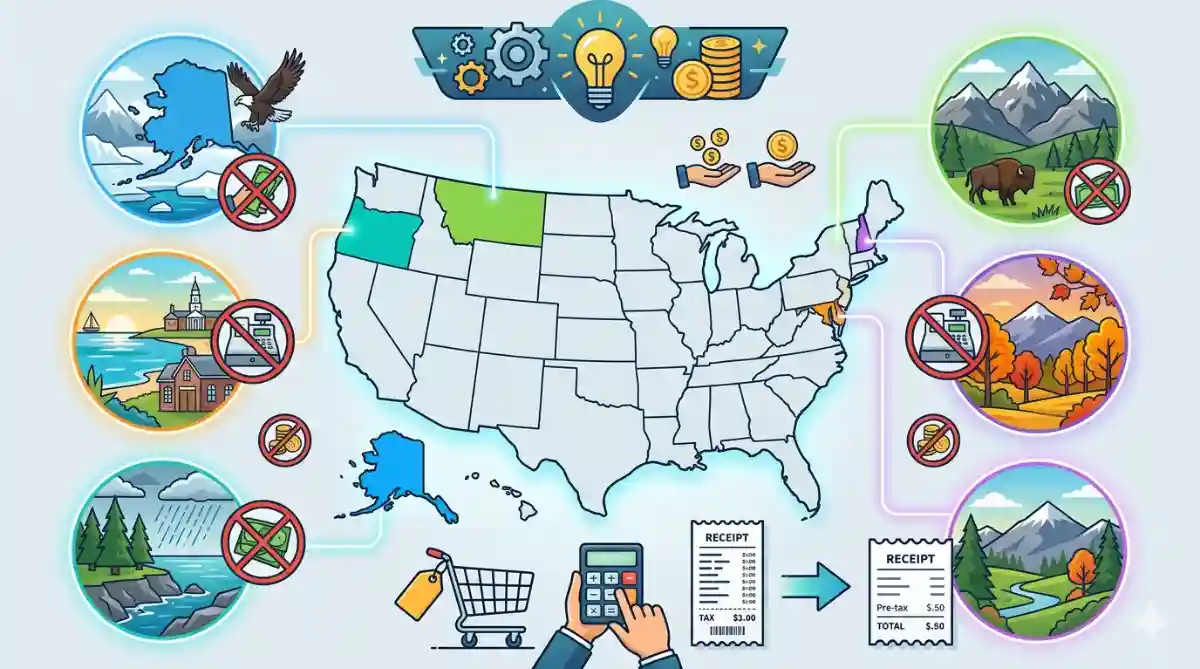
The United States has no national sales tax. Each of the 50 states independently decides whether to impose a sales tax and at what rate. This creates a wide range of tax environments — from states with combined rates exceeding 12% to five states that collect no sales tax at the state level at all.
The decision not to impose a sales tax is a deliberate policy choice. States without a sales tax typically rely more heavily on other revenue sources — income tax, property tax, corporate tax, natural resource extraction tax, or excise taxes on specific goods. The trade-off is a matter of ongoing political debate in each state, and every attempt to introduce a sales tax in Oregon and New Hampshire, for example, has been defeated by voters.
Key Highlights
- Five states have no statewide sales tax as of 2026: Alaska, Delaware, Montana, New Hampshire, and Oregon.
- Alaska is the only one of the five that allows local municipalities to impose their own sales taxes — up to 7.5% in some areas.
- Delaware, Montana, New Hampshire, and Oregon have no sales tax at any level — state or local.
- Louisiana has the highest combined sales tax rate in the country, reaching up to 12.95% in some parishes.
- Online purchasesDo Online Purchases Qualify for Sales Tax Holidays? (2026) are generally subject to the buyer's destination state rate since the 2018 South Dakota v. Wayfair Supreme Court ruling.
- Reverse sales tax formula: Pre-Tax Price = Total Price ÷ (1 + Tax Rate).
- Shopping in a no-sales-tax state can save hundreds of dollars on high-value purchases such as electronics, appliances, and vehicles.
- Most states have a "use tax" that technically applies to goods purchased in other states — though enforcement on personal purchases is rare.
The 5 States With No Sales Tax — At a Glance
The following table summarizes the five no-sales-tax states, their local tax situation, and the maximum rate a consumer might encounter.
| State | Statewide Sales Tax | Local Sales Tax Allowed? | Maximum Combined Rate | Primary Revenue Alternative |
|---|---|---|---|---|
| Alaska | 0% | Yes — up to 7.5% | 7.5% | Oil and gas taxes |
| Delaware | 0% | No | 0% | Corporate franchise taxes |
| Montana | 0% | No | 0% | Income tax, natural resources |
| New Hampshire | 0% | No | 0% | Property tax, business taxes |
| Oregon | 0% | No | 0% | Personal and corporate income tax |
Alaska — No State Tax, But Local Taxes Apply
Alaska is the largest US state by land area and one of the most unusual in its tax structure. There is no statewide sales tax and no statewide personal income tax — making Alaska one of only two states in the country with neither. (The other is Wyoming, which does have a sales tax.)
However, Alaska's cities and boroughs are permitted to levy their own local sales taxes, and many do. Rates vary widely by municipality. Juneau charges 5%, Sitka charges 6%, and some smaller jurisdictions reach as high as 7.5%. Consumers in Anchorage — Alaska's largest city — currently pay no local sales tax either, making it a true zero-rate shopping environment.
Alaska funds its state government primarily through taxes on oil and gas extraction. The Alaska Permanent Fund — a sovereign wealth fund established in 1976 — holds revenues from oil royalties and pays an annual dividend to every eligible Alaska resident. This unique structure has allowed Alaska to maintain its no-tax policy even as oil revenues have fluctuated significantly over the decades.
If you are visiting or shopping in Alaska, always verify the local rate for the specific city or borough where you are making your purchase. Anchorage and most rural areas outside incorporated municipalities charge zero local sales tax. Cities like Juneau and Sitka charge 5–6%. The same purchase can carry a very different total price depending on where in Alaska you buy it.
Delaware — True Zero Rate, No Exceptions
Delaware has no state sales tax and no local sales tax — making it one of the cleanest no-tax shopping environments in the country. Every retail purchase in Delaware is free from sales tax, with no exceptions based on municipality.
Delaware's no-sales-tax policy has made it a popular shopping destination for residents of neighboring high-tax states. Pennsylvania has a 6% state rate. New Jersey has a 6.625% rate. Maryland charges 6%. The result is substantial cross-border shopping activity, particularly in areas near the Pennsylvania and New Jersey borders.
Delaware compensates for the absence of a sales tax through several other revenue streams. Corporate franchise taxes are a major source — Delaware is the legal home of more than 60% of Fortune 500 companies due to its business-friendly legal environment, generating significant franchise tax revenue without a large corporate physical presence. Delaware also levies a gross receipts tax on businesses (a tax on total revenue, not profit), along with personal income taxes ranging from 0% to 6.6%.
Montana — No Tax, High Natural Beauty
Montana has no state sales tax and no local sales tax. With a relatively small population spread across a large geographic area, Montana's government relies primarily on property taxes, individual income taxes (graduated from 1% to 6.75%), and revenue from natural resource industries including coal mining, timber, and agriculture.
Montana's lack of a sales tax makes it attractive to residents near its borders with Idaho and Wyoming — both of which have sales taxes. Border-town shopping is a common economic pattern, particularly for large purchases like vehicles, farm equipment, and building materials.
Unlike New Hampshire and Oregon, which have faced repeated ballot initiatives to introduce a sales tax, Montana's no-sales-tax status has been relatively stable and faces less political pressure to change, partly due to the state's strong libertarian and anti-tax political culture.
New Hampshire — Live Free or Die, Pay No Sales Tax
New Hampshire is the only state in the northeastern United States with no general sales tax and no broad-based personal income tax on wages. The state's official motto — "Live Free or Die" — reflects a political philosophy that extends to its tax structure. Every attempt to introduce a sales tax in New Hampshire has failed, often decisively.
New Hampshire funds its government primarily through property taxes (among the highest in the country on a per-capita basis), meals and rooms taxes, motor vehicle fees, alcohol taxes, and business enterprise taxes. The combination results in a total tax burden that is moderate overall, despite the absence of the two most visible consumer taxes.
New Hampshire's location in the northeast makes it a major cross-border shopping destination. Massachusetts, with a 6.25% sales tax and higher income taxes, is directly to the south. Many Massachusetts residents regularly cross the border for large purchases — electronics, appliances, furniture, clothing — to take advantage of New Hampshire's zero-rate environment.
Oregon — Voters Have Said No to Sales Tax Repeatedly
Oregon has no state or local sales tax. Unlike some no-tax states that simply never introduced a sales tax, Oregon has actively and repeatedly rejected it. Voters have turned down sales tax proposals at least nine times since 1933. The most recent significant effort, in 1993, failed with approximately 75% of voters opposing it.
Oregon funds its government through a relatively high personal income tax — rates range from 4.75% to 9.9% — and a corporate minimum tax. The state consistently ranks among the higher income-tax states in the country, which is the deliberate trade-off Oregonians have chosen in exchange for no sales tax.
Oregon's border with Washington state — which has a 6.5% sales tax but no personal income tax — creates a classic cross-border economic dynamic. Washington residents cross into Oregon to avoid sales tax on large purchases. Oregon residents work in Washington to benefit from its lack of income tax while living in Oregon's no-sales-tax environment. Both behaviors are common and well-documented.
How Do These States Fund Government Without Sales Tax?
Eliminating or never introducing a sales tax does not mean a state collects less total revenue — it means the revenue comes from different sources. The five no-sales-tax states use varying combinations of the following:
| Revenue Source | Alaska | Delaware | Montana | New Hampshire | Oregon |
|---|---|---|---|---|---|
| Personal Income Tax | No | Yes (2.2%–6.6%) | Yes (1%–6.75%) | Limited (dividends/interest only) | Yes (4.75%–9.9%) |
| Corporate / Business Tax | Yes | Yes — major source | Yes | Yes | Yes |
| Property Tax | Yes (local) | Yes | Yes | Yes — primary source | Yes |
| Natural Resource Revenue | Yes — primary source | No | Yes — significant | No | Limited |
| Excise Taxes (fuel, alcohol, tobacco) | Yes | Yes | Yes | Yes | Yes |
Reverse Sales Tax — How to Calculate Your Pre-Tax Price
When a price tag already includes sales tax — or when you want to calculate what a purchase would cost in a different state — the reverse sales tax formula is the tool you need.
Step-by-Step: How to Use the Reverse Sales Tax Formula
Follow these four steps to find the pre-tax price from any tax-inclusive total.
Reverse Sales Tax Calculator
Global Reverse Tax Tool (VAT & GST) 2026 — Remove tax from any total and calculate the original price in seconds.
Real-World Savings Examples — No-Tax States vs. High-Tax States
Here are four practical examples showing how much a consumer saves by purchasing in a no-sales-tax state compared to high-rate states.
Example 1: Laptop Purchase — Oregon vs. California
Scenario
You purchase a laptop with a listed pre-tax price of $1,499 in two different states.
Oregon (0% sales tax): $1,499.00 total
Los Angeles, California (10.25% combined): $1,499 × 1.1025 = $1,652.65 total
Savings by purchasing in Oregon: $153.65
Example 2: Car Purchase — Montana vs. Tennessee
Scenario
You purchase a used car listed at $28,000 pre-tax.
Montana (0% sales tax): $28,000.00 total (plus registration fees)
Memphis, Tennessee (9.75% combined): $28,000 × 1.0975 = $30,730.00 total
Savings by purchasing in Montana: $2,730.00
Example 3: Electronics — New Hampshire vs. Massachusetts
Scenario
You buy a TV listed at $850 and a home appliance listed at $620 — total pre-tax: $1,470.
New Hampshire (0% sales tax): $1,470.00 total
Massachusetts (6.25%): $1,470 × 1.0625 = $1,561.88 total
Savings by purchasing in New Hampshire: $91.88
Example 4: Furniture — Delaware vs. New Jersey
Scenario
Furniture order with a pre-tax total of $3,200.
Delaware (0% sales tax): $3,200.00 total
New Jersey (6.625%): $3,200 × 1.06625 = $3,412.00 total
Savings by purchasing in Delaware: $212.00
Sales Tax Rates — All 50 States Reference Table (2026)
The table below provides state sales tax rates and maximum combined ratesSales Tax by State 2026: Combined Rates, Exemptions & What You Owe (including local taxes) for all 50 US states as of 2026, based on data from the Tax Foundation and individual state revenue departments.
| State | State Rate | Max Combined Rate | Notes |
|---|---|---|---|
| Alabama | 4% | 13.5% | High local rates in some counties |
| Alaska | 0% | 7.5% | No state tax; local taxes apply |
| Arizona | 5.6% | 11.2% | |
| Arkansas | 6.5% | 12.625% | |
| California | 7.25% | 10.75% | Highest base state rate in the country |
| Colorado | 2.9% | 11.2% | Lowest base state rate among taxing states |
| Connecticut | 6.35% | 6.35% | No local sales tax |
| Delaware | 0% | 0% | No tax at any level |
| Florida | 6% | 8.5% | |
| Georgia | 4% | 9% | |
| Hawaii | 4% | 4.5% | General excise tax, not a traditional sales tax |
| Idaho | 6% | 9% | |
| Illinois | 6.25% | 11% | |
| Indiana | 7% | 7% | No local sales tax |
| Iowa | 6% | 7% | |
| Kansas | 6.5% | 11.5% | |
| Kentucky | 6% | 6% | No local sales tax |
| Louisiana | 4.45% | 12.95% | Highest combined rate in the country |
| Maine | 5.5% | 5.5% | No local sales tax |
| Maryland | 6% | 6% | No local sales tax |
| Massachusetts | 6.25% | 6.25% | No local sales tax |
| Michigan | 6% | 6% | No local sales tax |
| Minnesota | 6.875% | 8.875% | |
| Mississippi | 7% | 8% | |
| Missouri | 4.225% | 11.988% | |
| Montana | 0% | 0% | No tax at any level |
| Nebraska | 5.5% | 8% | |
| Nevada | 6.85% | 8.375% | |
| New Hampshire | 0% | 0% | No tax at any level |
| New Jersey | 6.625% | 12.625% | |
| New Mexico | 5% | 9.0625% | Gross receipts tax structure |
| New York | 4% | 8.875% | NYC has highest local rate in state |
| North Carolina | 4.75% | 7.5% | |
| North Dakota | 5% | 8.5% | |
| Ohio | 5.75% | 8% | |
| Oklahoma | 4.5% | 11.5% | |
| Oregon | 0% | 0% | No tax at any level |
| Pennsylvania | 6% | 8% | |
| Rhode Island | 7% | 7% | No local sales tax |
| South Carolina | 6% | 9% | |
| South Dakota | 4.2% | 7.2% | |
| Tennessee | 7% | 10% | Taxes groceries at reduced rate |
| Texas | 6.25% | 8.25% | |
| Utah | 6.1% | 9.05% | |
| Vermont | 6% | 7% | |
| Virginia | 5.3% | 7% | |
| Washington | 6.5% | 10.6% | No personal income tax |
| West Virginia | 6% | 7% | |
| Wisconsin | 5% | 7.9% | |
| Wyoming | 4% | 8% | No personal income tax |
Source: Tax Foundation State and Local Sales Tax Rates, 2026. Rates are subject to change. Always verify with the official state revenue department before making financial decisions.
No-Sales-Tax States — Side-by-Side Comparison
| Feature | Alaska | Delaware | Montana | New Hampshire | Oregon |
|---|---|---|---|---|---|
| Statewide Sales Tax | None | None | None | None | None |
| Local Sales Tax | Up to 7.5% | None | None | None | None |
| Personal Income Tax | None | Yes | Yes | Limited | Yes (high) |
| Border Shopping Appeal | Limited (remote) | Very high (NJ, PA, MD nearby) | Moderate | Very high (MA nearby) | Very high (WA nearby) |
| Primary Revenue Source | Oil and gas | Corporate franchise | Income + natural resources | Property tax | Income tax |
| Voter Opposition to Sales Tax | Moderate | Strong | Strong | Very strong | Very strong (9+ rejections) |
Pros and Cons of Living in a No-Sales-Tax State
Advantages for Consumers
- Direct savings on every taxable purchase — no tax added at the register
- Significant savings on large purchases: vehicles, electronics, furniture, appliances
- Simpler budgeting — the listed price is the price you pay
- Attracts businesses and retail activity due to lower consumer cost
- Cross-border shoppers from high-tax neighboring states boost local economies
- No bookkeeping burden for small businesses selling exclusively in-state
Trade-offs and Limitations
- State typically compensates with higher income taxes, property taxes, or business taxes
- Online purchases are still taxed at the buyer's destination rate regardless of seller location
- Alaska residents still face local taxes depending on municipality
- Use tax technically applies to goods purchased in other states and brought home
- No guarantee that total tax burden is lower — just differently structured
- Services, not just goods, are taxed differently across states regardless of the sales tax rate
Expert Tip — Ritu Sharma
"The most common mistake consumers make is assuming that a no-sales-tax state automatically means a lower overall tax burden. It does not. Oregon residents pay among the highest income tax rates in the country. New Hampshire homeowners face some of the highest property tax bills per capita in the US. What no-sales-tax states offer is a different tax structure — one where the cost is less visible at the point of purchase but shows up elsewhere. For large one-time purchases like vehicles or appliances, the savings are real and significant. For a full cost-of-living comparison, you need to look at the complete tax picture: income, property, and sales together."
Who Benefits Most from No-Sales-Tax States?
Not every consumer or business benefits equally from no-sales-tax states. The advantage is largest for those in the following situations:
- Large-purchase buyers — anyone buying a car, boat, RV, high-end electronics, or major appliances where the dollar savings are significant
- Small business owners who buy substantial amounts of taxable equipment, supplies, or inventory
- Residents near state borders — Massachusetts residents near New Hampshire, Washington residents near Oregon, and New Jersey or Pennsylvania residents near Delaware have the easiest access to zero-rate shopping
- Online shoppers who buy from sellers located in no-tax states (though the Wayfair ruling limits this advantage significantly for most transactions)
- Tourists and travelers who can time large purchases to coincide with visits to no-tax states
- Business accountants and bookkeepers who benefit from simpler reconciliation when tracking purchases made in zero-rate states
Since the 2018 South Dakota v. Wayfair Supreme Court decision, online retailers are generally required to collect sales tax based on the buyer's location — not the seller's. This means that buying online from a Delaware or Oregon-based retailer does not exempt you from your own state's sales tax if the seller has established economic nexusWhat Is Economic Nexus? Post-Wayfair Guide in your state. The zero-rate advantage for online shopping has largely been eliminated for purchases from retailers above economic nexus thresholds.
Common Misconceptions About No-Sales-Tax States
Misconception 1 — "No sales tax means the lowest total tax burden." Not necessarily. Oregon's income tax rates are among the highest in the country. New HampshireNew Hampshire Sales Tax: 0.00%'s property taxes are among the highest per capita. The absence of a sales tax is offset by other taxes in every case.
Misconception 2 — "I can buy anything online from Oregon and pay no tax." Not since 2018. Online sellers above economic nexus thresholds are required to collect tax based on where you, the buyer, are located — not where the seller is located.
Misconception 3 — "Alaska has absolutely no sales tax." Alaska has no statewide sales tax, but local municipalities can and do charge local sales taxes. Always verify the rate for the specific city or borough where you are shopping.
Misconception 4 — "Use tax is never enforced." While personal use tax enforcement on small purchases is rare, states do actively pursue use tax from businesses, and some states are expanding their enforcement mechanisms for consumer purchases as well.
Final Verdict
Five US states — Alaska, DelawareDelaware Sales Tax: 0.00%, Montana, New Hampshire, and Oregon — impose no statewide sales tax as of 2026. Delaware, Montana, New Hampshire, and Oregon have zero sales tax at any level. Alaska allows local municipalities to charge up to 7.5% in some areas.
For consumers making large purchases, the savings can be substantial — hundreds or thousands of dollars on cars, electronics, appliances, and furniture. For businesses, the no-tax environment simplifies compliance for sales made exclusively within those states. The reverse sales taxA state and local consumption tax imposed on retail sales of tangible personal property and, in... formula — Pre-Tax Price = Total Price ÷ (1 + Tax Rate) — remains the essential tool for anyone calculating pre-tax prices, separating tax from total revenue, or comparing costs across state lines.