

What Is a Digital Product for Sales Tax Purposes?
For sales tax purposes, a digital product is any product that is delivered electronically rather than as a physical item. The three major categories are digital goods — downloadable files like software, music, e-books, and apps — digital services — SaaS platforms, cloud computing, and online subscriptions — and streaming services — video, audio, and gaming content accessed on demand without a permanent download.
The challenge is that US sales tax law was written for physical goods. When states first designed their tax codes, nobody anticipated that software would be delivered via the cloud, that music would be streamed rather than purchased on a disc, or that entire business operations would run on subscription-based platforms. The result is a patchwork of state-by-state rules where the same product can be taxable in one state and completely exempt in the next.
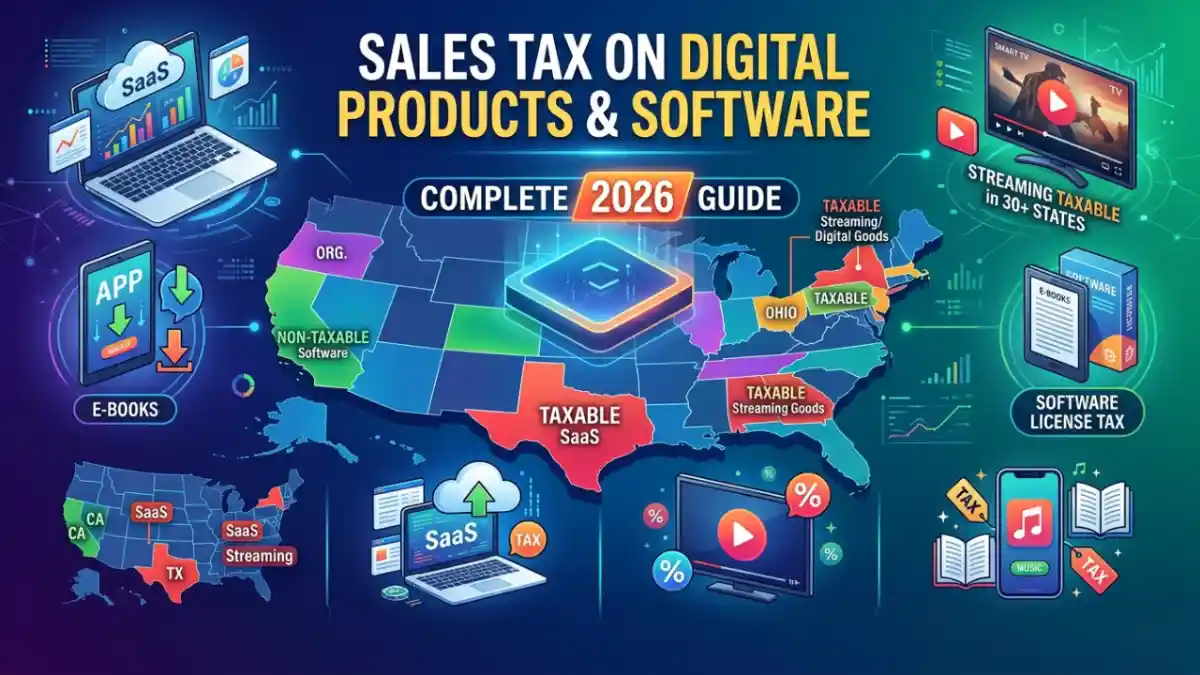
In 2026, more than 30 US states now tax at least some categories of digital products. The trend is strongly toward expansion — states that previously exempted digital goods are actively enacting new taxability rules to capture revenue from the growing digital economy. For both consumers and digital product sellers, understanding where and what is taxable has never been more important.
Key Highlights
- More than 30 US states now tax at least one category of digital products as of 2026.
- SaaS (Software as a Service) is taxable in over 20 states — including Texas, New York, and Pennsylvania.
- California does not currently tax most SaaS products — one of the largest exemptions in the country.
- Streaming services (Netflix, Spotify, Disney+) are taxable in more than 30 states in 2026.
- Downloaded software is treated differently from cloud-based software in most states.
- The Streamlined Sales Tax (SST) Board provides a digital goods taxability matrix for all 24 member states.
- Sellers of digital products must collect tax based on the buyer's location — not the seller's location.
- Economic nexusWhat Is Economic Nexus? Post-Wayfair Guide thresholds apply to digital product sellers the same as to physical goods sellers.
- Reverse sales tax calculation separates the pre-tax subscription price from the tax charged on any digital invoice.
- Digital product taxability rules changed in at least 8 states in 2025–2026 — always verify current rules before filing.
The Three Major Categories of Digital Products
Before applying any sales tax rule, it is essential to correctly identify which category a digital product falls into — because states frequently tax these categories differently, even within the same state.
| Category | Definition | Common Examples | States That Tax (Approx.) |
|---|---|---|---|
| Downloaded Digital Goods | Electronically transferred files the buyer permanently owns | Software downloads, e-books, MP3s, apps, games, fonts, templates | 30+ states |
| Streaming / Accessed Content | Content accessed on demand without permanent download | Netflix, Spotify, Disney+, YouTube Premium, Twitch, gaming services | 30+ states |
| SaaS / Cloud Software | Software accessed via the cloud on a subscription basis | Shopify, Salesforce, QuickBooks Online, Zoom, Adobe Creative Cloud, Slack | 20+ states |
Adobe Creative Cloud is a SaaS product in most states — software accessed via the cloud on a subscription basis. But in some states, because it also allows users to download and install the software locally, it is treated as a downloaded software product instead. The taxability classification — and therefore whether tax applies — can differ based on how a state legally categorizes the same product. Never assume the classification that applies in one state applies in another. Always verify through that state's Department of Revenue or a qualified tax professional.
Reverse Sales Tax Formula for Digital Subscriptions
When your digital subscription invoice shows a tax-inclusive total, the reverse salesWhat Is Reverse Sales Tax? Complete Guide tax formula works identically to any other purchase. The pre-tax subscription price is your actual cost, and the difference is the tax charged.
For example, if your Texas SaaS subscription invoice shows $107.63 total and Texas applies an 8.25% combined rate, divide $107.63 by 1.0825 to get $99.43 — your pre-tax subscription cost. The tax charged is $8.20. Use this formula for any digital product invoice where tax has been added to verify the correct rate was applied and to separate the tax from your actual software cost for expense reporting.
Step-by-Step: How to Determine If Your Digital Product Is Taxable
Follow these five steps to determine whether sales tax applies to any specific digital product in any US state.
Reverse Sales Tax Calculator
Global Reverse Tax Tool (VAT & GST) 2026 — Remove tax from any total and calculate the original price in seconds.
Real-World Digital Product Tax Scenarios
Here are four practical scenarios showing how digital product sales tax works across different product types, states, and situations — including how to reverse-calculate the pre-tax price from a digital invoice.
Example 1: SaaS Subscription in Texas
Scenario
A freelancer in Austin, Texas pays $107.63 for their monthly Shopify subscription. Texas taxes SaaS at the full combined rate. Austin's combined rate is 8.25%.
Pre-tax subscription price: $107.63 ÷ 1.0825 = $99.43
Tax charged: $107.63 − $99.43 = $8.20
Verification: $99.43 × 8.25% = $8.20 ✓
For expense reporting: Record $99.43 as the software cost and $8.20 as sales tax paid — not $107.63 as the full deductible software expense.
Example 2: Streaming Service in New York
Scenario
A household in New York City pays $18.23 per month for a Netflix subscription. New York taxes streaming services. NYC's combined rate is 8.875%.
Pre-tax streaming cost: $18.23 ÷ 1.08875 = $16.74
Tax charged: $18.23 − $16.74 = $1.49
Verification: $16.74 × 8.875% = $1.49 ✓
Note: Netflix, Spotify, Disney+, and other streaming services are required to collect and remit New York sales tax on all subscriptions to New York addresses.
Example 3: Downloaded Software in California
Scenario
A graphic designer in San Francisco downloads and purchases a font license for $54.00. California taxes downloaded software and digital goods. San Francisco's combined rate is 8.625%.
Pre-tax software price: $54.00 ÷ 1.08625 = $49.71
Tax charged: $54.00 − $49.71 = $4.29
Verification: $49.71 × 8.625% = $4.29 ✓
Important distinction: California taxes downloaded software (permanent file purchase) but does NOT currently tax most SaaS subscriptions (cloud-based access). The same vendor selling both products in California would charge tax on one and not the other.
Example 4: SaaS in a Non-Taxing State — No Tax Charged
Scenario
A startup based in Seattle, Washington pays $500.00 per month for a Salesforce CRM subscription. Washington taxes SaaS at the full state rate of 6.5% (plus local). Seattle's combined rate is 10.25%.
Pre-tax SaaS price: $500.00 ÷ 1.1025 = $453.51
Tax charged: $500.00 − $453.51 = $46.49
Compare to California: The same $500 Salesforce subscription to a California buyer would have zero sales tax — California does not currently tax SaaS. The $500 invoice from California would be the full pre-tax price with no reverse calculation needed.
Business implication: For high-volume SaaS users, the state of operation significantly affects software costs after tax.
Digital Product Taxability by State (2026)
The table below shows the current taxability status for the three major digital product categories in the largest US states. States not listed may have partial taxability rules or specific exemptions — always verify directly with that state's Department of Revenue.
| State | Downloaded Software | Streaming Services | SaaS / Cloud Software | State Rate |
|---|---|---|---|---|
| Texas | Taxable | Taxable | Taxable | 6.25% |
| New York | Taxable | Taxable | Taxable | 4.00% |
| Pennsylvania | Taxable | Taxable | Taxable | 6.00% |
| Washington | Taxable | Taxable | Taxable | 6.50% |
| Tennessee | Taxable | Taxable | Taxable | 7.00% |
| Michigan | Taxable | Taxable | Exempt | 6.00% |
| Illinois | Taxable | Taxable (amusement tax) | Exempt | 6.25% |
| Ohio | Taxable | Taxable | Exempt | 5.75% |
| California | Taxable | Exempt | Exempt | 7.25% |
| Florida | Taxable | Taxable (2023+) | Exempt | 6.00% |
| Colorado | Taxable | Taxable | Exempt | 2.90% |
| Minnesota | Taxable | Taxable | Taxable | 6.875% |
| Arizona | Exempt | Exempt | Taxable (TPT) | 5.60% |
| Oregon | No sales tax | No sales tax | No sales tax | 0.00% |
| New HampshireNew Hampshire Sales Tax: 0.00% | No sales tax | No sales tax | No sales tax | 0.00% |
Sources: State Departments of Revenue, Streamlined Sales Tax Board Taxability Matrix — 2026. Rules subject to change. Always verify current taxability at the specific state's Department of Revenue website.
Physical Software vs Digital Software — How Tax Treatment Differs
| Factor | Physical Software (Box / Disc) | Downloaded Software | SaaS / Cloud Software |
|---|---|---|---|
| Delivery method | Physical shipment | Electronic download | Cloud access / browser |
| Buyer owns the software? | Yes — permanent copy | Yes — permanent copy | No — subscription access only |
| States that tax it | All 45 sales tax states | 30+ states | 20+ states |
| Tax based on location | Ship-to address | Buyer's billing address | Buyer's billing address / primary use location |
| California taxability | Taxable | Taxable | Generally exempt (2026) |
| Texas taxability | Taxable | Taxable | Taxable |
| New York taxability | Taxable | Taxable | Taxable |
| Reverse formula applies? | Yes | Yes | Yes |
Pros and Cons of Digital Product Sales Tax
For States — Why Taxing Digital Products Makes Sense
- Captures revenue from a rapidly growing sector that physical-goods tax codes missed
- Creates tax neutrality between physical and digital versions of the same product
- Expands the tax base without raising rates on existing taxable goods
- Reflects how consumers actually spend money in the modern economy
- Streaming and SaaS taxes are relatively easy to enforce through large platform compliance
- Reduces competitive advantage of digital-only businesses over physical retailers
For Businesses and Consumers — Key Challenges
- No federal standard — 50 different state rules create massive compliance complexity
- Same product can be taxable in one state and exempt in the next with no consistent logic
- Rules change frequently — a product exempt last year may be taxable today
- SaaS businesses must maintain state-by-state taxability matrices for every product they sell
- Small digital product sellers face the same compliance burden as large enterprises
- Multi-user SaaS licenses create "primary use location" ambiguity for remote teams
Expert Tip — Ritu Sharma
"The most expensive digital product tax mistake I see businesses make is assuming that because their SaaS vendor does not charge tax, no tax is owed. In most states, the obligation to collect and remit sales tax sits with the seller — but if the seller fails to collect, the buyer can still be assessed use tax on the same transaction. Use tax is the mirror of sales tax: if you bought a taxable product without paying sales tax, you technically owe use tax to your state at the same rate. For businesses in Texas, New York, or Washington spending $10,000+ per month on SaaS tools from vendors who are not collecting, the cumulative use tax exposure over several years can be substantial. I always recommend that finance teams do an annual audit of their SaaS and digital subscription invoices — check which vendors are collecting tax, cross-reference against your state's taxability rules, and calculate whether any use tax liability has been accumulating on vendor invoices that show no tax collected."
Who Needs to Understand Digital Product Sales Tax?
- SaaS companies and software sellers who sell to customers in multiple states and must determine taxability in each state separately, configure checkout systems accordingly, and register where economic nexus thresholds have been crossed
- Freelancers and small businesses who subscribe to multiple SaaS tools — understanding which invoices include sales tax helps with accurate expense reporting and Schedule C deductions, since the tax portion is separate from the deductible software cost
- E-commerce businesses selling digital goods — fonts, templates, presets, e-books, courses, and digital downloads — who need to know which states require them to collect tax on these products
- Streaming and media platforms expanding their subscriber base across US states where streaming taxes now apply in 30+ jurisdictions
- Finance and accounting teams at companies with significant SaaS spending who need to separate the tax portion of vendor invoices for accurate financial reporting and tax filings
- Consumers who want to verify that the sales tax on their streaming or software subscription is correct — or understand why tax suddenly appeared on a subscription that previously showed no tax
When a digital subscription invoice shows a tax-inclusive total, always reverse-calculate to verify the correct rate was applied. The formula is: Pre-Tax Price = Total Invoice ÷ (1 + Tax Rate). If the vendor applied a state rate only (ignoring local additions), your calculation will reveal the discrepancy. A business subscribing to $10,000 per month in SaaS tools in a high-tax city like Chicago (10.25% combined) versus using the Illinois state rate only (6.25%) would see a difference of $400 per month in incorrectly collected tax — that is $4,800 per year in overcharged tax that the business is paying unnecessarily.
Risks and Limitations
Rules change without notice: Digital product taxability is the most actively legislated area of US sales tax law. A state that exempted SaaS in 2024 may have enacted taxability effective January 2026. Businesses that do not actively monitor state tax law changes face the risk of under-collecting in newly taxable states or continuing to charge tax in states that have granted exemptions.
Multi-state SaaS licenses: When a business buys a SaaS license used by employees in multiple states, the "primary use location" rule becomes complex. Some states tax based on where the software is primarily used, others on the billing address, others on where the contract was signed. For multi-state teams, the tax treatment of a single SaaS subscription can legitimately differ across the same company's offices.
Marketplace platforms may not collect correctly: If you sell digital products through an online marketplace, the platform may not collect sales tax in every state where your product is taxable — especially if the platform has not yet updated its systems to account for newer digital product taxability rules. Always verify what your marketplace is and is not collecting before assuming full compliance.
Bundled products create classification problems: When a vendor bundles physical and digital products — for example, a software license with a printed manual — the tax treatment of the bundle depends on the state's bundling rules. Some states tax the entire bundle at the physical goods rate, others apply separate rates to each component, and others exempt the bundle if the digital component is exempt.
Expert Insight and Market Impact
Digital product sales tax is the defining compliance challenge of the 2020s for US businesses. The scale of the shift is significant: in 2015, fewer than 10 US states taxed streaming services. By 2026, more than 30 do. In 2015, SaaS was taxable in fewer than 5 states. By 2026, more than 20 states tax it. The trend is linear and shows no sign of reversing — as state budgets become increasingly dependent on consumption tax revenue and digital spending continues to displace physical goods purchases, every state with a sales tax will eventually tax digital products in some form.
For SaaS companies specifically, the compliance picture has become significantly more complex since the Wayfair ruling expanded economic nexus to remote sellers. A SaaS startup with customers in 40 states may have nexus in all 40 — and must maintain 40 separate taxability determinations for every product it sells, updated continuously as state laws change. The cost of non-compliance is not theoretical: several high-profile SaaS companies have faced multi-million dollar state tax assessments for years of uncollected digital product taxes.
For consumers and business buyers, the practical impact is straightforward — subscription costs are higher in some states than others, and the difference is measurable. A business spending $50,000 per year on SaaS tools in Texas (where SaaS is taxable at up to 8.25%) pays roughly $4,125 more annually in sales tax than the same business spending the same amount in California (where SaaS is largely exempt). Reverse sales tax calculation is the tool that makes this comparison precise and allows businesses to accurately account for software costs across their financial statements.
Final Verdict
Sales tax on digital products in 2026 is state-by-state, category-by-category, and actively changing. The same SaaS subscription is taxable in Texas, New York, PennsylvaniaPennsylvania Sales Tax: 6.00%, and Washington — and exempt in California, Florida, and Ohio. The same streaming service is taxable in 30+ states and exempt in the rest. The same downloaded font file is taxable in most states but exempt in a few.
For sellers of digital products, the compliance imperative is to maintain a current taxability matrix for every product in every state where you have nexus, update it when state laws change, and configure your billing system to collect the correct combined rate — state plus local — at the buyer's specific location. For buyers, the reverse sales taxA state and local consumption tax imposed on retail sales of tangible personal property and, in... formula is the tool that separates your actual software cost from the tax charged on any digital invoice: divide the total by 1 plus the decimal tax rate, and the result is your pre-tax price.