
What is the sales tax rate in Texas?
The state sales and use tax applies to most retail sales, leases, rentals and taxable services. Local taxes sit on top of it.
Your exact rate depends on where the seller operates, so the same $100 purchase can cost slightly different amounts in two towns.
Key Highlights
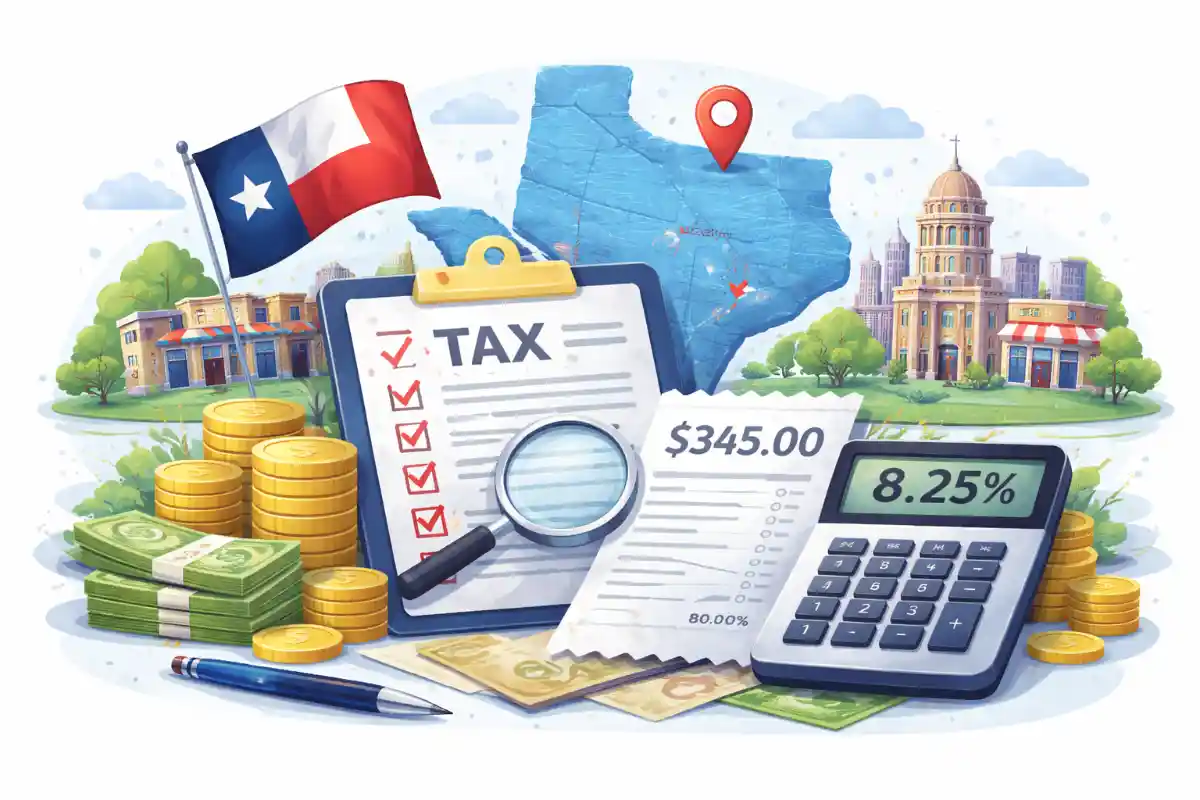
- The state rate is 6.25%; the combined cap with local tax is 8.25%.
- Unprepared groceries are exempt. Candy, soft drinks and restaurant-style food are taxed.
- Delivery charges are taxable when the item you buy is taxable.
- All three 2026 tax holidays are over. Back-to-school ran Aug. 7–9.
- Sellers file by the 20th, monthly, quarterly or yearly.
How do state and local rates add up?
Four kinds of local entities can add tax: cities, counties, special purpose districts and transit authorities. Their combined local rate can't pass 2%.
| Layer | Rate | What it covers |
|---|---|---|
| State sales and use tax | 6.25% | Most retail sales, leases, rentals and taxable services |
| All local taxes combined | Up to 2% | Cities, counties, special purpose districts, transit authorities |
| Maximum combined rate | 8.25% | 6.25% state plus 2% local |
| Motor vehicles | 6.25% | Sales price minus any trade-in allowance |
| Remote seller single local rate | 1.75% | Optional alternative to destination local rates |
Sources: Texas Comptroller sales tax overview, Publication 94-105, motor vehicle tax and remote sellers – October 2026. Rates can change, so confirm yours with the Comptroller's Rate Locator.
In general, Texas bases local sales tax on the seller's place of business. Local use tax follows where you first store or use the item, and orders not received at a Texas place of business are taxed at the delivery address. Check the specific address in the Sales Tax Rate Locator. Our Texas tax page shows the state summary.
What formula calculates Texas sales tax?
How do you calculate it step by step?
Reverse Sales Tax Calculator
Global Reverse Tax Tool (VAT & GST) 2026 — Remove tax from any total and calculate the original price in seconds.
How does the math work on real purchases?
Scenario 1: A laptop at the maximum rate
Situation
You buy a $899.99 laptop from a store charging the top combined rate.
$899.99 × 0.0825 = $74.25 tax. Total: $974.24.
Key lesson: Round the tax first, then add it to the price.
Scenario 2: Backing tax out of a receipt
Situation
A receipt shows $216.50 total at 8.25%.
$216.50 ÷ 1.0825 = $200.00 before tax. Tax paid: $16.50.
Key lesson: Divide by 1.0825. Taking 8.25% off the total gives the wrong answer.
Scenario 3: A grocery cart with mixed items
Situation
Milk $4.29, bread $3.79 and unflavored water $3.99 are exempt ($12.07). Flavored sparkling water $5.49 and a candy bar $2.50 are taxable ($7.99).
$7.99 × 0.0825 = $0.66 tax. Total: $20.72.
Key lesson: Only the flavored water and candy carry tax.
Scenario 4: A car with a trade-in
Situation
You buy a $30,000 vehicle and trade in a car worth $8,000.
($30,000 − $8,000) × 0.0625 = $1,375.00 tax.
Key lesson: The trade-in reduces the taxable price before the 6.25% applies.
Which items are taxable or exempt?
| Item | Taxable? | Detail |
|---|---|---|
| Flour, sugar, bread, milk, eggs, fruits, vegetables | No | Food products are not taxable |
| Plain, mineral, spring and sparkling water | No | Flavored water counts as a soft drink |
| Dietary supplements | No | Needs a "Supplement Facts" label or other listed criteria; CBD products don't qualify |
| Bakery items from a qualifying bakery | No | Over 50% of sales must be bakery items sold off premises |
| Candy and gum | Yes | Includes candied or chocolate-coated nuts and fruit |
| Soft drinks and flavored water | Yes | Includes sports drinks and sweetened bottled drinks |
| Prepared foodSales Tax: Grocery Food vs Prepared Food (2026) | Yes | Hot food, food sold with utensils, store deli counters |
| Ice and dry ice | Yes | Both count as taxable |
Source: Texas Comptroller Publication 96-280, Grocery and Convenience Stores – October 2026. Rules can change, so check the publication before you rely on a borderline item. Medicine has its own rules in our prescription and OTC guide.
How do the 2026 sales tax holidays compare?
All three holidays have ended, and the Comptroller announces each year's dates on its holiday pages. Our state holiday guide covers other states.
| Holiday | 2026 dates | Qualifying items | Limit |
|---|---|---|---|
| Back-to-school | Aug. 7–9 | Most clothing, footwear, school supplies, backpacks | Under $100 per item |
| Energy Star | May 23–25 | Air conditioners, refrigerators, ceiling fans, bulbs, washers, dishwashers, dehumidifiers | AC up to $6,000; refrigerators up to $2,000 |
| Water-efficient | May 23–25 | WaterSense products, rain barrels, drip hoses, mulch, plants, soil | No limit on quantity |
Sources: Comptroller release, Aug. 4, 2026, Energy Star holiday and water-efficient holiday – October 2026.
A $65 backpack and $85 sneakers cost $150 tax-free that weekend, which saved $12.38 at 8.25%. In-store, online, phone and mail purchases all qualified.
What are the pros and cons of Texas sales tax?
Who benefits
- Grocery shoppers – unprepared food carries no tax.
- Budget planners – the local cap sets a firm worst case.
- Back-to-school families – items under $100 skip tax for one weekend.
- Trade-in buyers – the allowance lowers the taxed price.
Who's affected most
- Snack buyers – candy and flavored drinks are taxed.
- Online shoppers – delivery on taxable items adds tax.
- Shoppers near city lines – the rate follows the seller's location.
- Late filers – penalties stack quickly.
Who has to collect and file Texas sales tax?
- Who must collect? – Retailers selling taxable items. Remote sellers must collect once their total TexasTexas Sales Tax: 6.25% revenue reaches $500,000 in the preceding 12 calendar months, counting taxable and nontaxable sales. See our economic nexus guide.
- How often do you file? – Under 34 Texas Administrative Code §3.94, returns are monthly unless you owe less than $1,500 in tax for a calendar quarter, which allows quarterly filing. The Comptroller notifies you by letter.
- When is the return due? – The 20th of the month after a monthly period. Quarterly returns are due Apr. 20, July 20, Oct. 20 and Jan. 20, and yearly returns Jan. 20. Weekend or holiday deadlines move to the next working day.
- Which local rate do remote sellers use? – Either the destination local rate from the Rate Locator or the single 1.75% local rate. Existing sellers switch with Form 01-799.
- Can Texas-based sellers use the 1.75% rate? – No. It isn't available to Texas-based businesses or marketplace providers.
Permitted taxpayers can claim a 0.5% discount on tax reported and paid on time. On $10,000 of tax, that's $50 you keep.
What happens if you file late?
Each late report draws a $50 penaltyAdditional charges imposed by the IRS for failure to comply with tax filing or payment.... Tax paid 1–30 days late adds 5%, and tax paid more than 30 days late adds 10%. Interest on past-due tax starts 61 days after the due date.
For example, $2,000 of tax paid 15 days late costs $50 plus $100, or $150 extra.
Why does the rate change by seller location?
Texas lets four kinds of local entities add tax but caps the combined local rate at 2%. Where their boundaries overlap, the Comptroller shares the revenue between them.
The state estimated the 2026 back-to-school holiday would save families $142.5 million in state and local sales taxes.
Final verdict: how should you calculate Texas sales tax?
Treat 8.25% as your ceiling and confirm the seller's real rate in the Rate Locator. Item type changes the tax, so sort groceries and plain water from candy and prepared food before you multiply. Next, run a receipt through our reverse sales tax calculator to check what you paid.