

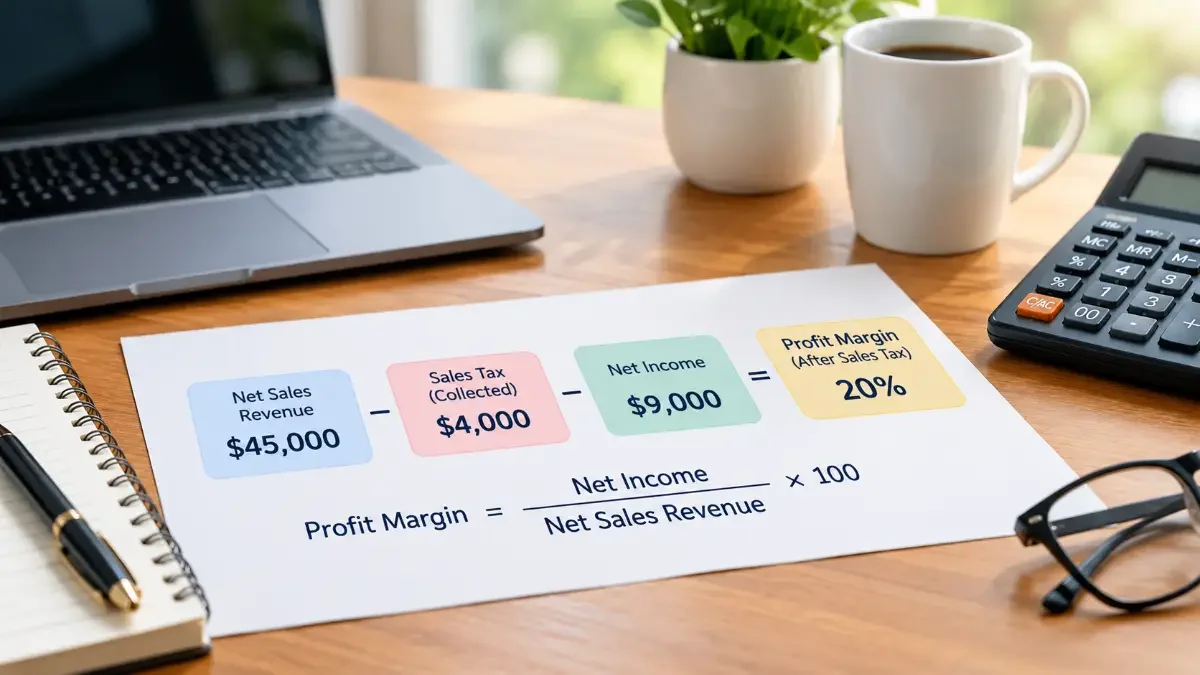
What is profit margin after sales tax?
Profit margin after sales tax is net income divided by net sales revenue, with the sales tax collected from customers removed from the math entirely. Sales tax is a pass-through. You collect it, hold it, and send it to the state, so it counts as neither revenue nor an expense.
Some people use the phrase to mean margin after income tax. That's a separate calculation, and it comes in at step 5 below.
Key Highlights
- Net sales = gross sales before tax, minus returns, allowances and discounts.
- Collected sales tax sits on the balance sheet as a liability until you remit it.
- Net profit margin = net income ÷ net sales × 100.
- Dividing by the register total (tax included) understates your margin.
- Counting the tax as revenue but never expensing the remittance overstates it.
How do net sales and margin break down line by line?
Here's a boutique's month with an 8% sales tax rate. The register rang up $54,000, but only $45,000 of it is net sales.
| Line item | Amount | Treatment |
|---|---|---|
| Gross sales (before tax) | $50,000 | Revenue |
| Sales tax collected (8%) | $4,000 | Liability, not revenue |
| Returns and allowances | −$2,000 | Subtract from sales |
| Sales discounts | −$3,000 | Subtract from sales |
| Net sales revenue | $45,000 | Denominator for every margin |
| Cost of goods sold | $27,000 | Direct cost |
| Gross profit | $18,000 | 40.0% gross margin |
| Operating expenses | $8,500 | Rent, wages, software |
| Interest expense | $500 | Financing cost |
| Net income before income tax | $9,000 | 20.0% net margin |
Source: illustrative figures; treatment of collected sales tax follows IRS Publication 334, October 2026. Rates vary by state and locality, so check your state revenue department.
A customer who pays $108 for a $100 item gave you $100 of revenue and $8 to hold for the state. Point-of-sale reports often show both in one "total collected" figure, so pull the pre-tax sales line before you calculate anything.
What is the formula for profit margin on net sales?
How do you calculate it step by step?
Reverse Sales Tax Calculator
Global Reverse Tax Tool (VAT & GST) 2026 — Remove tax from any total and calculate the original price in seconds.
What do real calculations look like?
Scenario 1: The boutique that used the register total
Situation
The boutique above rang up $54,000: $50,000 of merchandise plus $4,000 of tax. Returns were $2,000 and discounts $3,000. Costs were $27,000 (goods), $8,500 (operating) and $500 (interest).
Net sales: $50,000 − $2,000 − $3,000 = $45,000. Net income: $45,000 − $27,000 − $8,500 − $500 = $9,000. Margin: $9,000 ÷ $45,000 = 20.0%. Using the $54,000 register total gives 16.7%.
Key lesson: The wrong denominator makes a healthy business look 3.3 points weaker than it is.
Scenario 2: The farmers market vendor with tax-inclusive prices
Situation
A vendor sells jars at $10.80 with 8% tax included. Each jar costs $6.00 to make and $2.00 to sell.
Net sale: $10.80 ÷ 1.08 = $10.00. Tax held for the state: $0.80. Profit: $10.00 − $6.00 − $2.00 = $2.00. Margin: $2.00 ÷ $10.00 = 20.0%. Counting $10.80 as revenue and never expensing the $0.80 gives $2.80 ÷ $10.80 = 25.9%.
Key lesson: Mixing the 2 errors inflates the margin by almost 6 points.
Scenario 3: The seller that keeps a collection allowance
Situation
Take the boutique again, in a state that lets sellers keep $40 of the $4,000 collected for filing and paying on time.
Net sales stay at $45,000. The $40 is other income, so net income becomes $9,040. Margin: $9,040 ÷ $45,000 = 20.1%.
Key lesson: Retained tax raises profit but never touches the denominator. IRS Publication 334 treats it as other income.
Which taxes count as revenue and which count as costs?
| Tax or amount | Counts as revenue? | Counts as cost? |
|---|---|---|
| Sales tax imposed on the buyer, collected by you | No | No (passes to the state) |
| Sales tax imposed on you as the seller, collected from the buyer | Yes, in gross receipts | Yes, as a tax expense |
| Sales tax paid on business purchases | No | Added to the item's cost |
| Use tax on untaxed purchases | No | Added to the item's cost |
| Amount the state lets you keep | Other income | No |
Source: IRS Publication 334, Tax Guide for Small Business, October 2026. Which party owes the tax depends on state law, so confirm with your state department of revenue.
How does net margin compare with gross margin and markup?
These use the boutique's numbers. Margins divide by net sales; markup divides by cost.
| Metric | Formula | Result |
|---|---|---|
| Gross margin | ($45,000 − $27,000) ÷ $45,000 | 40.0% |
| Operating margin | ($18,000 − $8,500) ÷ $45,000 | 21.1% |
| Net margin (before income tax) | $9,000 ÷ $45,000 | 20.0% |
| Markup on cost | ($45,000 − $27,000) ÷ $27,000 | 66.7% |
Source: illustrative figures from the boutique example, October 2026. Markup and margin are different numbers; don't swap them when you set prices.
What are the pros and cons of using net sales?
Who benefits
- Multi-state sellers: margins stay comparable because local tax rates drop out.
- Owners seeking loans: lenders expect revenue figures that match your tax filings.
- Anyone setting prices: you see the real profit on each $1 of sales.
Where it gets harder
- Tax-inclusive pricing: you have to back the tax out of every sale.
- Mixed jurisdictions: rates differ by location, so one flat rate won't work.
- Marketplace sales: payout reports may define sales differently than your POS.
Who needs to calculate margin on net sales, and what do they ask?
Any seller that collects sales tax does: retailers, ecommerce shops, restaurants and service firms with taxable salesIs Shipping Taxable? Sales Tax on Shipping by State (2026).
- Does net sales revenue include sales tax? No. Net sales is pre-tax sales minus returns, allowances and discounts. Collected tax is a liability owed to the state.
- Is sales tax an expense on my income statement? Usually not. Tax you collect from buyers and remit never touches the income statement. Tax imposed on you as the seller is the exception.
- Should I use gross sales or net sales for margin? Net sales. Gross sales ignores refunds and discounts, so it overstates what you kept.
- What if my prices include tax? Divide the sticker price by 1 plus the tax rate. At 8%, a $10.80 sale is $10.00 of revenue.
- Do marketplace sales change the math? Many marketplaces collect and remit the tax for you, so payout reports may already exclude it. Read the report's definitions before pulling the sales number.
- Does my margin change if the tax rate changes? No, when the tax is excluded. Only your pre-tax sales, costs and discounts move it.
Your net sales figure should tie to the gross sales line on your sales tax return, after adjusting for exempt sales. A gap usually means tax slipped into revenue or exempt sales went unrecorded.
What mistakes distort the margin?
- Counting tax as revenue: it inflates the denominator and drags your margin down.
- Counting tax as revenue and never expensing the remittance: this lifts profit and the margin together; Scenario 2 shows a 5.9-point overstatement.
- Deducting tax that was never in income: if collected tax stayed out of your reported income, expensing it again double-counts the tax.
- Subtracting refunds with tax included: remove only the pre-tax portion from sales.
Why does sales tax stay out of revenue?
Most states put the tax on the buyer and make the seller the collection agent. Since the Supreme Court's 2018 South DakotaSouth Dakota Sales Tax: 4.50% v. Wayfair decision, many online sellers collect in states where they have no storefront once they pass a sales threshold.
Each state you collect in adds another liability to track apart from revenue.
Final verdict: which number should you divide by?
Divide by net sales revenue: pre-tax sales minus returns, allowances and discounts. The sales taxA state and local consumption tax imposed on retail sales of tangible personal property and, in... you collect is the state's money and has no place in your margin, in either direction. Pull your pre-tax sales this week, rerun last month's margin, and compare it with the old figure.