
What counts as a drug for sales tax purposes?
A prescription drug is one the law lets only a licensed practitioner authorize. Georgia's exemption, for example, covers drugs dispensable only by prescription and carves out OTC drugs by name.
OTC status comes down to the label. Texas looks for an FDA "Drug Facts" panel. Minnesota and New Jersey accept either a Drug Facts panel or a list of active ingredients. Illinois asks whether the label makes a medicinal claim such as "relieves muscular aches and pains."
Grooming and hygiene products (soap, shampoo, toothpaste, mouthwash) usually fall outside the drug definition, even when they contain an active ingredient.
Key Highlights
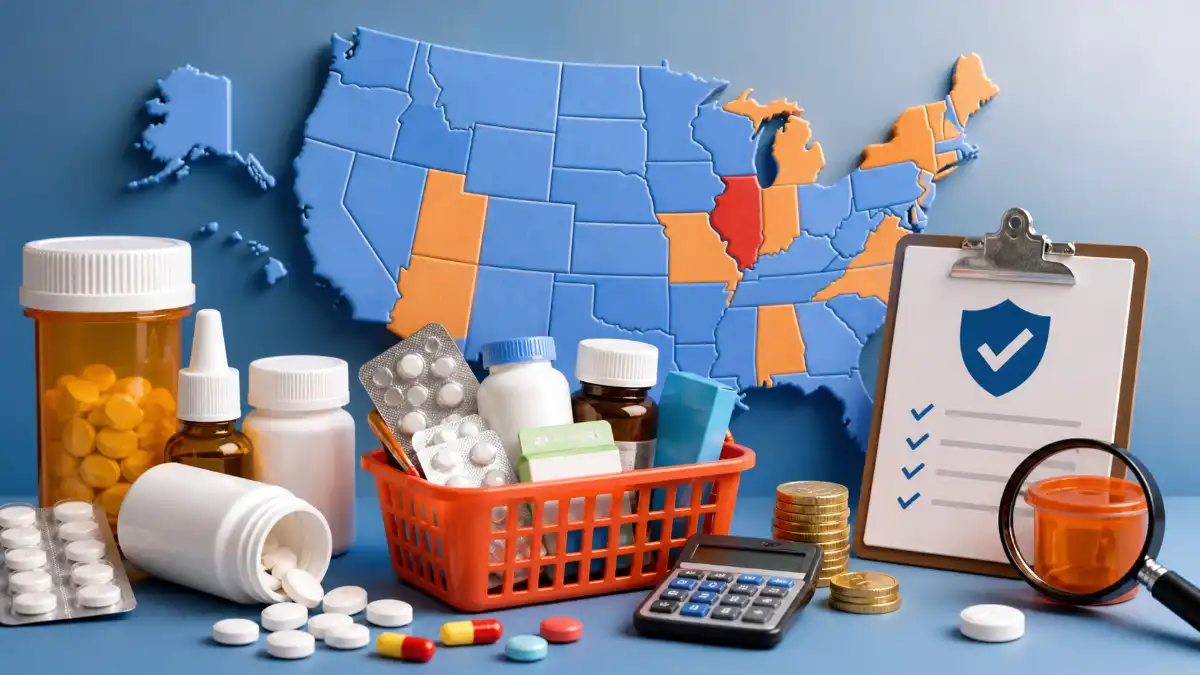
- Illinois is the only state that taxes prescription drugs, at a 1% rate.
- Ten states and DC exempt OTC drugs: CT, FL, MD, MN, NJ, NY, PA, TX, VT, VA.
- The other 34 states tax OTC drugs at their regular rate.
- Georgia, Nebraska, Oklahoma and Wyoming exclude OTC drugs from the exemption entirely.
- Kentucky, North CarolinaNorth Carolina Sales Tax: 4.75%, Massachusetts and Washington exempt OTC drugs a doctor prescribes.
- Texas exempts OTC drugs with a Drug Facts panel, and supplements with a Supplement Facts panel.
Which states exempt over-the-counter drugs?
| State | What qualifies | Still taxable |
|---|---|---|
| Connecticut | Listed categories: pain relievers, cough and cold, antacids, laxatives, vitamins and supplements with a Supplement Facts label | Cosmetics, toothpaste, soap, hair care, sunscreen, deodorant |
| Florida | Items on the state's "common household remedies" list (DR-46NT) | Cosmetics and toilet articles, even medicated ones |
| Maryland | Medicine, whether or not prescribed | No exclusion in the cited statute |
| Minnesota | OTC drugs with a Drug Facts panel or active-ingredient statement | Grooming and hygiene products; vitamins and minerals |
| New Jersey | OTC drugs with a Drug Facts panel or active-ingredient list | Grooming and hygiene products, including sun tan lotion |
| New York | Pain relievers, antacids, cough and cold remedies, dandruff shampoo | Cosmetics, deodorant, toothpaste, mouthwash |
| Pennsylvania | Prescription and nonprescription medicines | No exclusion in the cited code section |
| Texas | OTC drugs with a Drug Facts panel; supplements with a Supplement Facts panel | CBD products |
| Vermont | Nonprescription drugs such as pain relievers, antacids and laxatives | No exclusion on the cited state page |
| Virginia | Nonprescription drugs, including brand-name medicines sold to the public | Cosmetics, toilet articles, diet aids, vitamins sold as supplements |
| District of Columbia | Medicines and drugs, with or without a prescription | No exclusion in the cited statute |
Sources: Connecticut DRS (SN 2015(1)), Florida DOR (DR-46NT, R. 11/25), Maryland Tax-General §11-211, Minnesota Revenue, NJ Division of Taxation, NY Tax Department, 61 Pa. Code §31.3, Texas Comptroller, Vermont Department of Taxes, Virginia Tax Bulletin 13-5, D.C. Code §47-2005 – checked October 2026. Exemption lists change, so confirm the product at your state agency before relying on this table.
A sunscreen with a Drug Facts panel is an exempt drug in Texas. In New Jersey, the same bottle counts as a grooming product (sun tan lotion is on the taxable list). Same shelf, same price, different tax bill.
How do you back the tax out of a drug receipt?
How do states decide what is exempt?
Reverse Sales Tax Calculator
Global Reverse Tax Tool (VAT & GST) 2026 — Remove tax from any total and calculate the original price in seconds.
What does this look like at the register?
Scenario 1: Illinois cough syrup versus dandruff shampoo
Situation
You buy a $12.00 cough syrup whose label claims to relieve symptoms, and a $12.00 dandruff shampoo.
The syrup qualifies for Illinois's 1% drug rate: $12.00 × 0.01 = $0.12. Illinois puts grooming and hygiene products at the 6.25% general rate even with a medicinal claim: $12.00 × 0.0625 = $0.75.
Key lesson: identical prices, a $0.63 gap, all decided by product category. Local taxes on qualifying drugs apply only inside transportation districts, so your total can run higher.
Scenario 2: Texas vitamin D versus CBD gummies
Situation
You buy a $15.00 vitamin D bottle with a Supplement Facts panel and a $15.00 pack of CBD gummies.
The vitamin is exempt: $0.00. Texas excludes CBD products from the supplement exemption, so the gummies are taxed at your local combined rate, up to 8.25%: $15.00 × 0.0825 = $1.24.
Key lesson: one aisle, two tax outcomes.
Scenario 3: Prescribed allergy tablets in two kinds of state
Situation
Your doctor writes a prescription for a $25.00 box of OTC allergy tablets. We'll use an illustrative 7% combined rate.
In Kentucky the prescription makes the purchase exempt: $0.00. In Georgia the tablets stay an OTC drug, so you pay $25.00 × 0.07 = $1.75.
Key lesson: ask where you live before you ask your doctor for the paperwork.
Which states tie the exemption to a prescription?
| State | Rule for OTC drugs and prescriptions |
|---|---|
| Georgia | Exempts drugs dispensable only by prescription; OTC drugs are excluded. Insulin is exempt either way. |
| Nebraska | OTC drugs are taxable even if prescribed. Insulin is exempt with or without a prescription. |
| Oklahoma | OTC drugs do not qualify. Prescribed drugs, insulin and medical oxygen are exempt. |
| Wyoming | OTC drugs are excluded. Insulin is exempt only when sold under a prescription. |
| Ohio | Exempts drugs that can be dispensed only by prescription, plus insulin. OTC drugs are not mentioned in the exemption. |
| Michigan | Exempt if the drug is legally dispensed by prescription; other OTC drugs are taxable. |
| Kentucky | Exempts prescription drugs and OTC drugs bought under a prescription, plus insulin. |
| North Carolina | Exempts prescription drugs, OTC drugs sold on prescription, and insulin. |
| MassachusettsMassachusetts Sales Tax: 6.25% | OTC medicine is generally taxable unless a registered physician prescribes it. |
| Washington | OTC drugs are exempt only when prescribed directly for patients. |
| Illinois | Prescription and nonprescription drugs with medicinal claims: 1%. Grooming and hygiene: 6.25%. |
Sources: Georgia Code §48-8-3, 316 Neb. Admin. Code 1-050, Okla. Admin. Code 710:65-13-170, Wyo. Stat. §39-15-105, Ohio R.C. §5739.02, Michigan IPD 2016-1, KRS 139.472, N.C.G.S. §105-164.13, Massachusetts Directive 91-5, Washington DOR, Illinois 86 Ill. Adm. Code 130.310 – checked October 2026. Statutes are amended often, so confirm with your revenue department.
How do four states treat the same purchases?
| Purchase | Texas | New York | Illinois | Georgia |
|---|---|---|---|---|
| Prescription drug | Exempt | Exempt | 1% | Exempt |
| OTC pain reliever | Exempt (Drug Facts) | Exempt | 1% | Taxable |
| OTC drug a doctor prescribes | Exempt | Exempt | 1% | Taxable |
Sources: Texas Comptroller, NY Tax Department, Illinois Department of Revenue, Georgia Code §48-8-3 – checked October 2026. Taxable means the state's regular sales tax rate plus any local tax.
Who gains and who loses under these rules?
Who benefits
- Prescription patients – pay no sales tax in every sales-tax state except Illinois, where the rate is 1%.
- Shoppers in the 10 exempt states and DC – skip tax on routine pain, cold and stomach remedies.
- Insulin users – Georgia, Nebraska, Ohio and Oklahoma exempt it with or without a prescription.
Who pays more
- Shoppers in the other 34 states – pay the regular rate on aspirin and allergy tablets.
- Georgia, Nebraska, Oklahoma and Wyoming residents – a prescription doesn't make OTC items exempt.
- Supplement buyers outside Texas and ConnecticutConnecticut Sales Tax: 6.35% – vitamins can be taxable (Minnesota, Virginia).
Who qualifies for the exemption?
- Does insurance change the answer? – In New York, the product's purpose decides taxability, not who pays for it.
- What if an OTC drug has no Drug Facts panel? – In Texas, a physician must prescribe or dispense it for it to be exempt.
- Is medical cannabis taxed? – Illinois puts dispensary cannabis at the 1% drug rate; Connecticut exempts cannabis sold for palliative use.
- What about pet medicine? – Illinois taxes veterinary medicine at the higher rate, and Texas exempts animal drugs only with a veterinarian's prescription.
- Does a first-aid kit count? – In Virginia, a nonprescription item packaged with a nonqualifying one is taxed on the whole price.
At a pharmacy counter in a prescription-only state, one receipt can hold an exempt prescription and a taxable bottle of ibuprofen. Compute tax on the taxable lines only, or your reverse calculation will look wrong.
What can go wrong at checkout?
Bundles and look-alikes cause most errors. A medicated product can still be taxed as a cosmetic: Illinois charges 6.25% on grooming products with medicinal claims, which is the $0.63 gap on a $12.00 item in Scenario 1.
Supplements are inconsistent too. A Supplement Facts label earns the exemption in Texas and Connecticut but not in Minnesota or Virginia. CBD is excluded from the Texas supplement exemption.
The practical risk is overpaying without noticing: a store's register can code an exempt item as taxable, and a receipt rarely says why.
Why do states treat OTC medicine differently?
The patchwork is a product of legislative history, not a single policy. Connecticut repealed its OTC exemption on July 1, 2011 and brought it back for sales on or after April 1, 2015, which is why older articles list 9 exempt states and current law supports 10 plus DC.
Virginia passed its exemption in 1990, but repeated deferrals kept it from taking effect until July 1, 1998.
Illinois took a middle path: a 1% state rate on qualifying drugs, with local occupation taxes on them only inside transportation districts.
Final verdict: how should you handle drug sales tax?
Treat prescriptions as tax-free everywhere but Illinois, and treat OTC medicine as taxable until you confirm your state exempts it. Only Kentucky, North Carolina, Massachusetts and Washington reward a doctor's note on an OTC item. Next, run your latest pharmacy receipt through our reverse sales tax calculator and see whether the tax line matches your state's rule.