
Do You Pay Sales Tax on Groceries?
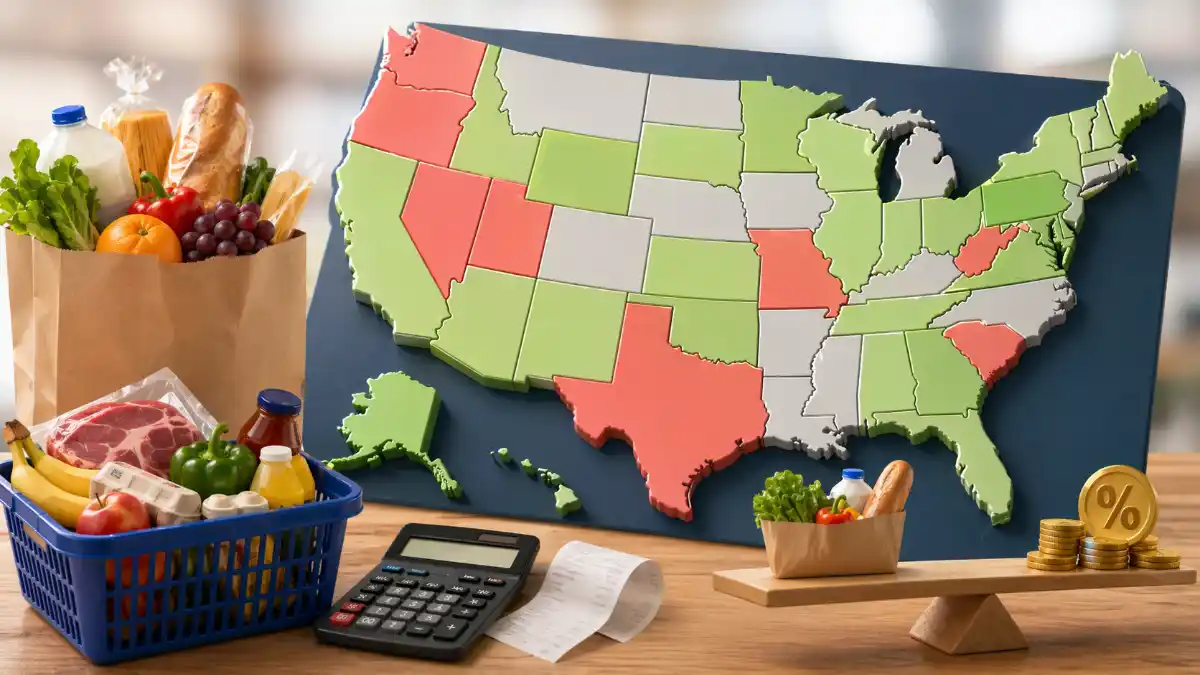
Whether you pay sales tax on groceries depends on the state where you shop. Most US states — 37 states plus Washington DC — do not impose a statewide sales tax on unprepared grocery food intended for home consumption. However, 13 states still tax groceries in 2026, either at the full state sales tax rate or at a reduced rate. And even in states that exempt groceries at the state level, local jurisdictions — cities and counties — sometimes impose their own food taxes on top.
The definition of "groceries" for tax purposes is typically unprepared food intended for home preparation and consumption. This broadly covers fresh produce, meat, dairy, bread, canned goods, and packaged staples. But the exemption almost never covers prepared food — hot meals, restaurant food, deli items sold ready to eat, food sold with utensils, and food prepared by the seller for immediate consumption are taxable in virtually every state, even those that broadly exempt groceries.
Two major changes took effect January 1, 2026: Arkansas eliminated its 0.125% state grocery tax, and Illinois eliminated its 1% state grocery tax. These join Kansas (2025), Oklahoma (2024), and Virginia (2023) in recently removing state-level grocery taxes. The trend is clearly moving toward broader exemption — but significant variation remains, and local taxes often persist even when state taxes are removed.
Key Highlights
- As of 2026, 13 states still impose a statewide sales tax on groceries — down from more in prior years.
- Arkansas and Illinois eliminated their state grocery taxes effective January 1, 2026 — the two most recent states to do so.
- Idaho now has the highest grocery tax rate in the US at 6% — after Mississippi reduced its rate from 7% to 5% in July 2025.
- Mississippi reduced its grocery tax from 7% to 5% effective July 1, 2025 — with further reductions planned through 2036.
- Even in states that exempt groceries from state tax, local jurisdictions may still charge their own grocery tax.
- Prepared food — hot meals, deli items, food with utensils — is taxable in virtually every state regardless of grocery exemptions.
- The "cutlery test" and "heating test" determine taxability in many states — same food item can be taxable or exempt depending on how it is sold.
- Tennessee taxes groceries at a reduced 4% state rate — local taxes also apply on top.
- South Dakota taxes groceries at a temporary reduced rate of 4.2% — set to revert to 4.5% in 2027 unless made permanent.
- Illinois eliminated its state grocery tax in 2026 — but 665 municipalities chose to impose their own 1% local grocery tax.
Three Categories — How States Treat Grocery Tax
Every US state falls into one of three categories for grocery tax treatment. Knowing your state's category is the starting point for understanding what you owe at the supermarket checkout.
| Category | What It Means | States | What You Pay |
|---|---|---|---|
| Full Exemption | No state sales tax on unprepared groceries | California, New York, Texas, Florida, Pennsylvania, Ohio, Michigan, New Jersey, Georgia, North Carolina, Virginia, Illinois (2026), Arkansas (2026), Oklahoma, Kansas, and most others | $0 state tax — local taxes may apply in some areas |
| Reduced Rate | Groceries taxed at a lower rate than general sales tax | Tennessee (4%), Utah (3% combined), Missouri (1.225%), South Dakota (4.2% temporary), Alabama (3%) | Reduced state rate + applicable local rates |
| Full Rate | Groceries taxed at the same rate as all other goods | Idaho (6%), Mississippi (5%), South Dakota (4.2%), Hawaii (GET 4%) | Full state rate + applicable local rates |
When your state exempts groceries from sales tax, it means the state government collects no tax on your grocery purchase. But many states allow cities and counties to impose their own local grocery taxes independently. In Georgia, groceries are exempt from the 4% state sales tax — but local counties charge their own rates, meaning Georgia shoppers still pay 2–4% on groceries depending on their county. In Illinois, the state 1% grocery tax was eliminated in 2026 — but 665 municipalities chose to impose their own 1% local grocery tax on the same date. Always check your specific city or county rate, not just the state exemption status, to know what you actually pay at checkout.
Reverse Formula — Calculate the Exact Grocery Tax on Any Receipt
When your grocery receipt shows a mixed total with some taxable items (prepared food, soda, candy) and some exempt items (bread, fresh produce, meat), the reverse formula helps you verify the tax was applied correctly to only the taxable items.
If the implied taxable subtotal from the reverse check equals only your taxable items (prepared food, soda, candy) and not your exempt groceries, the receipt is correct. If it is higher — covering some exempt items — the store's POS system may have miscategorized an item or applied the wrong tax code. The most common grocery receipt errors involve items categorized as taxable when they should be exempt, or vice versa.
Step-by-Step: How to Read a Grocery Receipt With Mixed Items
Follow these five steps to verify that your grocery receipt correctly applied tax only to the items that are taxable in your state.
Reverse Sales Tax Calculator
Global Reverse Tax Tool (VAT & GST) 2026 — Remove tax from any total and calculate the original price in seconds.
Real-World Grocery Tax Scenarios
Here are four practical examples showing how grocery tax rules work in different states — including how to spot and verify errors on mixed grocery receipts.
Example 1: California — Most Groceries Exempt, But Prepared Food Taxable
Scenario
A California shopper's cart: Bread $3.49 (exempt), Fresh chicken $8.99 (exempt), Rotisserie chicken $9.99 (taxable — sold hot), Soda 6-pack $5.49 (taxable), Apple $1.50 (exempt). Combined rate: 9.50% (Los Angeles).
Taxable items: Rotisserie chicken $9.99 + Soda $5.49 = $15.48 taxable subtotal
Expected tax: $15.48 × 9.50% = $1.47
Exempt items: Bread + Raw chicken + Apple = $13.98 — zero tax ✓
Total should be: $29.46 + $1.47 tax = $30.93
Key rule: The same chicken — raw and packaged (exempt) vs cooked and ready to eat (taxable) — is taxed differently at a California grocery store. The heating test determines taxability.
Example 2: Tennessee — Reduced Rate on ALL Groceries
Scenario
A Tennessee shopper buys $120.00 in groceries — all unprepared food items. Tennessee charges 4% state rate on groceries plus local rates. Memphis combined grocery rate: approximately 5%.
Grocery tax: $120.00 × 5% = $6.00
Total: $120.00 + $6.00 = $126.00
Reverse check: $6.00 ÷ 0.05 = $120.00 taxable subtotal ✓
Annual grocery tax estimate for Tennessee household: A family spending $800/month on groceries in Memphis pays: $800 × 5% = $40/month in grocery tax = $480/year
vs a Texas family: Same $800/month grocery bill in Texas = $0 grocery tax = $0/year. Tennessee groceries cost the same family $480 more annually purely in state and local taxes.
Example 3: Illinois — State Tax Gone in 2026, But Local Tax Still Applies
Scenario
An Illinois shopper buys $85.00 in groceries in Chicago in February 2026. Illinois eliminated its 1% state grocery tax effective January 1, 2026. But Chicago has enacted a 1% local grocery tax.
State grocery tax: $0 — eliminated January 1, 2026 ✓
Chicago local grocery tax (1%): $85.00 × 1% = $0.85
Total: $85.00 + $0.85 = $85.85
If shopper is in a suburb without local grocery tax: $85.00 + $0.00 = $85.00 — zero grocery tax
Key lesson: Illinois eliminated the state tax but 665 municipalities enacted their own 1% local tax. Whether you pay grocery tax in Illinois now depends entirely on which municipality the store is located in — not just the state rule.
Example 4: Idaho — Highest Grocery Tax in the US at 6%
Scenario
An Idaho family buys $650 in groceries per month. Idaho charges the full 6% state rate on all groceries with no exemption. A grocery tax credit is available on the Idaho state income tax return.
Monthly grocery tax: $650 × 6% = $39.00
Annual grocery tax paid: $39 × 12 = $468.00
Idaho grocery tax credit: Up to $155 per person on Idaho state income tax return. A family of four can claim up to $620 in credits — potentially offsetting most of the annual grocery tax paid.
Net annual grocery tax after credit (family of 4): $468 − $468 (credit exceeds tax paid) = effectively $0 net — but only if the family claims the credit on their Idaho tax return.
Important: The credit must be actively claimed — it is not automatic. Families who do not file Idaho income taxes or forget to claim the credit pay the full 6% with no offset.
Complete State-by-State Grocery Tax Guide (2026)
The table below shows the current grocery tax status for every US state as of April 2026, including recent changes and key local tax notes.
| State | Grocery Tax Rate (State) | Status | Key Note |
|---|---|---|---|
| Alabama | 3% | Reduced rate — taxable | Reduced from 4% — further reductions planned. Local taxes also apply. |
| Alaska | No state tax | No state sales tax | Some local jurisdictions impose food taxes |
| Arizona | 0% | Exempt at state level | Local taxes may apply in some cities |
| Arkansas | 0% (as of Jan 1, 2026) | Newly exempt — 2026 change | Previously 0.125%. Local taxes still apply. |
| California | 0% | Exempt — unprepared food | Prepared food, hot food, soda taxable at full rate |
| Colorado | 0% | Exempt at state level | Local taxes can add 3–5% in some areas |
| Connecticut | 0% | Exempt | Candy, soda, and prepared food fully taxable |
| Florida | 0% | Exempt | Most groceries exempt; prepared food taxable |
| Georgia | 0% | Exempt at state level | Local county taxes still apply — 2–4% in many areas |
| Hawaii | 4% GET | Taxable — GET applies | General Excise Tax — technically on businesses but passed to consumers |
| Idaho | 6% | Fully taxable — highest in US | Grocery tax credit available on state income tax return (up to $155/person) |
| Illinois | 0% (as of Jan 1, 2026) | Newly exempt at state level | 665 municipalities enacted 1% local grocery tax on same date |
| Indiana | 0% | Exempt | Prepared food taxable at 7% |
| Kansas | 0% (as of Jan 1, 2025) | Newly exempt — 2025 change | Fully eliminated as of 2025; local taxes may still apply |
| Louisiana | 0% | Exempt at state level | Local taxes can apply — some parishes tax food |
| Michigan | 0% | Exempt | Prepared food and candy taxable at 6% |
| Mississippi | 5% (reduced from 7%) | Taxable — reduced rate | Reduced July 1, 2025. Further 0.2% annual reductions planned through 2036. |
| Missouri | 1.225% | Reduced rate | Local taxes also apply — combined ratesSales Tax by State 2026: Combined Rates, Exemptions & What You Owe vary widely by county |
| New York | 0% | Exempt | Prepared food taxable. NYC exempts prepared food under $2.50. |
| Oklahoma | 0% (as of Aug 2024) | Newly exempt — 2024 change | State exemption in effect; local taxes still apply and can top 5% |
| Oregon | No state tax | No state sales tax | No sales tax on anything — groceries or otherwise |
| South Dakota | 4.2% (temporary) | Taxable — reduced rate | Temporary rate — set to revert to 4.5% in 2027 unless made permanent |
| Tennessee | 4% | Taxable — reduced rate | Local rates also apply; legislative attempts to eliminate have failed |
| Texas | 0% | Exempt | Strict snack food rules — individual portions of chips/candy taxable |
| Utah | 3% combined | Taxable — reduced rate | 1.75% state + 1.25% local = 3% combined on most food items |
| Virginia | 0% state (1% local optional) | State exempt since 2023 | Local governments may charge 1% — verify your specific locality |
Sources: Tax Foundation, Kiplinger, TaxHero, State Departments of Revenue — April 2026. Rates and rules subject to legislative change. Always verify with your state's Department of Revenue.
What Counts as "Groceries" vs Taxable Food?
Even in states that broadly exempt groceries, not all food at the grocery store qualifies for the exemption. The distinction between exempt groceries and taxable food is one of the most frequently misunderstood areas of sales tax for consumers.
| Food Type | Generally Exempt? | Key Rule | Exceptions |
|---|---|---|---|
| Fresh produce | Yes — in exempt states | Unprepared for home consumption | Pre-cut fruit trays with utensils may be taxable |
| Raw meat and poultry | Yes — in exempt states | Unprepared, packaged for home cooking | Pre-marinated or seasoned meats may vary |
| Bread and baked goods | Yes — generally | Packaged for home consumption | Bakery items sold with plates or utensils may be taxable |
| Dairy — milk, cheese, eggs | Yes — in exempt states | Standard grocery staples | Generally no exceptions |
| Rotisserie chicken | No — taxable in most states | Sold hot = prepared foodSales Tax: Grocery Food vs Prepared Food (2026) | Some states exempt if sold cold/packaged for later |
| Deli items sold ready to eat | No — taxable | Prepared for immediate consumption | Cold packaged deli meat (not ready to eat) may be exempt |
| Soda and soft drinks | No — taxable in most states | Not considered food staple under SST definitions | Some states exempt all beverages; check your state |
| Candy | No — taxable in most states | SST definition: sweetener-based without flour = candy | Products with flour (Kit Kat, Twix) often treated as food |
| Chips and snack foods | Varies — often exempt | Most states treat as food | Texas: individual-size portions taxable; family size exempt |
| Bottled water | Varies by state | Some states treat as grocery; others tax | Sparkling/flavored water more likely taxable |
Pros and Cons of Grocery Tax Exemptions
Arguments for Exempting Groceries
- Reduces the regressive burden of sales tax — lower-income households spend proportionally more on food
- Research shows the most food-insecure US counties are precisely those that tax groceries
- Simplifies compliance for grocery retailers — no need to categorize items
- Broadly popular with voters — grocery tax eliminations have passed in multiple states
- Reduces the administrative burden of tracking which food items are taxable vs exempt
- Consistent with how most other developed countries treat essential food — VAT-exempt in the EU and UK
Arguments Against Full Exemption
- States lose significant revenue — grocery taxes fund education and local services in many states
- The exemption is not targeted — wealthy households benefit as much as food-insecure households
- Creates complex taxability line-drawing between "groceries" and "prepared food"
- Local jurisdictions often fill the revenue gap with their own taxes — as Illinois municipalities did in 2026
- Tax credits (like Idaho's) can achieve the same distributional goal while preserving state revenue
- Definitions of "exempt food" are inconsistent and create confusion for both consumers and retailers
Expert Tip — Ritu Sharma
"The grocery tax error I see most consistently on consumer receipts is the hot food miscategorization. In every state I have reviewed — exempt or otherwise — prepared and hot food is taxable. But grocery store POS systems regularly fail to distinguish between a cold packaged rotisserie chicken (that was sold hot and has now cooled) versus a raw packaged chicken breast. If the item is entered into the system under the wrong product code at the store level, every customer who buys that item is either being overcharged or undercharged consistently. For families doing large weekly grocery runs in states like California, New York, or Texas where the base grocery exemption is broad, the most practical habit is to glance at the T/F codes on the receipt for any prepared or deli items you bought. If you bought a hot soup, a rotisserie chicken, or ready-made sushi — and those items are marked F (exempt) rather than T (taxable) — the store is undercharging tax on those items and you are benefiting. If your loaf of bread is marked T — the store is overcharging and you should request a correction. Two minutes at the checkout pays dividends over a year of weekly shopping."
Who Benefits Most From Knowing Grocery Tax Rules?
- Families with food-sensitive budgets — grocery tax in a state like Tennessee at 5% combined adds approximately $480 per year for a family spending $800 monthly on groceries, while the same family in a fully exempt state like Texas pays $0 in grocery tax on the same spending
- Shoppers near state borders — if you live near the border of a state with lower or no grocery tax, the savings from cross-border grocery shopping for large monthly hauls can meaningfully exceed the cost of the trip, particularly in states with full-rate grocery taxes like Idaho (6%) or Mississippi (5%)
- Illinois shoppers in 2026 — the state grocery tax was eliminated January 1, 2026, but 665 municipalities imposed their own 1% local tax. Whether you are paying grocery tax in Illinois now depends entirely on which municipality your store is in — worth checking on your receipt
- Idaho residents — the 6% grocery tax applies to all food purchases, but the grocery tax credit of up to $155 per person on the state income tax return can offset significant amounts — families must actively claim the credit each year to receive the benefit
- Consumers confused by the candy and soda distinction — the Streamlined Sales Tax definition means that chocolate bars with flour (like Kit Kat) are often treated as food (exempt) while pure sugar candy without flour is treated as candy (taxable) in states that tax candy — knowing this helps you verify whether your receipt correctly categorized these items
- Online grocery shoppers — when ordering grocery delivery or pickup through platforms like Instacart, Amazon Fresh, or Walmart Grocery, the platform applies the tax rules for the store's location — verifying that the correct rate and exemptions were applied to your specific items requires the same receipt-checking skills as in-store shopping
One of the most confusing grocery tax rules in the US involves candy. Under the Streamlined Sales Tax definition used by 24 member states, candy is defined as a preparation of sugar, honey, or sweeteners combined with chocolate, fruits, nuts, or other ingredients — without flour. This means a plain chocolate bar is candy (taxable in states that tax candy). But a Kit Kat, Twix, or Reese's Cup contains flour in the wafer or cookie component — making these products "food" rather than "candy" under the SST definition, and therefore exempt in states that exempt food but tax candy. Similarly, most states tax regular soda but exempt diet soda in some contexts, or tax soda in bottles but not when served from a fountain. These distinctions are real, legally defined, and reflected in how correctly configured POS systems code each product. If you see a candy bar marked T (taxable) and a Kit Kat marked F (food/exempt) on the same grocery receipt, the system is likely correct — not in error.
Common Errors and Risks
Rotisserie chicken — the most common grocery receipt error: Pre-cooked rotisserie chicken sold hot is taxable prepared food in virtually every state. But when the same chicken is sold cold in a package for later home preparation, it may be exempt as a grocery item. Grocery store POS systems sometimes miscategorize this based on how the item was entered — always check whether hot deli items on your receiptHow to Read Your Receipt: Tax Breakdown Explained are marked taxable, which they should be in most states.
Illinois 2026 confusion: The state grocery tax was eliminated January 1, 2026. But many Illinois shoppers assume their local store is now fully tax-free on groceries. Whether you pay grocery tax in Illinois now depends on which municipality the store is in. If your store is in Chicago or one of the 665 municipalities that enacted a local 1% grocery tax, you still pay 1% at checkout. If your store is in a municipality that did not enact the local tax, your groceries are now genuinely tax-free at the state and local level.
Georgia local taxes — commonly overlooked: Georgia exempts groceries from the 4% state sales tax, which many shoppers understand. But Georgia counties impose their own sales taxes on groceries independently, and rates vary by county. A shopper in a Georgia county with a 4% local rate pays 4% on groceries — the same total they would pay if the state taxed them. Always verify the specific county rate, not just the state exemption.
Online grocery platforms and incorrect item coding: When grocery delivery platforms like Instacart or Amazon Fresh process your order, they rely on item tax classification codes to determine whether each product is taxable. If a product is miscoded in the platform's catalog — as prepared food when it should be exempt, or vice versa — every customer in that state is affected. If your online grocery order shows unexpected taxes on items that should be exempt in your state, contact the platform's customer support with the specific items and your state's exemption rules.
Expert Insight and Market Impact
The trend toward eliminating grocery taxes is one of the most significant ongoing shifts in US state sales tax policy. Since 2022, six states have eliminated or substantially reduced their grocery taxes — Virginia (2023), Oklahoma (2024), Kansas (2025), MississippiMississippi Sales Tax: 7.00% (reduced July 2025), Arkansas (January 2026), and Illinois (January 2026). The bipartisan appeal of grocery tax elimination reflects both the policy argument — that taxing essential food is regressive — and the political reality that few voters oppose removing a tax on their grocery bill.
The revenue implications are significant. Illinois's 1% grocery tax, while small per transaction, generated hundreds of millions of dollars in annual state revenue. The decision to eliminate it and simultaneously authorize municipalities to impose their own 1% local tax represents a shift in how that revenue is collected — from the state to local governments — rather than a net reduction in consumer taxes for Illinois shoppers who happen to live in one of the 665 municipalities that enacted the replacement local tax.
For consumers, the practical grocery tax savings from exemption are meaningful at the household level but require understanding both state and local rules to calculate correctly. A TennesseeTennessee Sales Tax: 7.00% family paying 5% on $800 in monthly groceries pays $480 more annually than an identical Texas family — a real and significant budget difference. Knowing your state's grocery tax rate, whether it has changed recently, and whether local additions apply in your specific city or county is the foundation of understanding your real grocery bill in 2026.
Final Verdict
As of 2026, most US states do not tax unprepared groceries — but 13 states still do, with rates ranging from 1.225% in Missouri to 6% in Idaho. ArkansasArkansas Sales Tax: 6.50% and Illinois both eliminated their state grocery taxes effective January 1, 2026 — the most recent additions to the growing list of states moving toward food tax exemption. Mississippi reduced its grocery tax from 7% to 5% in July 2025, with further annual reductions planned through 2036.
Even in exempt states, local taxes sometimes apply, prepared food is almost always taxable, and specific items like soda, candy, and hot deli foods carry their own rules. Verify your grocery receipt by looking at the tax codes next to each item — T means taxable, F or N means exempt — and use the reverse formula to check that the tax was applied only to the correct taxable items: Tax Charged ÷ Tax Rate = Implied Taxable Subtotal. If that subtotal includes exempt grocery items, you have found an error worth correcting before you leave the store.