

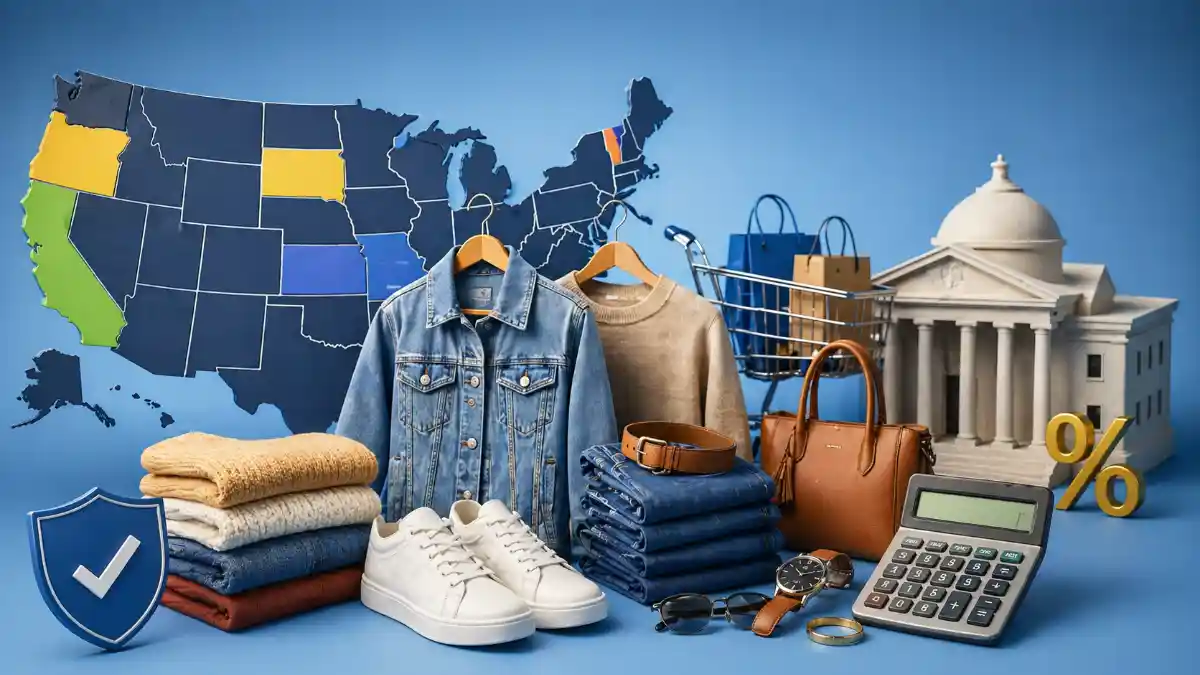
How States Treat Clothing Sales Tax — The Four Categories
Every US state falls into one of four categories for clothing sales tax. Knowing your state's category is the essential first step before purchasing clothing — or before configuring a retail or e-commerce business for clothing sales.
The first category is states with no sales tax at all — the five NOMAD states (Alaska, Delaware, Montana, New HampshireNew Hampshire Tax: 0.00%, Oregon). Clothing is never taxed in these states because nothing is taxed. The second category is states that fully exempt clothing year-round — PennsylvaniaPennsylvania Tax: 6.00%, New Jersey, Minnesota, Vermont are the clearest examples. The third category is states that partially exempt clothing up to a per-item price threshold — New York (under $110), MassachusettsMassachusetts Tax: 6.25% (under $175), Rhode IslandRhode Island Tax: 7.00% (first $250). The fourth and largest category is states that fully tax clothing at the standard combined rate with no permanent exemption — California, Texas, Florida, Illinois, and most others.
An additional layer applies in all four categories: even in states that broadly exempt clothing, specific categories are almost always taxable — fur clothing, accessories (jewelry, handbags, wallets), athletic and sporting equipment, protective gear worn specifically for athletic activity, and in some states formal wear. These "always taxable" subcategories exist in nearly every clothing-exempt state and produce the most common clothing receipt errors for both consumers and retailers.
Key Highlights
- 8 states fully or partially exempt clothing year-round — Pennsylvania, New Jersey, Minnesota, Vermont fully exempt; NY, MA, RI have price thresholds.
- 5 NOMAD states have no sales tax at all — Alaska, Delaware, Montana, New Hampshire, Oregon.
- New York exempts clothing and footwear under $110 per item — items at $110 or more are fully taxable.
- Massachusetts exempts clothing under $175 per item — items over $175 are taxed only on the amount exceeding $175.
- Rhode Island exempts the first $250 of any clothing item — amounts above $250 are taxable on the excess only.
- Pennsylvania exempts almost all clothing — but explicitly taxes formal wear, sporting equipment, and fur.
- Accessories — jewelry, handbags, wallets, umbrellas — are taxable in virtually every state regardless of clothing exemptions.
- Athletic and protective clothing specifically designed for sports is taxable in Minnesota, New Jersey, Pennsylvania, Vermont, and most other exempt states.
- Connecticut taxes clothing under $100 at 0% and clothing over $1,000 at a luxury rate — unique two-threshold system.
- About 16 states offer annual back-to-school clothing tax holidays — most exempt clothing under $100 per item during a weekend in July or August.
What Is Always Taxable — Even in Clothing-Exempt States
Before diving into state-by-state rules, understand the categories that are almost universally taxable regardless of general clothing exemptions. Even in Pennsylvania, Minnesota, New Jersey, and Vermont — states that broadly exempt clothing — these specific subcategories are taxable.
| Category | Examples | Taxable in Exempt States? | Key Rule |
|---|---|---|---|
| Accessories | Jewelry, handbags, wallets, belts, scarves, umbrellas, watches | Yes — in virtually all states | Not considered clothing for tax purposes — always a separate taxable category |
| Fur clothing | Fur coats, fur-trimmed items, imitation fur | Yes — in most exempt states | Explicitly carved out as taxable in MN, NJ, PA, VT, NY, and others |
| Athletic / sports clothing | Cleats, ski boots, football pads, helmets, athletic uniforms | Yes — in most exempt states | Designed exclusively for athletic use — not "normal" clothing. Yoga pants and athletic leggings may be exempt if marketed as everyday wear. |
| Protective equipment | Hard hats, safety goggles, steel-toed boots (in some states) | Varies — often taxable unless worn as everyday work clothing | Some states exempt protective clothing when worn daily as a work uniform |
| Formal / ceremonial wear | Tuxedos, evening gowns, wedding dresses, costumes | Varies — PA taxes formal wear; MN, NJ, VT, RI exempt it | Pennsylvania is the primary exception — formal day and evening wear explicitly taxable |
| Clothing repair materials | Thread, buttons, patches, sewing supplies | Generally taxable | New York exempts some clothing repair materials — most other states tax them |
The most frequently misunderstood clothing tax rule is the athletic wear distinction. In states like Minnesota, New Jersey, and Vermont that exempt "clothing," athletic and sports clothing designed exclusively for athletic or protective use is taxable — but everyday athletic-style clothing is not. The test is whether the item is designed and used primarily for athletic activity or for general wear. A football uniform, cleats, and shoulder pads are clearly athletic equipment — taxable. Yoga pants, athletic leggings, and running shorts that are commonly worn for everyday activities — shopping, commuting, casual wear — are generally treated as clothing and exempt. The gray area is items marketed specifically as sport-specific (official team uniforms, competition swimwear, etc.) vs. items marketed broadly as athletic lifestyle wear. When in doubt, look at how the item is marketed and primarily used.
Reverse Formula — Verify Any Clothing Purchase Receipt
When you buy clothing in a state with a price threshold — New York, Massachusetts, Rhode Island — the tax calculation can be complex. The reverse formula helps you verify whether the correct tax was applied and whether the threshold was correctly applied.
For example in Massachusetts: you buy a $220 jacket. Threshold is $175. Taxable portion = $220 − $175 = $45. Tax = $45 × 6.25% = $2.81. If your receipt shows $13.75 (taxing the full $220), the store incorrectly applied tax to the entire price instead of just the excess above $175 — a $10.94 overcharge. Use the reverse formula to check: Tax Charged ÷ Tax Rate = Implied Taxable Portion. $13.75 ÷ 0.0625 = $220 — confirms the whole price was taxed instead of just $45.
Step-by-Step: How to Determine if Your Clothing Purchase Should Be Taxed
Follow these five steps to determine whether sales tax applies to any specific clothing purchase in 2026.
Reverse Sales Tax Calculator
Global Reverse Tax Tool (VAT & GST) 2026 — Remove tax from any total and calculate the original price in seconds.
Real-World Clothing Tax Scenarios
Here are four practical scenarios showing how clothing tax works — including threshold calculations, the accessory distinction, and how to catch a receipt error.
Scenario 1: New York — Under and Over the $110 Threshold
Scenario
A New York City shopper buys two items: a $85 shirt (under $110 threshold) and a $145 pair of jeans (over $110 threshold). NYC combined rate: 8.875%.
$85 shirt: Under $110 threshold — fully exempt. Tax = $0.
$145 jeans: At or over $110 — fully taxable at 8.875%. Tax = $145 × 8.875% = $12.87
Total tax on order: $0 + $12.87 = $12.87
Reverse check: $12.87 ÷ 0.08875 = $145.01 implied taxable base ≈ $145 (jeans price only) ✓
Key rule: In New York, the threshold is all-or-nothing per item — a $109.99 shirt is fully exempt, a $110.00 shirt is fully taxable. There is no partial exemption for the amount over the threshold (unlike Massachusetts and Rhode Island).
If both were under $110: Total tax = $0. If both were over $110: Tax = ($85 + $145) × 8.875% = $20.41.
Scenario 2: Massachusetts — Only the Amount Over $175 Is Taxed
Scenario
A Massachusetts shopper buys a $220 jacket. Massachusetts exempts clothing under $175 per item — items over $175 are taxed only on the amount exceeding $175. Massachusetts combined rate: 6.25% (no local additions).
Taxable portion: $220 − $175 = $45
Tax owed: $45 × 6.25% = $2.81
If store incorrectly taxes the full $220: $220 × 6.25% = $13.75 — overcharge of $10.94
Reverse check on correct receipt: $2.81 ÷ 0.0625 = $44.96 ≈ $45 taxable portion ✓
This is why Massachusetts receipts show partial tax on expensive clothing — unlike New York's all-or-nothing rule, Massachusetts applies tax only to the amount that exceeds the $175 threshold. A $300 coat: $300 − $175 = $125 taxable × 6.25% = $7.81 tax, not $300 × 6.25% = $18.75.
Scenario 3: Pennsylvania — Formal Wear Is the Exception
Scenario
A Pennsylvania shopper buys: work shirt $45 (exempt), dress pants $89 (exempt), tuxedo rental $180 (taxable — formal wear), leather belt $35 (taxable — accessory). Pennsylvania combined rate: 6% (Philadelphia adds 2% = 8% in Philly).
Work shirt and dress pants: Standard clothing — fully exempt in Pennsylvania. Tax = $0.
Tuxedo rental: Formal wear — explicitly taxable in Pennsylvania even though other clothing is exempt. Tax = $180 × 6% = $10.80 (state only, not in Philly)
Leather belt: Accessory — always taxable in Pennsylvania. Tax = $35 × 6% = $2.10
Total tax: $10.80 + $2.10 = $12.90
Key lesson: Pennsylvania's broad clothing exemption covers everyday work and casual wear, but formal wear (tuxedos, evening gowns) is explicitly excluded. If a Pennsylvania store charges you tax on a regular dress shirt, that is an error. If they charge you tax on a tuxedo, that is correct.
Scenario 4: Fully Taxable State — Texas Clothing + Accessories
Scenario
A Texas shopper buys: T-shirt $29.99, jeans $79.99, leather handbag $149.99. Dallas combined rate: 8.25%. Texas fully taxes all clothing — no permanent exemption.
All items taxable: $29.99 + $79.99 + $149.99 = $259.97 taxable base
Total tax: $259.97 × 8.25% = $21.45
Reverse check: $21.45 ÷ 0.0825 = $259.82 ≈ $259.97 ✓ (rounding)
vs buying in Pennsylvania: T-shirt and jeans ($109.98) = $0 tax (exempt). Handbag ($149.99) = taxable accessory × 6% = $9.00 tax. Total PA tax: $9.00 vs $21.45 Texas — Pennsylvania saves $12.45 on the same shopping trip due to the clothing exemption.
Back-to-school holiday comparison: During Texas's August 7–9 back-to-school holiday, the T-shirt and jeans (both under $100 per item) would be exempt. The handbag (accessory) would still be taxable. Holiday tax savings on clothing only: $109.98 × 8.25% = $9.07.
Clothing Sales Tax — All 50 States (2026)
The table below shows the clothing tax status for every US state. States with no sales tax or full clothing exemptions are listed first, followed by threshold states, then fully taxable states with notable rules.
| State | Clothing Tax Status | Key Rule / Threshold | Always Taxable Exceptions |
|---|---|---|---|
| Alaska | No state tax | No statewide sales tax — local jurisdictions may tax | Varies by municipality |
| Delaware | No state tax | No sales tax on anything | None |
| Montana | No state tax | No sales tax on anything | None |
| New Hampshire | No state tax | No sales tax on anything | None |
| Oregon | No state tax | No sales tax on anything | None |
| Minnesota | Fully exempt (with exceptions) | No price limit — all standard clothing exempt | Accessories, fur, athletic/sports clothing, protective equipment |
| New Jersey | Fully exempt (with exceptions) | No price limit — all standard clothing exempt | Accessories, fur, athletic/sports equipment |
| Pennsylvania | Fully exempt (with exceptions) | Broad exemption — most clothing exempt | Formal wear (tuxedos, evening gowns), sporting equipment, fur |
| Vermont | Fully exempt (with exceptions) | No price limit — standard clothing exempt | Accessories, fur, athletic/sports clothing, protective equipment |
| New York | Exempt under $110 per item | All-or-nothing: under $110 = exempt; $110+ = fully taxable | Accessories, fur, items over $110. Note: some NYC counties still tax exempt clothing locally |
| Massachusetts | Exempt up to $175 per item | Items over $175: tax on excess only (price − $175 × rate) | Athletic clothing designed for sports, accessories |
| Rhode Island | First $250 exempt per item | Items over $250: tax on amount exceeding $250 only | Accessories, fur, athletic/sports clothing |
| Connecticut | Exempt under $100 / Luxury rate over $1,000 | Under $100 = 0%; $100–$999.99 = standard rate; $1,000+ = luxury rate (7.75%) | Clothing $100–$999.99 fully taxable; jewelry, accessories always taxable |
| Alabama | Fully taxable | Standard rate on all clothing year-round | Back-to-school holiday: clothing under $156/item exempt in 2026 |
| Arizona | Fully taxable | Standard rate — no clothing exemption | None specific — all clothing taxable |
| Arkansas | Fully taxable | Standard rate — holiday exemption for clothing under $100 | Back-to-school holiday Aug 1–2 provides temporary exemption |
| California | Fully taxable | Full combined rate on all clothing | Some nonprofit/thrift store exemptions — not consumer exemptions |
| Colorado | Fully taxable | Standard combined rate on all clothing | None — all clothing fully taxable |
| Florida | Fully taxable (with holiday) | Standard rate — holiday exemption for clothing under $100 | Back-to-school holiday: July 25 – Aug 7 clothing exemption |
| Georgia | Fully taxable | Standard rate — no permanent clothing exemption | Back-to-school holiday: some clothing exempt briefly |
| Hawaii | Fully taxable (GET) | GET applies to all clothing sales | All clothing subject to General Excise Tax |
| Idaho | Fully taxable | Standard rate — no clothing exemption | Some charity exemptions — not consumer exemptions |
| Illinois | Fully taxable | Standard combined rate on all clothing | None — all clothing fully taxable |
| Indiana | Fully taxable | 7% state rate on all clothing | None — all clothing fully taxable |
| Iowa | Fully taxable (with holiday) | Standard rate — Aug 7–8 holiday: clothing under $100 exempt | Back-to-school holiday provides temporary exemption only |
| Maryland | Fully taxable (with holiday) | Standard rate — Aug 9–15 back-to-school holiday | Back-to-school holiday: clothing under $100 exempt |
| Michigan | Fully taxable | 6% flat rate on all clothing | None — all clothing taxable |
| Mississippi | Fully taxable | 5% rate on clothing | Clothing for motion picture production may be exempt |
| Missouri | Fully taxable (with holiday) | Standard rate — Aug 7–9 back-to-school holiday | Back-to-school holiday: clothing under $100 exempt |
| Nevada | Fully taxable | Full combined rate — no clothing exemption | None — all clothing taxable |
| North CarolinaNorth Carolina Tax: 4.75% | Fully taxable | 4.75% state rate plus local | None — all clothing taxable |
| Ohio | Fully taxable (with holiday) | Standard rate — Aug back-to-school holiday: clothing under $75 exempt | Back-to-school holiday: clothing under $75 only |
| Oklahoma | Fully taxable (with holiday) | Standard rate — Aug 7–9 back-to-school holiday | Back-to-school holiday: clothing under $100 exempt |
| South CarolinaSouth Carolina Tax: 6.00% | Fully taxable (with holiday) | Standard rate — Aug 7–9 holiday: all qualifying clothing exempt (no cap) | SC back-to-school holiday has no price limit — most generous clothing holiday |
| Tennessee | Fully taxable (with holiday) | 7% state rate — Jul 25–27 back-to-school holiday: clothing under $100 | Back-to-school holiday provides temporary exemption |
| Texas | Fully taxable (with holiday) | Standard rate — Aug 7–9 back-to-school holiday: clothing under $100 | Accessories always taxable — back-to-school holiday excludes accessories |
| Virginia | Fully taxable (with holiday) | Standard rate — Aug 7–9 back-to-school holiday: clothing under $100 | Some protective workplace clothing exempt year-round |
| Washington | Fully taxable | Standard combined rate on all clothing | None — all clothing taxable |
| West VirginiaWest Virginia Tax: 6.00% | Fully taxable (with holiday) | Standard rate — July–Aug back-to-school holiday: clothing under $125 | West Virginia has higher per-item limit ($125) than most holiday states |
| Wisconsin | Fully taxable | Standard rate on all clothing | None — all clothing taxable |
Sources: TaxJar, Commenda, AccurateTax, LegalClarity, Tax Foundation, State Departments of Revenue — April 2026. Always verify current rules with your state's DOR before purchase.
Exempt Clothing vs Taxable Accessories — Key Distinctions
| Item | Generally Exempt? | Key Rule |
|---|---|---|
| T-shirts, dress shirts, blouses | Yes — in exempt states | Standard clothing — core exemption item |
| Jeans, pants, skirts, dresses | Yes — in exempt states | Standard clothing — fully exempt where clothing is exempt |
| Shoes and footwear | Yes — in most exempt states | NY, MA, RI, MN, NJ, PA, VT all exempt footwear with clothing |
| Socks, underwear, hosiery | Yes — in exempt states | Considered standard clothing — exempt where clothing is exempt |
| Jewelry (necklaces, rings, earrings) | No — always taxable | Accessory — taxable in virtually every state including exempt states |
| Handbags and purses | No — always taxable | Accessory — taxable in all states |
| Belts | No — taxable in most states | Accessory — taxable in most exempt states (MN, NJ, VT) except some interpretations in PA |
| Athletic cleats, ski boots | No — taxable as sports equipment | Designed exclusively for sport — not everyday footwear |
| Yoga pants / athletic leggings | Generally yes — if marketed for everyday wear | Gray area — if marketed as lifestyle/everyday wear, typically exempt as clothing |
| Fur coats | No — taxable in most exempt states | Explicitly excluded from exemption in MN, NJ, PA, VT, NY |
Shopping Strategy — How to Reduce Clothing Tax Legally
Strategies That Reduce Clothing Tax
- Shop in Pennsylvania, New Jersey, Minnesota, or Vermont for standard clothing — no tax on most purchases regardless of price
- Keep individual items under the threshold in NY ($110), MA ($175), RI ($250) — buy multiple under-threshold items instead of one over-threshold item
- Shop online during your state's back-to-school clothing holiday — clothing under $100 per item exempt in most holiday states
- In Massachusetts — expensive items over $175 are taxed only on the excess, not the full price. $250 coat = $75 taxable = $4.69 tax (not $15.63 on full price)
- Separate accessories from clothing purchases where possible — accessories are always taxable; keeping receipts separate helps track deductible business expenses accurately
- For business purchases of work clothing — some states (Virginia) exempt protective workplace clothing year-round; verify whether your work gear qualifies
Common Clothing Tax Misconceptions
- "All clothing is exempt in New York" — only under $110 per item; $110 and above is fully taxable
- "Shoes are taxable everywhere" — wrong; shoes are exempt in PA, NJ, MN, VT, NY (under $110), MA (under $175)
- "Athletic wear is always exempt like other clothing" — wrong in MN, NJ, PA, VT; designed-for-sport items are taxable
- "Pennsylvania exempts all clothing" — wrong; formal wear (tuxedos, evening gowns) is explicitly taxable in PA
- "Crossing into a no-tax state to buy clothing saves tax" — true only if you physically shop there and take delivery there. Shipping to your home state means your home state tax applies.
- "The tax holiday applies to accessories" — wrong in virtually every state; accessories are always taxable even during back-to-school holidays
Expert Tip — Ritu Sharma
"The clothing tax error that costs Massachusetts shoppers the most money is the full-price taxation mistake — and it happens at surprisingly large and sophisticated retailers. The rule is clear: for clothing over $175, only the amount exceeding $175 is taxable. But I regularly see Massachusetts receipts where the full item price was taxed. On a $350 designer dress, the correct Massachusetts tax is ($350 − $175) × 6.25% = $10.94. The incorrect full-price tax is $350 × 6.25% = $21.88. The overcharge is $10.94 on a single item. Use this quick check: divide the tax on your Massachusetts clothing receipt by 6.25%. If the result is the full item price, the store taxed the whole amount incorrectly. The result should equal only the amount over $175. For a $350 dress: $10.94 ÷ 0.0625 = $175 — wait, that gives you the taxable portion correctly. So the check is: Tax ÷ Rate = Taxable Portion. Taxable Portion + $175 should equal the item price. If Taxable Portion + $175 does not equal the item price, the store calculated it wrong. In the $350 dress example: $10.94 ÷ 0.0625 = $175.04 ≈ $175 taxable portion. $175 + $175 = $350 ✓. If the receipt showed $21.88 tax: $21.88 ÷ 0.0625 = $350.08 = $350 taxable portion. $350 + $175 = $525 — does not equal $350. Error confirmed."
Who Needs to Know Clothing Tax Rules?
- New York City residents and visitors — the $110 per-item threshold means every clothing purchase decision in NYC involves a quick mental check: is this item under or over $110? A $109.99 item is fully exempt (saving $9.76 in NYC tax at 8.875%). A $110.00 item is fully taxable ($9.76 in tax). Understanding this threshold turns a 1-cent price difference into a $9.76 tax difference
- Massachusetts shoppers buying expensive clothing — Massachusetts uniquely taxes only the excess above $175 per item, not the full price. A $300 winter coat incurs tax only on $125 ($300 − $175), producing $7.81 in tax rather than $18.75. Many Massachusetts shoppers and even some retailers miscalculate this and apply tax to the full price — knowing the correct rule protects against overcharges
- Pennsylvania shoppers buying formal wear — Pennsylvania's broad clothing exemption covers everything from T-shirts to expensive dresses, but formal wear (tuxedos, evening gowns) is explicitly taxable. Wedding season shoppers in Pennsylvania may be surprised to find that their everyday dress is exempt but a tuxedo rental is taxable — knowing this in advance avoids the surprise
- E-commerce sellers shipping clothing nationwide — online clothing retailers must apply different rules in every state: exempt in MN, NJ, PA, VT; threshold rules in NY, MA, RI; luxury rate in CT for items over $1,000; standard rate in 30+ other states. Product tax code configuration must correctly handle all these variations to avoid under-collection (audit exposure) or over-collection (customer overcharges)
- Back-to-school shoppers in fully taxable states — for residents of Texas, Florida, Tennessee, Ohio, Missouri, and other states that fully tax clothing year-round, the annual back-to-school holiday is the single best opportunity to buy qualifying clothing under $100 per item tax-free. Knowing the holiday dates and the $100 per-item limit (or state-specific limit) allows families to plan major clothing purchases around the holiday
- Consumers who shop across state lines — understanding that New Jersey, Pennsylvania, Minnesota, and Vermont have no clothing tax year-round creates legitimate shopping opportunities for residents of neighboring fully-taxing states when they physically travel to those states. A Delaware (no-tax state) shopping trip is popular among Pennsylvania, New Jersey, Maryland, and New York residents for different reasons — but clothing is exempt in all four of those states anyway, making the Delaware trip less valuable for clothing than for taxable goods
Rhode Island's clothing tax rule is the most frequently misapplied threshold rule in the US. Rhode Island exempts the first $250 of any clothing item's sale price — amounts above $250 are taxable only on the excess. This means a $350 pair of boots in Rhode Island should produce tax of ($350 − $250) × 7% = $100 × 7% = $7.00 — not $350 × 7% = $24.50. The correct tax is $7.00. Many retailers — especially those with national tax configurations — incorrectly apply Rhode Island's rule as either (a) fully taxable when any item exceeds $250, or (b) fully exempt for all items. Neither is correct. The partial exemption means you always pay some tax on clothing over $250, but never on the full price. Use the reverse formula to verify: Tax Charged ÷ 7% = Implied Taxable Amount. For a $350 item, the implied taxable amount should be approximately $100 — not $350. If it shows $350, you were overcharged $17.50 in tax and should request a correction.
Common Clothing Tax Errors and Receipt Mistakes
New York all-or-nothing threshold misapplied: The most common New York clothing tax error is stores applying tax to items priced at exactly $110 when the threshold is "under $110" — meaning items at exactly $110.00 are taxable, not items at $109.99. This creates a $0.01 difference that produces a full tax charge. The reverse formula identifies this: if you bought a $109.99 shirt and see any tax on your receipt, the store taxed a qualifying exempt item.
Massachusetts full-price taxing instead of excess-only: Many Massachusetts retailers incorrectly apply sales tax to the full price of clothing over $175 rather than only to the amount exceeding $175. A $220 jacket taxed at 6.25% on the full $220 = $13.75, when the correct tax on only the $45 excess = $2.81. A $10.94 overcharge on a single jacket. The reverse check: divide the tax by 6.25%. If the result is $220 instead of $45, the store applied full-price tax incorrectly.
Accessory miscategorized as exempt clothing: Stores sometimes miscategorize accessories — handbags, belts, jewelry — as exempt clothing, particularly in states with broad clothing exemptions. If your New Jersey receipt shows no tax on a $200 handbag, the store made an error — New Jersey exempts clothing but accessories are taxable. This type of error benefits the consumer but creates a compliance problem for the retailer.
Athletic wear misclassification: The athletic vs everyday wear distinction creates consistent errors. A yoga studio selling branded athletic leggings may treat them as clothing (exempt in Minnesota) when a state auditor might classify them as athletic clothing (taxable). The reverse is also true — a sporting goods store may tax athletic-style casual wear that is genuinely exempt everyday clothing. The "designed and used for athletic activity specifically" test is the key distinction.
Expert Insight and Market Impact
Clothing sales tax exemptions are one of the oldest and most politically popular forms of tax relief in US state policy — dating back to the recognition that clothing is a basic necessity and taxing it is regressive. States like Pennsylvania and New Jersey have maintained broad clothing exemptions for decades, while most southern and western states continue to treat clothing as fully taxable goods. The political momentum in recent years has been toward more holiday exemptions rather than permanent year-round exemptions — providing temporary tax relief without permanently reducing state revenue.
For e-commerce sellers, clothing tax configuration is one of the most technically demanding aspects of multi-state sales tax compliance. A clothing retailer selling nationwide must configure their system to apply no tax in New Jersey, threshold-based tax in New York and Massachusetts, luxury rate triggers in Connecticut, and full combined rates in 30+ other states — all while correctly categorizing accessories, athletic wear, and formal items separately from general clothing in each jurisdiction. Tax automation platforms that maintain clothing-specific product tax codes (PTCs) are essential for accurate compliance at scale.
For consumers, the practical dollar impact of clothing tax varies dramatically by state. A family spending $2,000 annually on clothing in Texas at 8.25% pays $165 in clothing tax. The same family in New Jersey pays $0. In New York City, the same $2,000 in clothing purchases under $110 per item pays $0; if purchases exceed $110 per item, the city rate of 8.875% kicks in. Understanding these differences makes shopping in exempt states or during holiday periods a genuinely meaningful financial decision — not just a minor convenience.
Final Verdict
Clothing sales tax in the US ranges from completely tax-free in five no-tax states and four fully-exempt states, to partially exempt in three threshold states (New York, Massachusetts, Rhode Island), to fully taxable in 30+ states. The key rules to remember: accessories are always taxable regardless of clothing exemptions; athletic wear designed exclusively for sport is taxable in most exempt states; formal wear is taxable in Pennsylvania despite the broad clothing exemption; and New York's $110 threshold is all-or-nothing while Massachusetts and Rhode Island tax only the excess above their thresholds.
The reverse formula verifies any clothing receipt in seconds. In threshold states, divide the tax charged by the tax rate — the result should equal only the amount over the threshold, not the full item price. In fully taxable states, divide the tax by the rate — the result should equal the full price including all taxable items. Any discrepancy over a few cents is worth bringing to the store's customer service with the calculation. For back-to-school shopping in fully taxable states, the annual holiday window (typically a weekend in late July or August) is the best opportunity to buy qualifying clothing under $100 per item completely tax-free, both in store and online.