
The Core Distinction — Grocery Food vs Prepared Food
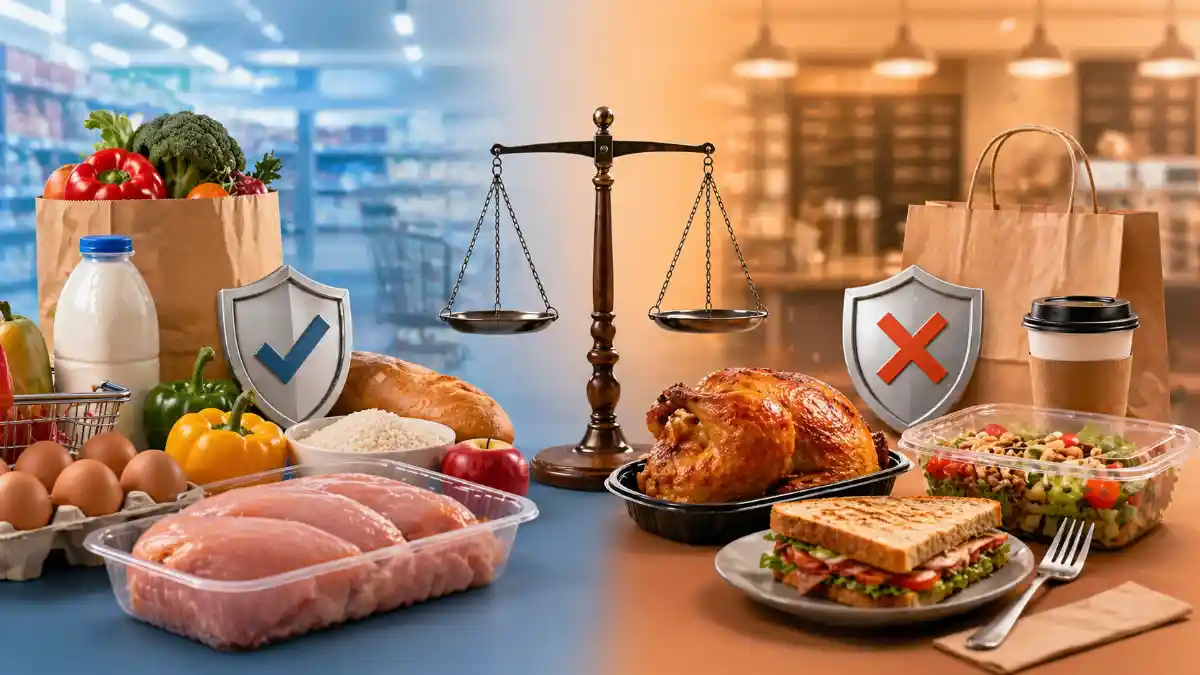
In US sales tax law, "food" falls into two fundamentally different categories that are treated differently in virtually every state. The first is grocery food — unprepared food and food ingredients intended for home consumption and preparation. The second is prepared food — food sold ready to eat, heated, assembled by the seller, or provided with eating utensils. Most states exempt or reduce tax on grocery food while taxing prepared food at the full combined rate.
The Streamlined Sales Tax (SST) Agreement, adopted by 24 member states, provides the clearest formal definition. Under SST, "prepared food" means any food where the seller: (1) combines two or more food ingredients and sells them as a single item, (2) sells the food in a heated state or heats it, or (3) sells the food with eating utensils provided — including plates, knives, forks, spoons, glasses, cups, napkins, or straws. If any one of these three conditions is met, the food is "prepared food" and taxable in most states, regardless of where it is sold or how it is packaged.
The practical result is that the same ingredient can be taxable or exempt depending entirely on how it is sold. Raw chicken breast in a sealed package: exempt grocery. Rotisserie chicken cooked and sold hot at the deli counter: taxable prepared food. The food is identical — the preparation and presentation determines the tax treatment.
Key Highlights
- Grocery food — unprepared food for home consumption — is exempt or reduced-rate in most states.
- Prepared food — heated, assembled, or served with utensils — is taxable at the full rate in virtually all states.
- The three SST tests: (1) heated by seller, (2) two or more ingredients combined by seller, (3) utensils provided.
- Any ONE of the three tests being met makes food "prepared" and taxable — all three do not need to apply.
- A plastic fork placed next to a cold sandwich can make it taxable — even if the sandwich itself is cold and unheated.
- Rotisserie chicken is taxable in virtually every state — sold hot by the seller. Cold packaged chicken is exempt in most states.
- The 80/80 Rule in California and Virginia: if a business derives more than 80% of revenue from food and over 80% is ready-to-eat, ALL sales may become taxable.
- Restaurant meals are taxable in every state with a sales tax — no exceptions for restaurant-sold prepared food.
- Cold deli items sold without utensils and not for immediate on-premises consumption may qualify as exempt grocery food in some states.
- Mixed receipts at grocery stores require the store's POS to correctly split taxable (prepared) from exempt (grocery) items — errors are common.
The Three Tests — How Any Food Item Gets Classified
Every food item sold in the US can be analyzed using three tests derived from the SST definition. If the answer to any one of these is "yes," the food is almost certainly prepared food and taxable. If all three are "no," the food is likely exempt grocery food in states that exempt groceries.
| Test | Question | Exempt Example | Taxable Example |
|---|---|---|---|
| 1. Heating Test | Was the food sold in a heated state or heated by the seller? | Raw chicken breast — cold, packaged, requires cooking | Rotisserie chicken — cooked and sold hot at deli counter |
| 2. Combination Test | Did the seller combine two or more ingredients to create a single item for sale? | Packaged pasta + packaged sauce sold separately | Pasta salad assembled at the deli counter and sold as one item |
| 3. Utensil Test | Did the seller provide eating utensils (fork, plate, napkin, straw, cup) with the food? | Cold sandwich in sealed bag — no utensils included | Same cold sandwich placed on a tray with a plastic fork |
The utensil test is the most counterintuitive of the three tests. A food item that fails both the heating test and the combination test — meaning it is cold and unassembled — can become taxable simply because a plastic fork, napkin, or plate is placed with it at the time of sale. This is not an accident of tax law — it reflects the policy intent. Utensils signal that the food is intended for immediate consumption rather than home preparation. A cold sandwich in a sealed bag with no utensils is sold for home consumption (exempt in most states). The same cold sandwich on a cafeteria tray with a fork is sold for immediate on-site eating (taxable in virtually every state). The physical presence of eating utensils changes the classification regardless of the food's temperature or ingredients. Always check your receipt: if you bought a cold item from a grab-and-go case without utensils, it should generally be exempt in grocery-exempt states. If it was provided with a fork, plate, or napkin — it may correctly appear as taxable on your receipt.
Reverse Formula — Verify Your Grocery or Restaurant Receipt
When a receipt contains both exempt grocery items and taxable prepared food, the reverse formula tells you whether the store correctly separated the two categories in its tax calculation.
Example: You buy $22.50 in groceries (exempt) and $8.99 hot soup (taxable) at a store in Texas (8.25% rate). Expected tax: $8.99 × 8.25% = $0.74. If your receipt shows $2.59 in tax, divide: $2.59 ÷ 0.0825 = $31.39 — suggesting the store taxed $31.39 worth of items, not just the $8.99 hot soup. Some exempt grocery items were likely miscategorized as taxable. The reverse check instantly flags the discrepancy.
Step-by-Step: How to Determine if a Specific Food Item Is Taxable
Apply these five steps to determine whether any specific food purchase should be taxed in 2026.
Reverse Sales Tax Calculator
Global Reverse Tax Tool (VAT & GST) 2026 — Remove tax from any total and calculate the original price in seconds.
Real-World Food Tax Scenarios — Exempt vs Taxable
Here are four practical scenarios showing how the grocery vs prepared food distinction works in real shopping situations.
Scenario 1: Grocery Store Deli Counter — Same Ingredients, Different Tax
Situation
A Florida shopper visits a grocery store with a 7% combined rate. They buy: raw chicken breast $6.99 (packaged, cold), rotisserie chicken $8.99 (hot, sold from deli counter), pre-packaged potato salad $4.49 (sealed, made by manufacturer), deli-made potato salad $4.99 (assembled in-store), bottle of water $1.99.
Tax classification:
Raw chicken breast: Cold, unheated, no utensils — Exempt grocery
Rotisserie chicken: Heated by seller — Taxable prepared food. $8.99 × 7% = $0.63
Pre-packaged potato salad: Made by manufacturer off-site, not assembled by this seller — Exempt in most states (packaged food ingredient)
Deli-made potato salad: Two+ ingredients combined by the seller — Taxable prepared food. $4.99 × 7% = $0.35
Bottled water: Taxable in Florida (non-food beverage) — $1.99 × 7% = $0.14
Total tax: $0.63 + $0.35 + $0.14 = $1.12
Reverse check: $1.12 ÷ 0.07 = $16.00 implied taxable base ≈ $8.99 + $4.99 + $1.99 = $15.97 ✓
Scenario 2: The Utensil Test — Cold Sandwich in New York
Situation
A New York City shopper at a deli buys a cold turkey sandwich ($8.50). NYC combined rate: 8.875%. The sandwich is cold (assembled by the seller — combination test triggered, but in New York cold deli items have specific rules).
New York's specific rule: Cold sandwiches sold without utensils and intended for off-premises consumption may qualify for a food exemption. Hot sandwiches and any food sold with utensils are taxable.
Scenario A — Cold sandwich in a bag, no utensils: Potentially exempt under NY food rules for cold prepared food not for immediate on-premises consumption. Tax = $0.
Scenario B — Same cold sandwich on a tray with napkin and fork: Utensil test triggered — taxable. $8.50 × 8.875% = $0.75
One fork = $0.75 in tax on an $8.50 sandwich.
Key lesson: If you are buying a cold item to take home, ask for it without utensils — in states with cold food exemptions, the utensil triggers taxability. If you plan to eat it immediately in the store, utensils will be provided and the item will correctly be taxable.
Scenario 3: Convenience Store — The 75% Rule in Washington State
Situation
A Washington state shopper stops at a convenience store. The store sells primarily hot prepared food and drinks (more than 75% of sales). They buy: hot coffee $2.50, packaged candy bar $1.49, bottled soda $2.25, pre-packaged granola bar $1.99. Seattle combined rate: 10.25%.
Washington's 75% rule: If a retailer's prepared food sales are 75% or more of total food sales, the retailer cannot segregate sales and must charge sales tax on ALL food — including items that would otherwise be exempt as unprepared food.
Since this convenience store exceeds 75% prepared food sales:
All four items are taxable: ($2.50 + $1.49 + $2.25 + $1.99) × 10.25% = $8.23 × 10.25% = $0.84
vs a grocery store (under 75% prepared food): Hot coffee $2.50 taxable ($0.26), candy bar $1.49 taxable ($0.15), soda $2.25 taxable ($0.23), granola bar $1.99 exempt ($0). Total tax: $0.64 — $0.20 less than at the convenience store.
Key lesson: The same granola bar costs more in tax at a convenience store than at a grocery store in Washington state — because the store type determines whether the 75% rule applies.
Scenario 4: Restaurant Meal — Always Taxable Regardless of Ingredients
Situation
A Chicago shopper eats at a restaurant. Meal: pasta $18.00, salad $9.00, water $3.00. Chicago combined rate with restaurant tax: up to 11.75% in some downtown areas. Let's use 10.25% standard combined.
Restaurant rule: All food sold by a restaurant is prepared food — taxable at the full rate. There are no exempt items at a restaurant regardless of what the food is. Even plain water served at a restaurant table is part of the taxable meal in most states.
Total tax: ($18.00 + $9.00 + $3.00) × 10.25% = $30.00 × 10.25% = $3.08
vs buying the same ingredients at a grocery store in Chicago: Pasta $3.99 (exempt), salad greens $4.99 (exempt), bottled water $1.49 (taxable beverage). Tax: $1.49 × 10.25% = $0.15. The restaurant version of the same food costs $3.08 in tax vs $0.15 for the grocery ingredients — a $2.93 difference purely from food classification.
State-by-State Prepared Food Rules — Key Differences
While the SST three-test framework is widely adopted, states apply it with meaningful variations. The table below highlights the most important state-specific rules beyond the standard SST definition.
| State | Key Prepared Food Rule | Notable Exception or Quirk |
|---|---|---|
| California | Standard SST three tests apply | 80/80 Rule: if seller gets 80%+ revenue from food AND 80%+ is ready-to-eat, ALL sales taxable — even packaged items |
| New York | Hot food taxable; cold food complex rules | Cold sandwiches sold for off-premises consumption without utensils may be exempt; heated same-day items taxable; NYC bagel split for eating taxable, uncut bagel exempt |
| Texas | Hot food and food ready for immediate consumption taxable | Cold food sold at a deli for home consumption may be exempt if not sold with utensils; bakery items sold without plates/utensils often exempt |
| Florida | Standard three tests; restaurant meals always taxable | Relatively straightforward — groceries exempt, prepared food taxable. Cold sandwiches without utensils may be exempt. |
| Illinois | Food for immediate consumption taxable at 6.25% | Chicago downtown restaurant tax can reach 11.75% combined — additional city and MPEA taxes on prepared food on top of state rate |
| Washington | 75% rule — if prepared food exceeds 75% of food sales, all food taxable | Retailers below 75% threshold can exempt qualifying food; those above must tax everything including normally exempt items |
| Virginia | Standard SST tests; meals tax added by localities | 80/80 Rule applies; Fairfax County added 4% meals tax January 2026; Arlington added 5% meals tax July 2025 — restaurant meals now up to 10%+ in Northern Virginia |
| Tennessee | Full SST three-test definition adopted | 4% reduced rate on grocery food; full 7% on all prepared food — significant rate difference makes classification important |
| Arkansas | Grocery tax eliminated Jan 1, 2026 — prepared food still taxable at full 6.5% | Hot prepared food and restaurant meals taxable at full rate; cities may add HMR (Hotel/Motel/Restaurant) taxes on top |
| Pennsylvania | Food for home consumption exempt; meals and prepared food taxable | Candy and soft drinks taxable even as grocery items; prepared meals from restaurants, school cafeterias, institutional providers all taxable |
Sources: SST Agreement, TaxJar, SalesTaxSolutions, Restaurant CPAs, State DOR websites — April 2026. Rules subject to change.
Grocery Food vs Prepared Food — Quick Classification Guide
| Food Item | Grocery (Generally Exempt) | Prepared Food (Generally Taxable) | Key Factor |
|---|---|---|---|
| Chicken | Raw packaged chicken breast | Rotisserie chicken (hot), grilled chicken from deli | Heating test |
| Potato salad | Sealed manufacturer-made packaged variety | Made in-store at deli counter | Combination test (assembled by seller) |
| Sandwich | Cold, sealed, no utensils (in many states) | Hot, or served with fork/napkin/plate | Heating + utensil test |
| Soup | Sealed canned soup — not heated | Hot soup sold from a container at deli counter | Heating test |
| Salad | Bag of lettuce, loose vegetables | Prepared salad from salad bar with dressing mixed in | Combination test |
| Bagel | Packaged, unsliced, untoasted (NY rule) | Sliced, toasted, or served with cream cheese (NY) | Heating + combination test (NY-specific) |
| Pizza | Frozen uncooked pizza from freezer section | Hot pizza, by-the-slice from pizza counter | Heating test |
| Fruit | Whole fruit, packaged cut fruit in sealed container | Fruit cup with fork provided; fruit from salad bar | Utensil test; combination test |
| Bakery items | Packaged bread, rolls, unheated baked goods | Freshly baked items sold warm; items sold with plates/utensils | Heating test; utensil test |
| Coffee | Packaged coffee grounds, beans, K-cups | Brewed coffee in a cup — any coffee sold hot and ready to drink | Heating test; combination test (water + coffee) |
Why the Distinction Matters — For Consumers and Businesses
Consumer Implications
- Shopping at grocery stores rather than restaurants for the same food can produce dramatically lower tax — $0.15 vs $3.08 on the same ingredients in Chicago
- Buying cold deli items without utensils in states with cold food exemptions avoids prepared food tax — ask the deli to package without a fork
- Checking your grocery receipt for correctly applied prepared food tax vs grocery exemption catches POS miscategorization errors
- Understanding which items are taxable at convenience stores (which often trigger the 75–80% rule) vs grocery stores explains why the same item costs more in tax at 7-Eleven
- Restaurant meals are always fully taxable — no exemptions apply at the restaurant level in any state
- The reverse formula quickly identifies whether a mixed grocery receipt was correctly split between taxable and exempt items
Common Merchant Errors on Receipts
- Taxing cold packaged items as prepared food — common in store POS systems that miscategorize deli items
- Exempting hot deli items — rotisserie chicken, hot soup, hot prepared food should always be taxable
- Missing the utensil trigger — a grab-and-go cold item placed in a container with a fork should be taxable; without the fork it may be exempt
- Not applying the 80/80 or 75% rule — convenience stores and coffee shops that exceed the threshold must tax all food, even packaged items
- Incorrectly applying the combination test to manufacturer-packaged items — packaged potato salad from a food manufacturer sold sealed is not "assembled by the seller"
- Missing locally imposed meals taxes — Virginia, Illinois, and South CarolinaSouth Carolina Sales Tax: 6.00% localities add separate meals taxes on top of state sales tax for prepared food
Expert Tip — Ritu Sharma
"The prepared food tax error that costs grocery shoppers the most money — and is most worth catching — is the miscategorized deli item error. Most large grocery chains have sophisticated POS systems that correctly classify hot deli items as taxable and packaged items as exempt. But mid-size regional grocery stores and specialty food markets often have older or misconfigured systems that apply one rule to all deli items regardless of temperature. I have seen receipts from grocery stores in California and New York where sealed, cold, manufacturer-packaged items from the deli case were taxed at the full 9.50–8.875% rate — when they should have been exempt. The error typically happens because the item was entered into the POS system under a 'deli' product category that is flagged as taxable for all items, regardless of whether the individual item is prepared by the store or pre-packaged. The fix: take your receipt and identify any sealed, cold, packaged items — yogurt cups, pre-packaged sandwiches, sealed deli meats in factory packaging — that appeared in the taxable section. These should generally be exempt. Use the reverse formula to confirm the overcharge, then bring it to customer service. Most grocery stores will refund the overpaid tax on the spot and flag the miscategorized item for their IT team to fix."
Who Needs to Understand This Distinction?
- Grocery shoppers who visit stores with full-service deli counters — the presence of both exempt grocery items and taxable prepared food on the same receipt means the POS system must correctly classify every item. Understanding which items are taxable helps you verify the receipt before leaving the store — rotisserie chicken and hot soup should be taxable; packaged raw meat and sealed canned goods should not be
- Convenience store and gas station shoppers — these businesses often exceed the 75–80% prepared food threshold, making even normally exempt packaged items taxable. Knowing that the same granola bar may be exempt at a grocery store but taxable at a convenience store (in states like Washington) helps you understand why identical items ring up differently at different locations
- Residents in states with grocery tax exemptions buying prepared items — in California, New York, Florida, and most states that exempt groceries, every hot or assembled food item from a grocery store deli is taxable at the full combined rate. A $12 prepared meal from a grocery deli in Los Angeles at 9.50% generates $1.14 in sales tax that the $12 worth of raw ingredients would not
- Food business owners and restaurant operators — the prepared food classification directly determines what rate applies to every item sold. In Illinois, Chicago restaurant operators face up to 11.75% combined tax including city and MPEA taxes. Virginia restaurant owners in Fairfax County face 10% combined after the January 2026 meals tax. Correctly classifying every menu item as prepared food (always taxable) ensures correct collection and prevents audit exposure
- Shoppers in New York who buy from delis and bodegas — New York's rules around cold prepared food are among the most complex in the country. A cold sandwich sold without utensils for off-premises consumption may be exempt; the same sandwich sliced with a knife, placed on a paper plate, or sold with a napkin becomes taxable. The bodega bagel rule — sliced for eating is taxable, whole uncut is exempt — is New York-specific and worth knowing for regular deli shoppers
- Consumers who travel between states and notice different tax on the same food — a hot breakfast sandwich that is taxable in California (heated by seller) may also be taxable in New York and Florida, but the rates differ. A cold packaged sandwich may be exempt at a grocery store in most states but taxable at a convenience store in Washington. Understanding that location, seller type, and preparation method all affect the classification explains the apparent inconsistency
The quickest way to verify a grocery store receipt that includes both exempt food and taxable prepared food is the reverse formula check. Take the total sales tax on the receipt and divide by the combined tax rate for that store's ZIP code. The result is the implied taxable base — the total dollar amount the store treated as taxable. Now manually add up only the items on your receipt that you believe should be taxable: all hot foods, all assembled deli items, all sodas and candy (in states that tax them), and any items sold with utensils. That sum should roughly match your implied taxable base from the reverse formula (within a few cents for rounding). If the implied taxable base is significantly larger than your manually calculated taxable items total, the store taxed some exempt grocery items. The most common culprits are pre-packaged deli items, sealed bakery goods, and manufacturer-packaged prepared foods that were miscategorized as taxable prepared food by the store's POS system. Bring the specific items and your calculation to customer service — most grocery stores correct these errors immediately.
Edge Cases and Gray Areas
The bakery items gray area: Freshly baked bread and pastries occupy a middle ground in many states. Unheated baked goods sold in a sealed bag or without utensils are generally treated as exempt grocery food even though they were made by the seller (combination test triggered). Most states provide an explicit exception for unheated bakery items — the combination test does not apply if the item is typically purchased as a food ingredient or for home consumption and is sold cold. However, a warm croissant sold with a plate and fork at a café counter triggers the heating and utensil tests simultaneously and is fully taxable.
Refrigerated prepared food that customers reheat: Refrigerated ready-to-eat items — like pre-packaged meals designed to be microwaved at home — are treated differently across states. Most states treat these as exempt grocery food because the seller did not heat them and the customer takes them home for later preparation. Washington state explicitly lists "refrigerated food that is typically reheated prior to eating" as an exception to the combination test — meaning pre-packaged refrigerated meals are generally exempt despite being combinations of ingredients.
The New York bagel rule: New York's most famous food tax quirk — the sliced bagel rule — is real and legally enforced. A whole, unsliced bagel from a bakery or grocery store is exempt grocery food. The same bagel, sliced in half for you by the bakery counter worker, is taxable prepared food because slicing it involves a service that prepares it for immediate consumption. Adding cream cheese makes it taxable under the combination test as well. For New Yorkers who eat bagels daily, this distinction is worth knowing: buying unsliced saves the 8.875% NYC combined tax on every bagel.
The 80/80 rule complexity in CaliforniaCalifornia Sales Tax: 7.25%: California's 80/80 rule creates situations where a coffee shop or juice bar that primarily sells ready-to-eat items must tax everything — including packaged granola bars, bottled beverages, and sealed snacks that would be exempt at a grocery store. The rule applies at the business level, not the transaction level — if the business meets both 80% thresholds, every item it sells is taxable regardless of what it is. Consumers buying packaged goods at a coffee shop may pay more in tax than at a grocery store for identical items because the coffee shop's overall sales profile triggers the rule.
Expert Insight and Market Impact
The grocery vs prepared food distinction is one of the most commercially significant tax classification questions in US retail, affecting trillions of dollars in food transactions annually. The line between exempt grocery food and taxable prepared food runs directly through the deli counter, the convenience store, and the grocery store café — creating compliance requirements for food retailers that range from simple (all restaurant meals taxable) to extremely complex (cold deli items with and without utensils, bakery items heated vs unheated, the 80/80 rule threshold).
For consumers in grocery-exempt states, the practical difference is meaningful at the individual transaction level. In California at Los Angeles rates (9.50%), a shopper who buys $30 in grocery staples pays $0 in tax. A shopper who buys $30 in hot deli prepared food pays $2.85 in tax. Over a year of weekly grocery shopping that includes $15 in deli prepared food, that adds up to approximately $148 in annual sales tax purely from the prepared vs grocery classification — tax that would be zero if those same calories were purchased as raw ingredients.
For food retailers, the classification is an audit risk. State tax auditors frequently examine the grocery vs prepared food split at stores with deli operations, convenience stores, and food service businesses. A grocery store that incorrectly exempts hot prepared food from its deli counter under-collects tax and faces back tax liabilityThe total amount of tax legally owed to the government for a given tax year, before accounting for... with penalties. A convenience store that incorrectly taxes sealed packaged items when it should not (because it is below the 75–80% threshold) over-collects and creates customer overcharge exposure. Accurate POS configuration that correctly applies the three-test classification to every food item is essential for retailers in states with grocery exemptions.
Final Verdict
The distinction between exempt grocery food and taxable prepared food comes down to three tests: was the food heated by the seller, did the seller combine two or more ingredients to create the item, and did the seller provide eating utensils? If any one of these is yes, the food is prepared food and taxable in most states. If all three are no, the food is likely exempt grocery food in states with grocery exemptions.
Restaurant meals are always taxable — no exemptions apply at the restaurant level regardless of what the food is. Deli items, convenience store food, and grocery store prepared items require applying the three tests to each specific item. The reverse formula verifies any mixed receipt: Tax Charged ÷ Combined Rate = Implied Taxable Base. This should equal only the taxable prepared food items on your receipt — not the exempt grocery items. Any significant discrepancy is worth bringing to the store's customer service with the specific items and the calculation.