

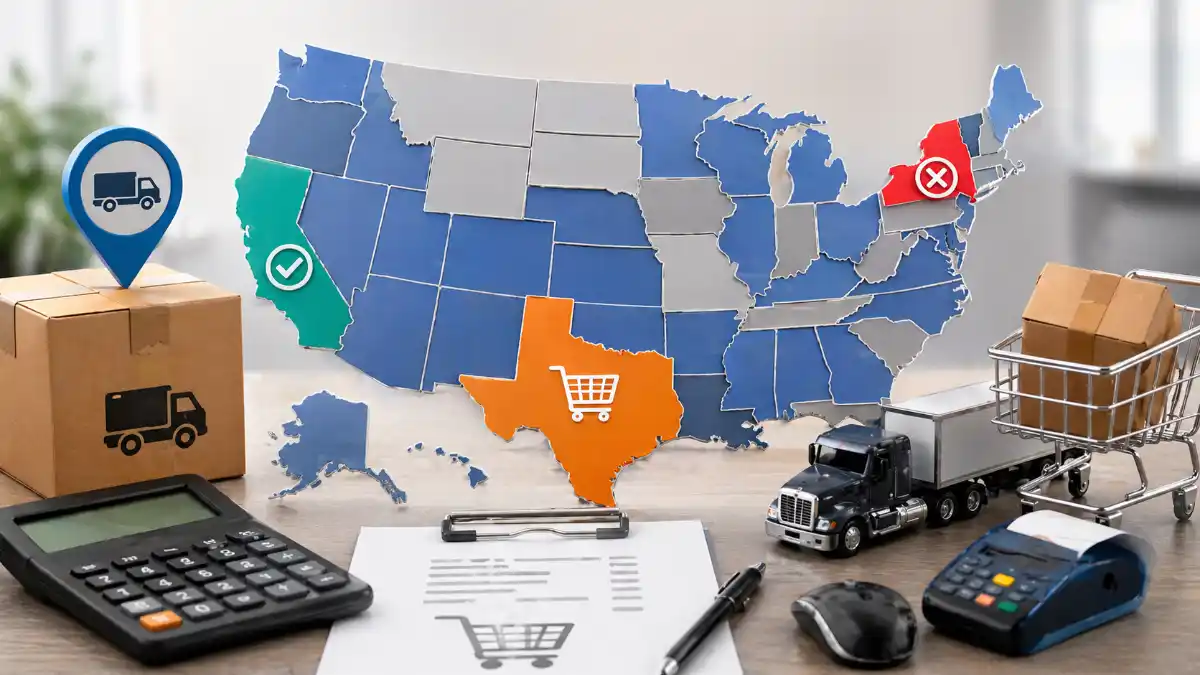
The Three Categories of Shipping Taxability
Every US state falls into one of three categories for how it treats shipping and delivery charges. Knowing your delivery state's category is the starting point for determining whether shipping tax should appear on any order confirmation or receipt.
The first category is states that always tax shipping on taxable orders — regardless of how the shipping charge is presented on the invoice. Texas, New York, West Virginia, and several others fall here: if the item being shipped is taxable, the shipping charge is taxable, full stop. Separately stating the charge does not help.
The second category is states that exempt shipping if it is separately stated on the invoice. California, Florida, and many others fall here: if the seller shows shipping as a distinct line item — separate from the product price — the shipping charge is not taxable. But if the seller buries shipping in the product price or bundles it with handling in a single line, the shipping component becomes taxable.
The third category is states that never tax shipping charges, regardless of presentation. These states exempt delivery charges entirely for separately arranged shipping on taxable goods. And a critical baseline rule applies in virtually every state: if the items being shipped are exempt from sales tax (groceries, prescription drugsSales Tax on Prescription Drugs & OTC Medications by State (2026), clothing in exempt states), the shipping charge is also exempt — with Hawaii being the notable exception, where shipping is taxable even on exempt goods due to the General Excise Tax structure.
Key Highlights
- There is no federal rule on shipping taxability — each of the 45 sales tax states sets its own policy.
- Texas always taxes shipping on taxable orders — separately stating the charge makes no difference.
- California exempts shipping if separately stated on the invoice and the charge equals actual carrier cost.
- New York taxes delivery charges on taxable sales regardless of how they appear on the invoice.
- If the items being shipped are tax-exempt, shipping is also exempt in virtually every state — Hawaii is the only exception.
- Louisiana changed its rules in 2025 — shipping is now taxable even when separately stated if passed on to the buyer from third-party delivery.
- Handling charges are almost always taxable — even in states where shipping itself is exempt.
- Mixed shipments (taxable + exempt items) require proportional allocation of shipping tax in most states.
- Several states have enacted Retail Delivery Fees — flat fees on deliveries containing taxable items — separate from and in addition to shipping tax.
- Reverse calculation: Pre-Tax Total = Order Total ÷ (1 + Tax Rate) — verifies whether tax was applied to the item only or to shipping as well.
The Four Key Rules That Determine Shipping Taxability
Before looking up your specific state, understand the four factors that determine shipping taxability in most states. These factors interact — a single shipment can be analyzed using all four simultaneously.
| Factor | What It Means | Example |
|---|---|---|
| 1. Product taxability | If the item being shipped is exempt, shipping is almost always exempt too | Shipping groceries in California — both item and shipping are exempt |
| 2. How shipping appears on invoice | In many states, separately stated shipping is exempt; bundled shipping is taxable | California: $49.99 item + $5.99 shipping (separate) = no shipping tax. $55.98 all-in = shipping taxable |
| 3. Who arranges the shipping | Seller-arranged shipping is more likely taxable; customer-arranged (common carrier) is more likely exempt | Customer pays FedEx directly = often exempt. Seller charges customer for FedEx = depends on state |
| 4. Mixed shipment composition | If both taxable and exempt items ship together, shipping tax is allocated proportionally in most states | $80 taxable item + $20 exempt item = 80% of shipping charge is taxable in most states |
Even in states that exempt shipping charges from sales tax, handling charges are almost always taxable. This distinction matters for sellers who combine "shipping and handling" into a single line item on invoices. If your invoice shows "$8.99 Shipping & Handling" as one combined charge, many states will treat the entire amount as taxable — because the handling component is taxable and the two charges are inseparable. The safe practice is to always show shipping and handling as two separate line items. In states that exempt separately stated shipping, the shipping portion is protected from tax while the handling portion is correctly taxed. Bundling them loses the exemption for the shipping portion unnecessarily.
Reverse Formula — Verify Whether Shipping Was Taxed on Your Order
When your online order confirmation shows a tax amount, you can use the reverse formula to determine whether tax was calculated only on the item price or whether shipping was also included in the taxable base.
For example: Order shows $79.99 item + $8.99 shipping + $7.38 tax. Your state's combined rate is 8.25%. Divide: $7.38 ÷ 0.0825 = $89.45 implied taxable base. Since $89.45 ≈ $79.99 + $8.99 + $0.47 rounding, the seller taxed both the item and the shipping. If your state exempts separately stated shipping (and the seller listed shipping separately), you were overcharged. If your state always taxes shipping on taxable orders (Texas, NY), the charge is correct.
Step-by-Step: How to Determine If Shipping Is Taxable on Your Order
Follow these five steps to determine whether shipping should have been taxed on any specific online order in 2026.
Reverse Sales Tax Calculator
Global Reverse Tax Tool (VAT & GST) 2026 — Remove tax from any total and calculate the original price in seconds.
Real-World Shipping Tax Scenarios
Here are four practical examples showing how shipping taxability works in different states — with reverse calculations to verify whether each order was taxed correctly.
Example 1: Texas — Shipping Always Taxable on Taxable Orders
Scenario
You order a $79.99 phone case (taxable) from an online retailer. Shipping: $6.99 separately stated. You are in Dallas, Texas. Combined rate: 8.25%.
Texas rule: Shipping is always taxable when the item is taxable — regardless of how it appears on the invoice.
Correct taxable base: $79.99 + $6.99 = $86.98
Correct tax: $86.98 × 8.25% = $7.18
Reverse check: $7.18 ÷ 0.0825 = $87.03 ≈ $86.98 ✓ (rounding difference)
If seller only taxed the item: $79.99 × 8.25% = $6.60 — understating tax by $0.58
Key lesson: In Texas, if your order shows tax only on the item price and not on shipping, the seller is under-collecting. The buyer is not liable for the shortfall — but the seller has a compliance problem.
Example 2: California — Shipping Exempt If Separately Stated
Scenario
You order a $149.99 jacket (taxable) from an online store. Your Los Angeles order shows: Item $149.99, Shipping $9.99 (separately stated), Tax $14.25. Combined LA rate: 9.50%.
California rule: Shipping exempt if separately stated and equals actual carrier cost.
Reverse check: $14.25 ÷ 0.095 = $150.00 implied taxable base
$150.00 ≈ $149.99 ✓ — Tax was applied to item only, not to shipping.
Order is correct. The $9.99 separately stated shipping was correctly excluded from the taxable base in California.
If shipping had been taxed: ($149.99 + $9.99) × 9.50% = $15.20 — overcharge of $0.95 on this order.
If seller had bundled shipping into the price: $159.98 all-in price × 9.50% = $15.20 — the bundling makes the full amount taxable, including the shipping component.
Example 3: Mixed Shipment — Taxable and Exempt Items
Scenario
You order from an online grocery/general store in Ohio. Your cart: $45.00 blender (taxable) + $22.00 fresh produce (exempt). Shipping: $7.99. Ohio combined rate: 7.25%.
Ohio rule: Shipping is taxable when the sale involves taxable goods — proportional allocation required for mixed shipments.
Taxable proportion: $45.00 ÷ ($45.00 + $22.00) = 67.16% of shipment is taxable
Taxable shipping portion: $7.99 × 67.16% = $5.37
Total taxable base: $45.00 + $5.37 = $50.37
Tax owed: $50.37 × 7.25% = $3.65
vs taxing full shipping: ($45.00 + $7.99) × 7.25% = $3.84 — overcharge of $0.19
vs not taxing shipping at all: $45.00 × 7.25% = $3.26 — undercharge of $0.39
Correct answer requires proportional allocation. Most e-commerce platforms do this automatically — but verify by checking the implied taxable base using the reverse formula.
Example 4: New York — Shipping Taxable Even When Separately Stated
Scenario
You order a $89.99 book (taxable in NY — most books are taxable) online. Shipping: $4.99 separately stated. New York City combined rate: 8.875%.
New York rule: Shipping charges are taxable when the item is taxable — regardless of whether separately stated.
Taxable base: $89.99 + $4.99 = $94.98
Tax owed: $94.98 × 8.875% = $8.43
Reverse check: $8.43 ÷ 0.08875 = $94.99 ≈ $94.98 ✓
If seller exempted shipping: $89.99 × 8.875% = $7.99 — undercharge of $0.44
Note: If the customer arranges and pays for shipping directly with a common carrier (UPS, FedEx account), that shipping charge may be exempt in New York — but only when the customer controls the shipping arrangement, not the seller.
Shipping Taxability — Complete State Guide (2026)
The table below shows the current shipping taxability status for every US state as of April 2026. "Always taxable" means the shipping charge is taxable on taxable orders regardless of invoice presentation. "Exempt if separately stated" means showing shipping as a distinct line item protects it from tax in that state. "Always exempt" means shipping is never taxed in that state.
| State | Shipping Taxability | Key Rule / Note |
|---|---|---|
| Alabama | Always taxable | Delivery charges included in taxable sales price — no exemption for separate statement |
| Alaska | No state tax | No statewide sales tax — some local jurisdictions may tax |
| Arizona | Exempt if separately stated | Freight billed separately from manufacturer/wholesaler to purchaser often exempt |
| Arkansas | Taxable (proportional for mixed) | Taxable when item is taxable; proportional allocation for mixed shipments |
| California | Exempt if separately stated | Must equal actual carrier cost; handling always taxable; seller-delivered always taxable |
| Colorado | Exempt if separately stated | Exempt only if "separable" — customer must have option to use alternate carrier |
| Connecticut | Taxable on taxable orders | Delivery charges included in sales price when item is taxable |
| Delaware | No state tax | No sales tax — shipping not taxable |
| Florida | Exempt if separately stated + pick-up option | Must be separately stated AND customer must have option to pick up in person |
| Georgia | Exempt if separately stated | Delivery charges exempt when separately stated and not part of the sales price |
| Hawaii | Always taxable — including on exempt goods | Only state that taxes shipping even when the item is exempt — GET applies to gross receipts |
| Idaho | Taxable in most situations | Shipping taxable when seller passes cost to buyer; drop-ship rules complex |
| Illinois | Exempt if separately stated | Taxable only if item is taxable AND shipping is NOT separately stated |
| Indiana | Exempt if separately stated | Delivery charges exempt when separately stated from item price |
| Iowa | Exempt if separately stated | Delivery charges exempt when identified separately and buyer has option not to pay |
| Kansas | Exempt if separately stated (2023+) | Rules changed 2023 — separately stated delivery charges now exempt |
| Kentucky | Always taxable | Delivery charges always included in taxable sales price |
| Louisiana | Taxable (expanded 2025) | 2025 change — third-party delivery charges passed to buyer now taxable even if separately stated |
| Maine | Exempt if separately stated | Must be separate from handling; handling charges always taxable |
| Maryland | Exempt if separately stated | Must be separately stated AND separate from handling fees |
| Massachusetts | Exempt if separately stated | Separately stated delivery charges by common carrier exempt on taxable goods |
| Michigan | Exempt if separately stated | Delivery charges exempt when separately stated from the sales price |
| Minnesota | Taxable on taxable orders | Delivery charges included in taxable sales price for taxable goods |
| Missouri | Exempt if separately stated | Delivery charges exempt when separately stated and not required as part of the sale |
| Nebraska | Taxable on taxable orders | Delivery charges included in taxable amount for taxable goods |
| Nevada | Exempt if separately stated | Delivery charges exempt when separately stated from the selling price |
| New Jersey | Exempt if separately stated | Delivery charges exempt when separately stated from item price |
| New Mexico | Taxable (Gross Receipts Tax) | GRT applies — delivery charges taxable when associated with a taxable sale |
| New York | Always taxable on taxable orders | Taxable regardless of separate statement — unless customer arranges shipping directly |
| North CarolinaNorth Carolina Sales Tax: 4.75% | Taxable on taxable orders | Delivery charges included in sales price for taxable goods |
| Ohio | Taxable (proportional for mixed) | Taxable on taxable portion; proportional allocation for mixed shipments |
| Oklahoma | Exempt if separately stated | Delivery charges exempt when separately stated from the sales price |
| Oregon | No state tax | No sales tax — nothing is taxable including shipping |
| Pennsylvania | Exempt if separately stated | Delivery charges exempt when separately stated; handling always taxable |
| South Carolina | Exempt if separately stated | Delivery charges exempt when separately stated from the selling price |
| Tennessee | Always taxable on taxable orders | Delivery charges included in sales price — separately stating does not exempt |
| Texas | Always taxable on taxable orders | Separately stating shipping does not exempt — taxable whenever item is taxable |
| Utah | Taxable in most cases | Delivery charges generally included in sales price; complex rules for seller-originated drop ships |
| Virginia | Exempt if separately stated | Must be separately stated AND separate from handling charges |
| Washington | Taxable on taxable orders | Delivery charges taxable when item is taxable — separately stating does not exempt |
| West Virginia | Always taxable | Delivery charges included in taxable sales price — no deduction allowed |
| Wisconsin | Always taxable | Delivery charges included in taxable sales price — no deduction allowed |
Sources: Numeral, Zamp, TaxJar, NexusFlag, Avalara, State Departments of Revenue — April 2026. Rules change frequently — verify with your state's Department of Revenue for current guidance.
Seller Includes Shipping in Price vs Lists Separately — Tax Impact
| Factor | Shipping Bundled Into Product Price | Shipping Separately Stated on Invoice |
|---|---|---|
| Taxable in "exempt if separately stated" states? | Yes — full bundled price including shipping is taxable | No — shipping portion is exempt; item only is taxable |
| Taxable in "always taxable" states (TX, NY, TN)? | Yes | Yes — separate statement makes no difference |
| Consumer transparency | Hidden — consumer cannot see how much is shipping vs product | Clear — consumer sees exact shipping cost and tax status |
| Risk of audit issues for seller | Higher in exempt-if-separate states — overcollecting is a liability | Lower — clear documentation of what was and was not taxed |
| Handling charges included? | Often buried — taxable regardless | Must be separated from shipping — handling always taxable |
| Best practice for sellers? | Only if operating exclusively in "always taxable" states | Best practice in all states — protects exemption where available |
Pros and Cons — Knowing Shipping Tax Rules as a Consumer and Seller
Consumer Benefits of Understanding Shipping Tax
- Verify online orders are not overtaxing shipping in states that exempt it
- Use the reverse formula to quickly identify whether shipping was included in the tax base
- Identify misconfigured seller tax settings — common on small e-commerce sites
- Understand why shipping tax changes when ordering from different states
- Avoid unnecessary tax on shipping by choosing sellers who separately state charges in exempt states
- Know to request refunds when shipping was incorrectly taxed in your exempt state
Seller Compliance Risks From Getting Shipping Tax Wrong
- Under-collecting in "always taxable" states creates sales tax liability
- Over-collecting in "exempt if separately stated" states creates customer overcharge and audit risk
- Bundling shipping with handling loses the shipping exemption even in exempt states
- Mixed shipment proportional allocation errors are common in manual configurations
- Louisiana 2025 rule change caught many sellers who were correctly exempt under old rules now under-collecting
- E-commerce platform default settings may not match your specific state's current rules
Expert Tip — Ritu Sharma
"The shipping tax error I encounter most in e-commerce audits is the bundled shipping-and-handling line item in states that exempt separately stated shipping. A seller in an "exempt if separately stated" state like California or Pennsylvania shows one line: "$9.99 Shipping & Handling." Because handling is always taxable and the two charges are inseparable on the invoice, the entire $9.99 is treated as taxable — the seller loses the shipping exemption they would have had if they had shown "$6.99 Shipping / $3.00 Handling" on two separate lines. The fix costs nothing and takes 5 minutes in your e-commerce platform settings — but it saves your customers the sales tax on the shipping portion on every order in every exempt state. For a seller shipping 500 orders per month to California customers, each with $7 in shipping at 9.5% rate — correctly separating shipping and handling saves those customers $0.665 per order × 500 orders = $332.50 per month in correctly avoided tax. That is not a rounding error. That is real money being overcollected because of one uncorrected invoice template setting."
Who Needs to Know Shipping Tax Rules?
- Online shoppers who frequently buy from small or mid-size e-commerce stores — large platforms like Amazon and Walmart have sophisticated tax engines that correctly handle shipping taxability, but smaller sellers often rely on default platform settings that may not reflect current state rules — especially recent changes like Louisiana's 2025 expansion
- E-commerce sellers shipping to multiple states — the combination of "always taxable," "exempt if separately stated," and "always exempt" states means a seller with customers in 10 states may need 10 different shipping tax configurations, each updated when state rules change
- Shoppers in California — California's rule exempts separately stated shipping that equals actual carrier cost, making this one of the most valuable shipping exemptions in a high-tax state (9.50%+ in major cities). Verifying that your California orders correctly exclude shipping from the taxable base is worth the 30-second reverse calculation on any significant purchase
- Business buyers ordering supplies and equipment — when businesses buy taxable equipment for their operations, shipping charges are taxable in many states and must be included in the use tax calculation if the seller did not correctly collect it. This creates direct financial exposure in states like Texas, New York, and Tennessee
- Sellers updating their platform tax settings after state rule changes — Louisiana's 2025 change, Kansas's 2023 change, and ongoing state-level modifications mean that sellers using auto-calculated shipping tax cannot assume their platform's default settings reflect the current rules in every state without periodic verification
- Consumers who receive free shipping but pay a combined price — when a seller advertises "free shipping" but builds the shipping cost into the product price, the shipping cost is effectively included in the taxable base in all states — making "free shipping" offers in high-tax states slightly more expensive in effective tax terms than the same seller charging shipping separately in exempt-if-separate states
Before or after placing any online order in a state that exempts separately stated shipping (California, Florida, Illinois, Georgia, PennsylvaniaPennsylvania Sales Tax: 6.00%, and many others), run this 30-second check. From your order confirmation: take the tax charged and divide it by your state's combined rate. The result is the implied taxable base. Compare this to the item price alone versus item + shipping. If the implied base equals item + shipping, the seller taxed your shipping. If your state exempts separately stated shipping — and the seller clearly listed shipping as a separate line — you were overcharged. Contact the seller's customer support with your order number and explain that your state exempts separately stated shipping charges. Most sellers will issue a refund for the overcharged amount immediately — it is almost always an e-commerce platform tax configuration error, not intentional overcharging. On a $10 shipping charge at California's average 9% combined rate, the overcharge is $0.90 — small on one order but worth correcting, and worth mentioning to the seller so they fix the configuration for all future customers in your state.
Risks, Limitations and Recent Changes
Louisiana 2025 rule change: Louisiana updated its shipping taxability rules in 2025, expanding the definition of taxable sales price to include transportation costs passed to the buyer from third-party delivery. This means that in Louisiana, even separately stated shipping charges are now taxable when the seller is passing on third-party delivery costs. Sellers who were previously correctly exempt under the old "separately stated" approach are now under-collecting in Louisiana if they have not updated their tax configuration.
Florida's pick-up option requirement: Florida's shipping exemption has an additional condition beyond separate statement — the seller must also offer the customer the option to pick up the item instead of having it shipped. For pure online sellers with no physical pickup location, this condition may not be met, making shipping taxable even when separately stated. This is one of the most frequently misunderstood shipping tax rules among Florida-nexus e-commerce sellers.
Retail Delivery Fees: Several states — including Colorado and Minnesota — have enacted Retail Delivery Fees (RDFs), which are flat per-order fees on deliveries containing at least one taxable item. These fees are separate from and in addition to any shipping sales tax. Colorado charges $0.29 per qualifying delivery. Minnesota charges $0.50 per qualifying delivery. These fees appear as distinct line items on invoices and are non-refundable even if the product is returned. Nebraska and New York have active legislative discussions about similar fees in 2026.
Handling charges: Even in states where shipping is clearly exempt when separately stated, handling charges are taxable in almost every state. A seller who shows "Shipping $6.99 / Handling $2.00" as two separate lines protects the $6.99 shipping from tax (in exempt states) while correctly taxing the $2.00 handling. A seller who shows "$8.99 Shipping & Handling" as one line loses the shipping exemption entirely because the components cannot be separated.
Expert Insight and Market Impact
Shipping taxability has become one of the most actively litigated and frequently updated areas of US sales tax law, driven by the explosion of e-commerce and the increasing volume of interstate shipping transactions. Before widespread internet retail, shipping taxes were largely an afterthought — most retail transactions were in-person and no shipping was involved. Today, with trillions of dollars in goods shipped annually across state lines, the question of whether the $8.99 shipping charge is taxable or exempt is a compliance issue that affects millions of transactions per day.
The practical compliance challenge for e-commerce sellers is significant. A seller shipping to customers in all 50 states must maintain accurate shipping tax configurations for each state — and those configurations must be updated when states change their rules, as Louisiana did in 2025 and Kansas did in 2023. Most major e-commerce platforms (Shopify, WooCommerce, BigCommerce) attempt to handle this automatically through integration with tax calculation services, but the accuracy of those calculations depends on correct product and shipping configuration settings that sellers must maintain.
For consumers, the practical impact is straightforward: shipping tax at a 9% combined rate adds approximately $0.90 per $10 in shipping charges. On large orders with significant shipping costs — furniture, appliances, heavy equipment — the shipping tax can be meaningful. A $150 furniture delivery with $35 shipping, taxed at CaliforniaCalifornia Sales Tax: 7.25%'s 9.50% rate, produces $3.33 in shipping tax that would be avoided if the shipping were correctly exempt. The reverse formula takes 15 seconds to verify any order.
Final Verdict
Shipping taxability in the US depends on three things working together: the taxability of the item being shipped, the shipping tax category of the delivery state, and how the shipping charge appears on the invoice. The golden rule that applies in almost every state is this: if the item is exempt, the shipping is exempt. For taxable items, the state category determines what happens — always taxable (Texas, New York, Tennessee), exempt if separately stated (California, Florida, Illinois, Georgia), or a mixed approach with proportional allocation for combined shipments.
The reverse formula verifies any order in seconds: Tax Charged ÷ Tax Rate = Implied Taxable Base. If that base includes shipping when your state exempts it, the seller has a tax configuration error worth correcting. If the base correctly excludes shipping in an exempt state, the order is correct. Use the calculator above to run the check instantly on any order total — enter the total paid and your local combined rate to see the implied taxable base and compare it against your item price.